GBP/USD Price Forecast: Sees more downside below 1.3300
- GBP/USD falls to near 1.3300 as the British Pound faces pressure due to UK political uncertainty and rising gilt yields.
- UK PM Starmer faces a leadership challenge after a major setback in local elections.
- US President Trump’s threats against Iran have renewed geopolitical tensions.

The GBP/USD pair trades lower near 1.3300 in the early European trade at the start of the week, the lowest level seen in over five weeks. The Cable is down as the British Pound faces broader selling pressure due to the combined effects of United Kingdom (UK) political uncertainty, rising gilt yields, and geopolitical tensions.
UK Prime Minister (PM) Keir Starmer faces a leadership challenge from Greater Manchester Mayor Andy Burnham after the defeat of the Labour Party in regional elections.
Concerns over UK PM Starmer’s leadership stemmed after resignations from various ministers. According to analysts at Jefferies, their base case is “one of a managed exit for Starmer and Burnham likely becoming the next PM”.
Fears of a UK leadership change have prompted gilt yields, in hopes that the new leadership would follow a loose fiscal policy. As of writing, 10-year yields on UK government bonds are up almost 3% to near 5.19%, the highest level seen since the sub-prime crisis.
Meanwhile, tensions between the United States (US) and Iran have renewed as President Donald Trump has warned of serious consequences against Tehran, through a post on Truth Social, if it doesn’t reach a deal soon.
GBP/USD technical analysis
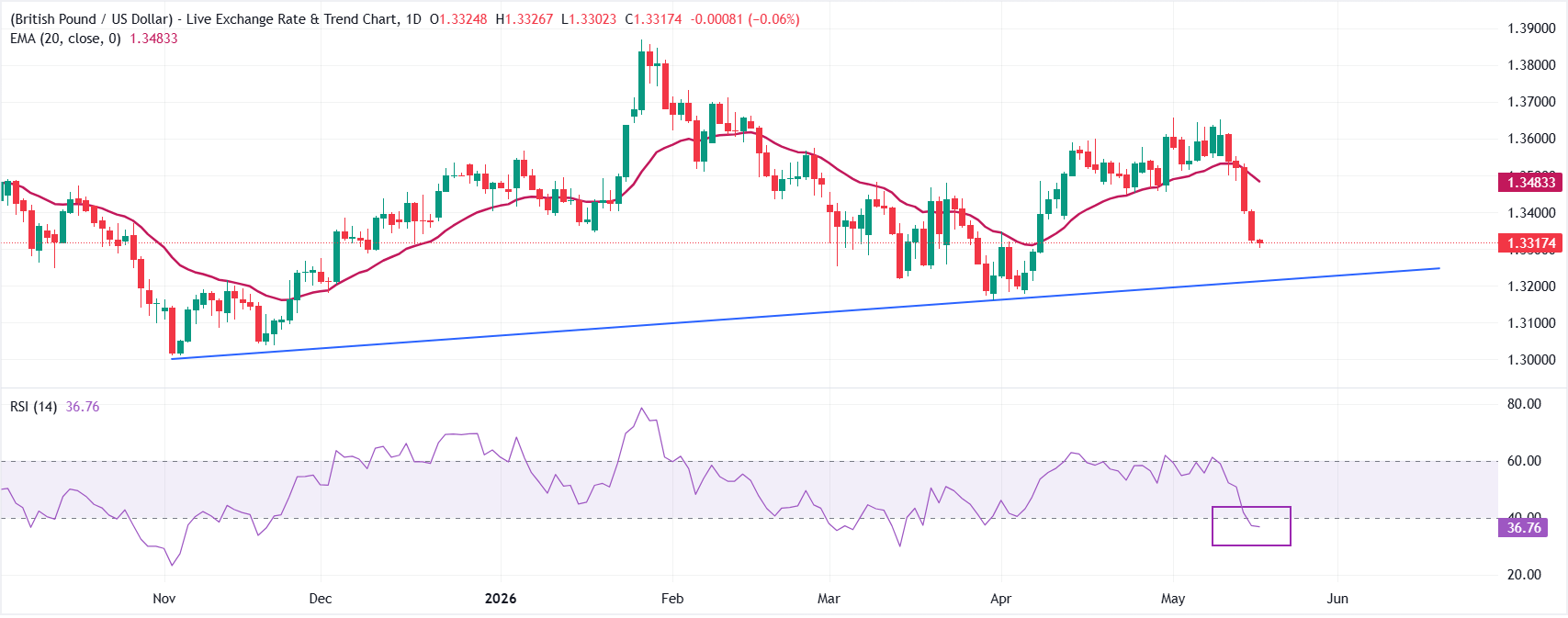
GBP/USD trades lower at around 1.3300 as of writing. The pair keeps a bearish near-term tone as it holds below the 20-day Exponential Moving Average (EMA) at 1.3483 after losing its prior uptrend structure.
The Relative Strength Index (RSI) at 36.8 sits just above oversold territory, hinting that while downside pressure persists, the immediate selling impulse is no longer extreme.
On the downside, the next notable support is the former rising trend-line area around 1.3213, where buyers may attempt to slow the decline. A downside move below the upward-sloping trendline would expose the pair towards 1.3100.
Looking up, initial resistance is reinforced by the 20-day EMA at 1.3483, and only a daily close back above this barrier would start to ease the current bearish bias.
(The technical analysis of this story was written with the help of an AI tool.)
UK gilt yields FAQs
UK Gilt Yields measure the annual return an investor can expect from holding UK government bonds, or Gilts. Like other bonds, Gilts pay interest to holders at regular intervals, the ‘coupon’, followed by the full value of the bond at maturity. The coupon is fixed but the Yield varies as it takes into account changes in the bond's price. For example, a Gilt worth 100 Pounds Sterling might have a coupon of 5.0%. If the Gilt's price were to fall to 98 Pounds, the coupon would still be 5.0%, but the Gilt Yield would rise to 5.102% to reflect the decline in price.
Many factors influence Gilt yields, but the main ones are interest rates, the strength of the British economy, the liquidity of the bond market and the value of the Pound Sterling. Rising inflation will generally weaken Gilt prices and lead to higher Gilt yields because Gilts are long-term investments susceptible to inflation, which erodes their value. Higher interest rates impact existing Gilt yields because newly-issued Gilts will carry a higher, more attractive coupon. Liquidity can be a risk when there is a lack of buyers or sellers due to panic or preference for riskier assets.
Probably the most important factor influencing the level of Gilt yields is interest rates. These are set by the Bank of England (BoE) to ensure price stability. Higher interest rates will raise yields and lower the price of Gilts because new Gilts issued will bear a higher, more attractive coupon, reducing demand for older Gilts, which will see a corresponding decline in price.
Inflation is a key factor affecting Gilt yields as it impacts the value of the principal received by the holder at the end of the term, as well as the relative value of the repayments. Higher inflation deteriorates the value of Gilts over time, reflected in a higher yield (lower price). The opposite is true of lower inflation. In rare cases of deflation, a Gilt may rise in price – represented by a negative yield.
Foreign holders of Gilts are exposed to exchange-rate risk since Gilts are denominated in Pound Sterling. If the currency strengthens investors will realize a higher return and vice versa if it weakens. In addition, Gilt yields are highly correlated to the Pound Sterling. This is because yields are a reflection of interest rates and interest rate expectations, a key driver of Pound Sterling. Higher interest rates, raise the coupon on newly-issued Gilts, attracting more global investors. Since they are priced in Pounds, this increases demand for Pound Sterling.
Author

Sagar Dua
FXStreet
Sagar Dua is associated with the financial markets from his college days. Along with pursuing post-graduation in Commerce in 2014, he started his markets training with chart analysis.

















