|

GBP/USD Price Analysis: Rises to 1.2700 nearing 14-day EMA

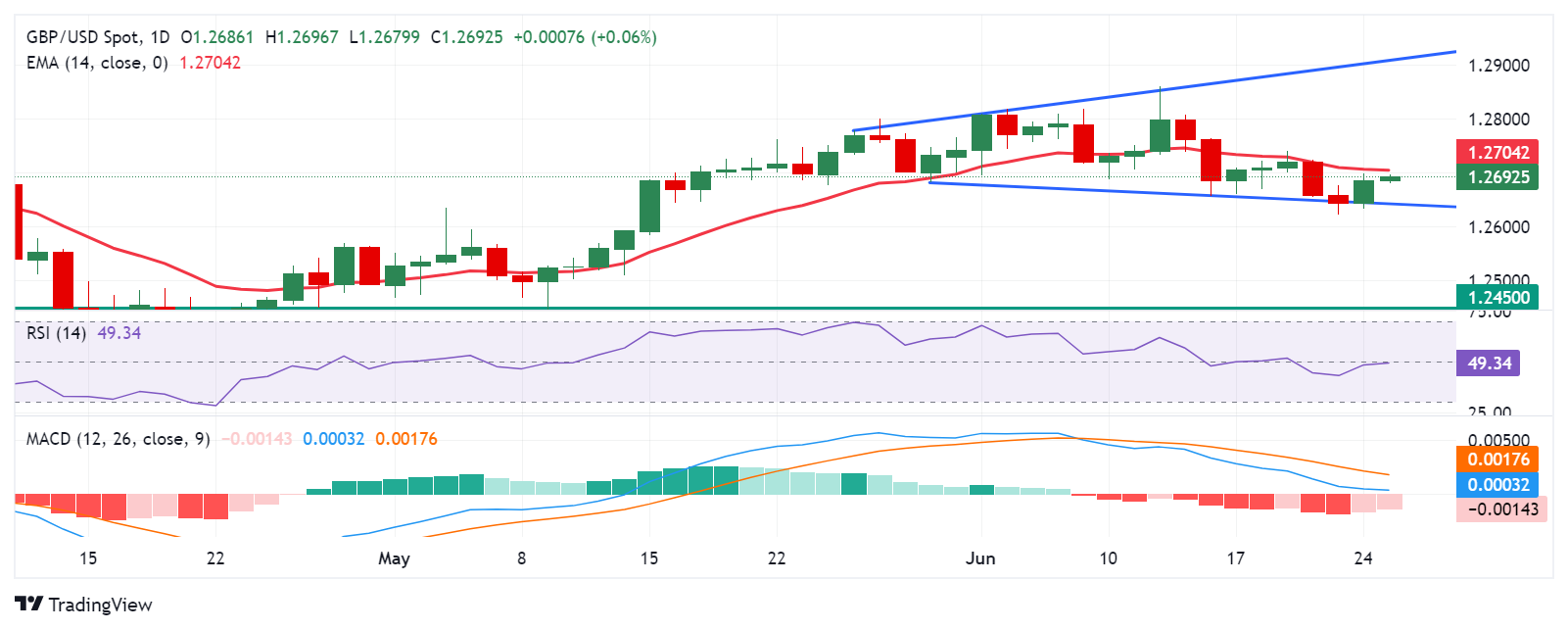
  • GBP/USD extends gains to test 14-day EMA at 1.2704 level.
  • A broadening bottom pattern on a daily chart suggests a potential correction before moving lower.
  • The lower boundary of the broadening bottom pattern around the level of 1.2640 could act as a key support.

GBP/USD extends gains for the second successive session, trading around 1.2700 during Asian hours on Tuesday. Analysis of the daily chart shows a broadening bottom pattern in price action, representing increasing volatility. This chart pattern suggests a potential correction before moving lower.

The 14-day Relative Strength Index (RSI) is positioned below the 50 level, indicating a bearish bias. Furthermore, the Moving Average Convergence Divergence (MACD) momentum indicator also suggests a downward trend, as the MACD line is above the centerline but diverges below the signal line. Breaking below the centerline may strengthen the downward trend.

To the downside, the GBP/USD pair may find key support at the bottom wedge of the broadening bottom pattern around the level of 1.2640. A break below this level could exert pressure on the pair to navigate the vicinity of the throwback support at 1.2450.

In terms of resistance, the immediate barrier appears at the 14-day Exponential Moving Average (EMA) at the 1.2704 level. A breakthrough above this level could propel the GBP/USD pair toward testing the top wedge of the broadening bottom pattern around 1.2900.

GBP/USD: Daily Chart
GBP/USD

Overview
Today last price1.2692
Today Daily Change0.0007
Today Daily Change %0.06
Today daily open1.2685
 
Trends
Daily SMA201.2733
Daily SMA501.2629
Daily SMA1001.2641
Daily SMA2001.2558
 
Levels
Previous Daily High1.2698
Previous Daily Low1.2633
Previous Weekly High1.274
Previous Weekly Low1.2623
Previous Monthly High1.2801
Previous Monthly Low1.2446
Daily Fibonacci 38.2%1.2673
Daily Fibonacci 61.8%1.2658
Daily Pivot Point S11.2646
Daily Pivot Point S21.2607
Daily Pivot Point S31.2581
Daily Pivot Point R11.2711
Daily Pivot Point R21.2737
Daily Pivot Point R31.2776

Author

Akhtar Faruqui

Akhtar Faruqui is a Forex Analyst based in New Delhi, India. With a keen eye for market trends and a passion for dissecting complex financial dynamics, he is dedicated to delivering accurate and insightful Forex news and analysis.


More from Akhtar Faruqui
Share:

Editor's Picks

GBP/USD flirts with tops near 1.3470

GBP/USD manages to regain composure and challenge the area of daily highs around 1.3470 on Friday. Cable picks up pace despite marginal gains in the Greenback in a context of swelling geopolitical tensions and rising global oil prices.

EUR/USD trims losses, back above 1.1500

EUR/USD picks up some pace and bouces off earlier lows, reclaiming the 1.1500 threshold and beyond at the end of the week. The pair’s modest pullback follows a persistent risk-averse market mood and renewed buying interest for the US Dollar.

Gold: The $4,000 mark holds the downside for now

Gold faces renewed selling pressure, falling sharply toweard the $4,000 mark per troy ounce as the US Dollar regains momentum. Escalating US-Iran tensions are keeping inflation concerns and expectations of further Fed rate hikes alive, weighing further on the yellow metal.

Bitcoin eyes 50-day EMA breakout, Ethereum consolidates, XRP steadies

Bitcoin, Ethereum, and Ripple trade near key technical levels on Friday as the broader cryptocurrency market pauses following last week's recovery. BTC is approaching the 50-day Exponential Moving Average while ETH continues to consolidate between two major EMAs.

Warsh needs to restore his reputation
We were glad to see our deeply negative reaction to the Warsh press conference was not some personal peculiarity. Just about everybody in the financial press felt the same way. The consensus is building it’s not the Fed in the dog-house but only Warsh. Today the WSJ changed it tune and blasted Warsh—"the honeymoon is already over..”
9-3: Is the Federal Reserve’s vote tally Warsh's new forward guidance?
The rate did not move. Neither did the statement, and that’s the more interesting fact. Set the July 29 Federal Open Market Committee (FOMC) statement beside the one issued on June 17, and the two documents are identical apart from a single verb and a paragraph at the bottom naming three dissenters.















