|

GBP/USD hits a new YTD high above 1.2500 on upbeat sentiment, weak US jobs data

  • GBP/USD remains trading nearby the YTD highs hit at 1.2525.
  • US JOLTs reports drop to the lowest level in two years; could this be a prelude to a jump in the Unemployment Rate?
  • BoE Pill focused on incoming data to decide his stance at the May meeting.

The Pound Sterling (GBP) climbs above 1.2500 and hits a new YTD high at 1.2525, on risk on impulse in the FX space and overall US Dollar (USD) weakness. Economic data released in the United States (US) flashes the economy is slowing down, a headwind for the greenback. At the time of writing, the GBP/USD is trading at 1.2499, above its opening price by 0.72%.

GBP/USD stays positive, despite sentiment shifting sour

Wall Street reversed its course and turned red. The US JOLTs reports, sought by the US Federal Reserve (Fed) as they monitor labor market data, dropped to their lowest level in two years. Figures showed a decrease of 32K to 9.9 million job openings on the last day of February, its lowest since May 2021. Meanwhile, Factory Orders in the US fell for two consecutive months, printing a 0.7% MoM plunge, worst than an estimated contraction of 0.5%, according to the US Commerce Department.

On the data release, the GBP/USD increased from around 1.2465 to its new YTD high at 1.2525. The Fed has constantly reiterated the tightness of the labor market, and a decrease in job vacancies, could help inflation to continue its downward trajectory. Despite OPEC’s latest crude oil production cut, that could make Fed’s job easier.

On Wednesday, the ADP Employment Change report, followed by jobless claims on Thursday, and the US Nonfarm Payrolls data, would update the effect of higher rates on the labor market.

On the UK front, Bank of England (BoE) speakers had been crossing the wires. Of late, the BoE Chief Economist Huw Pill commented that his May rate decision would be focused on “data flow and its interpretation in the forecast.” Earlier, Sylvana Tenreyro, a BoE Monetary Policy Committee (MPC) member, said that a “looser stance is needed to meet the inflation target.”

GBP/USD Technical analysis
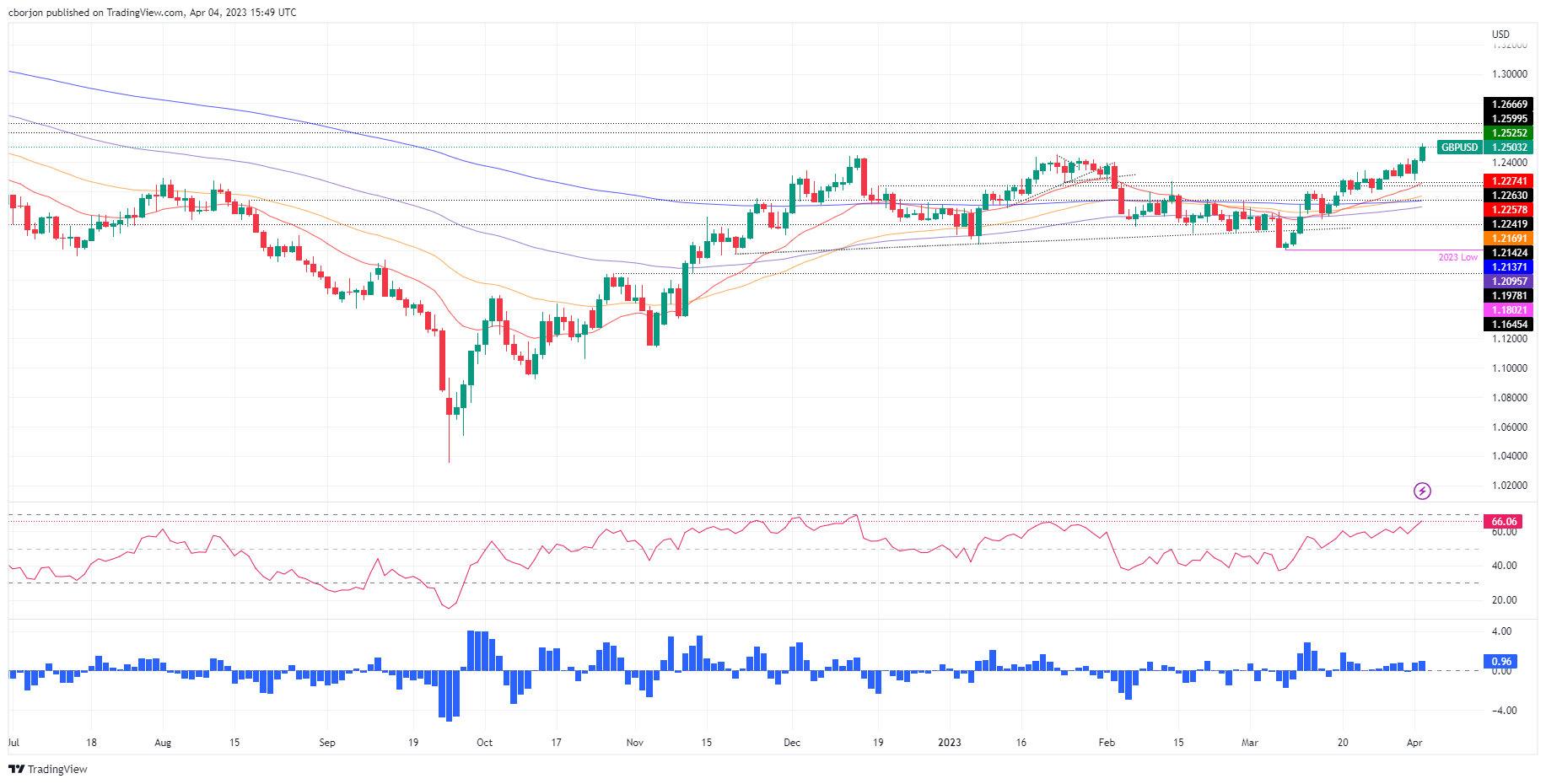
GBP/USD Daily chart

From a daily chart perspective, the GBP/USD turned bullish after cracking the February 14 daily high of 1.2270. Additionally, oscillators like the Relative Strength Index (RSI) and the Rate of Change (RoC) justified the case for higher prices. RSI is still in bullish territory, with space before turning overbought. For a bullish continuation, the GBP/USD must achieve a daily close above 1.2500 to test the newly hit YTD high at 1.2525. A breach of the latter will expose the June 7 high at 1.2599, with upside risks at May 27 daily high at 1.2667. Otherwise, a daily close below 1.2500 could pave the way for a pullback. The first demand area would be 1.2400, followed by the 20-day EMA at 1.2274.

GBP/USD

Overview
Today last price1.2497
Today Daily Change0.0084
Today Daily Change %0.68
Today daily open1.2413
 
Trends
Daily SMA201.2183
Daily SMA501.215
Daily SMA1001.2136
Daily SMA2001.1896
 
Levels
Previous Daily High1.2424
Previous Daily Low1.2275
Previous Weekly High1.2424
Previous Weekly Low1.2219
Previous Monthly High1.2424
Previous Monthly Low1.1803
Daily Fibonacci 38.2%1.2367
Daily Fibonacci 61.8%1.2332
Daily Pivot Point S11.2317
Daily Pivot Point S21.2221
Daily Pivot Point S31.2168
Daily Pivot Point R11.2466
Daily Pivot Point R21.2519
Daily Pivot Point R31.2615

Author

Christian Borjon Valencia

Markets analyst, news editor, and trading instructor with over 14 years of experience across FX, commodities, US equity indices, and global macro markets.


More from Christian Borjon Valencia
Share:

Editor's Picks

AUD/USD meets fresh supply and tests 0.7100 amid weak Australian PMIs

AUD/USD has come under fresh selling pressure and is testing 0.7100 in the Asian session on Wednesday. Australia's flash PMIs showed manufacturing slipped into contraction and services expanding slowly for a second straight month, renewing the pair's downside. Furthermore, a bullish US Dollar acts as a headwind for the pair as traders keenly await the crucial Trump-Xi summit on Thursday. Meanwhile, markets shrug off US-Iran indirect talks.

USD/JPY stands firm near mid-157.00s, close to two-week high

USD/JPY hovers around mid-157.00s in the Asian session on Wednesday, near two-week highs touched last Friday as the BoJ's dovish rate hike continues to undermine the Japanese Yen. Meanwhile, the US Dollar remains firm amid the Fed's hawkish stance, adding support to the pair, though JPY intervention fears cap further gains. Markets pay little heed to the completion of the round of US-Iran indirect talks ahead of Trump-Xi meeting.

Gold sticks to losses below $4,350 as USD buying remains unabated amid hawkish Fed

Gold struggles to capitalize on the previous day's goodish rebound from sub-$4,300 levels and meets with fresh supply during the Asian session. The US Dollar extends its recent uptrend, hitting a fresh high since July 30 amid the Federal Reserve's hawkish outlook. This, in turn, is seen as a key factor undermining the non-yielding bullion.

Cardano Bulls push higher as open interest, funding rates rise

Cardano (ADA) extends gains, trading above $0.262 after rallying more than 14% so far this week. The bullish momentum is supported by rising Open Interest (OI), positive funding rates and signs of whale accumulation. If buying pressure persists, ADA could extend its rally and target higher levels. Cardano’s derivatives metrics show strengthening conditions.

Trump meets Xi: Why markets are watching this summit so closely

United States President Donald Trump and Chinese President Xi Jinping are set to meet in Washington on Thursday for a summit closely watched by markets. After several months of easing trade tensions between the US and China, the meeting could determine whether the world's two largest economies extend their truce or enter a new period of uncertainty.

BoJ Recap: Not as hawkish as expected

The Bank of Japan (BoJ) raised its short-term interest-rate target to 1.25% from 1.00% in a 7-2 vote, marking another step in the normalisation of monetary policy and widely matching what everyone has been expecting for weeks.