GBP/USD edges lower as UK fiscal concerns, Fed rates dampen demand for Sterling
- GBP/USD weakens as UK fiscal concerns continue to dampen demand for Sterling.
- Fed cautious rate cut hopes provide some support for the US Dollar
- GBP/USD slips below the 20-day SMA at 1.3596, with the 50-day SMA providing support at 1.3480.

The British Pound (GBP) is weakening against the US Dollar (USD) on Tuesday as markets look to news on trade developments, which is influencing the broader economic outlook.
For GBP/USD, fiscal concerns in the United Kingdom (UK), combined with risks of a weaker economy, have pushed prices toward 1.3550 at the time of writing.
While Federal Reserve (Fed) Chair Jerome Powell advocates for data-driven decisions and has not ruled out a July rate cut, the Fed is adopting a cautious approach amid mixed economic signals. The odds of easing in July are now minimal, and markets are increasingly targeting September as a more likely starting point.
According to the CME Fed Watch Tool, markets are pricing a 4.7% probability of a 25-basis-point move in July, down from 20.7% last week. The probability of a 25 bps rate cut in September is now 62.8%, down from 73.2% last week.
In the UK, fiscal risks are adding to the Pound’s weakness. The Office for Budget Responsibility (OBR) published its Fiscal Risks and Sustainability report on Tuesday, issuing a stark warning about the country’s long-term financial outlook.
OBR Chairman Richard Hughes warned that current UK fiscal policies are unsustainable. He foresaw that if left unchanged, government debt would increase to around 270% of GDP in the early 2070s from below 100% today.
The long-term debt path is largely a consequence of escalating costs associated with the state pension triple lock, anticipated climate-related expenditure (e.g., net-zero transitions and damage from extreme weather), and demographic pressures. Hughes noted state pension costs could rise from approximately 5% to 7% of GDP by 2070, adding further pressure on public finances.
Additionally, higher tariffs by US President Trump have given markets a scare, fuelling risk aversion and uncertainty among investors.
In response to these developments, GBP/USD is falling below the 20-day Simple Moving Average (SMA), which now provides resistance at 1.3596.
Current price action remains within the confines of an ascending channel on the daily chart, which has guided the pair since May.
Further downside pressure is emerging as the price approaches the 50-day SMA at 1.3480. A break below this level would signal a deeper bearish correction toward the 23.6% Fibonacci retracement of the January-July move at 1.3390.
The recent failure to reclaim the July 1 high of 1.3789 now confirms the presence of a short-term top.
GBP/USD daily chart
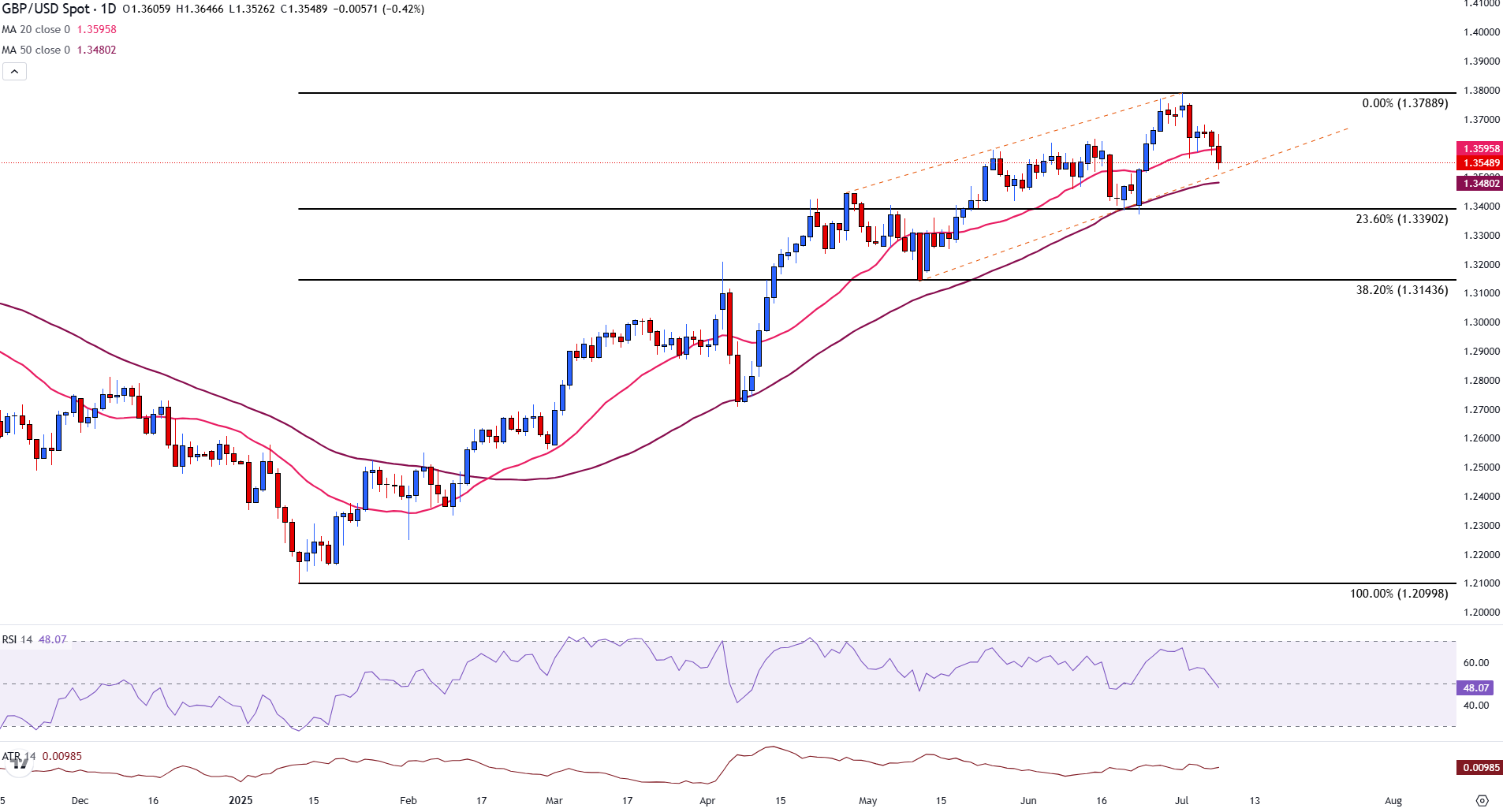
The Relative Strength Index (RSI) has dipped below 49, indicating fading bullish momentum but not yet entering oversold territory.
The Average True Range (ATR) shows a contraction in volatility, which could precede a breakout in either direction.
GBP/USD is vulnerable to further losses toward channel support, with the focus now on whether buyers can defend the 50-day SMA. A clear failure to hold above 1.3480 would confirm a deeper bearish correction, while a rebound above 1.3595 is needed to restore bullish momentum.
Pound Sterling FAQs
The Pound Sterling (GBP) is the oldest currency in the world (886 AD) and the official currency of the United Kingdom. It is the fourth most traded unit for foreign exchange (FX) in the world, accounting for 12% of all transactions, averaging $630 billion a day, according to 2022 data. Its key trading pairs are GBP/USD, also known as ‘Cable’, which accounts for 11% of FX, GBP/JPY, or the ‘Dragon’ as it is known by traders (3%), and EUR/GBP (2%). The Pound Sterling is issued by the Bank of England (BoE).
The single most important factor influencing the value of the Pound Sterling is monetary policy decided by the Bank of England. The BoE bases its decisions on whether it has achieved its primary goal of “price stability” – a steady inflation rate of around 2%. Its primary tool for achieving this is the adjustment of interest rates. When inflation is too high, the BoE will try to rein it in by raising interest rates, making it more expensive for people and businesses to access credit. This is generally positive for GBP, as higher interest rates make the UK a more attractive place for global investors to park their money. When inflation falls too low it is a sign economic growth is slowing. In this scenario, the BoE will consider lowering interest rates to cheapen credit so businesses will borrow more to invest in growth-generating projects.
Data releases gauge the health of the economy and can impact the value of the Pound Sterling. Indicators such as GDP, Manufacturing and Services PMIs, and employment can all influence the direction of the GBP. A strong economy is good for Sterling. Not only does it attract more foreign investment but it may encourage the BoE to put up interest rates, which will directly strengthen GBP. Otherwise, if economic data is weak, the Pound Sterling is likely to fall.
Another significant data release for the Pound Sterling is the Trade Balance. This indicator measures the difference between what a country earns from its exports and what it spends on imports over a given period. If a country produces highly sought-after exports, its currency will benefit purely from the extra demand created from foreign buyers seeking to purchase these goods. Therefore, a positive net Trade Balance strengthens a currency and vice versa for a negative balance.
Author

Tammy Da Costa, CFTe®
FXStreet
Tammy is an economist and market analyst with a deep passion for financial markets, particularly commodities and geopolitics.