GBP/USD drops below 1.2400, defying speculations of imminent BoE rate hike next week
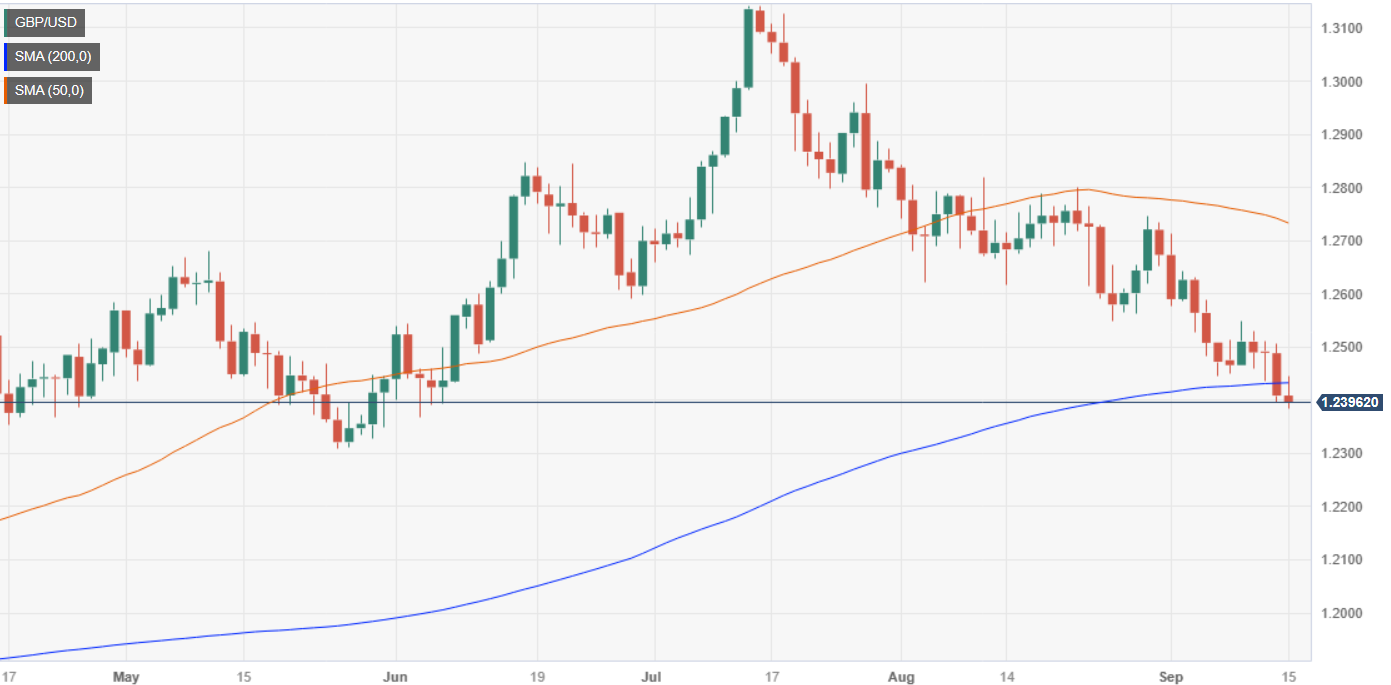
- As US economic data strengthens the dollar, GBP/USD trades at 1.2397, slipping below its 200-day Moving Average.
- Odds for a November rate hike by the Fed stand at 32.45%, while bets on a BoE rate hike toward 6% are scaled back.
- With U.S. 10-year Treasury yields at 4.326% and a solid US economy, the BoE may be the first to blink and cut rates, pressuring GBP/USD further.

The Pound Sterling (GBP) continues to weaken against the US Dollar (USD) for the second consecutive day after a tranche of positive US economic data bolstered the Greenback. Hence, the GBP/USD is set to finish the week with losses, exchanging hands at 1.2397, below its 200-day Moving Average (DMA).
GBP/USD dips below its 200-day Moving Average as positive US data boosts the dollar, while the Bank of England faces a rate hike dilemma
Sentiment shifted sour, bolstering appetite for safe-haven assets, notably the US Dollar. Data revealed on Friday showed Americans’ inflation expectations were lowered, as demonstrated by the University of Michigan (UoM) poll. Inflation is expected to rise to 3.1% below August’s reading for one year, and it is projected at 2.7% for a ten-year period. Despite people’s high spirits, consumer sentiment dropped to 67.7, below forecasts of 69.1.
The US Federal Reserve earlier revealed that Industrial Production expanded 0.4% MoM, below July’s 1% but above the consensus forecasts. Further data released by the New York Fed showed its Empire State Manufacturing Index for September improved to 1.9 from a -21 figure in August, above forecasts of a -10 drop.
In the meantime, money market futures remain skeptical that the US Federal Reserve would hike rates once more before the year’s end, as shown by the CME FedWatch Tool. For the next week, the US central bank is projected to hold rates, and for November, odds for a 25 bps hike lie at a decent 32.45% chance.
Nevertheless, US Treasury bond yields advanced, as the latest inflation reports on the consumer and producer side revealed an uptick after decelerating sharply through the year. The US 10-year Treasury Note yields 4.326%, but the buck is losing some steam.
Across the pond, the Bank of England (BoE) is expected to raise rates by 25 bps, though it faces some challenges, like a slowdown in the economy. The Bank Rate would be lifted toward 5.50%, but traders scaled back previous bets the BoE would lift rates toward 6%, as odds for the November 2 meeting are around 15%.
The Fed would likely keep rates unchanged on the US front, but its economy remains solid, and investors are optimistic the US central bank would achieve a soft landing. Therefore, further downward action is expected in the GBP/USD, as monetary policy could suggest the BoE would be the first to blink and cut rates.
GBP/USD Price Analysis: Technical outlook
Since peaking at around 1.3140s, the major is in a downward trend, with the GBP/USD threatening to achieve a daily close below the 200-day Moving Average (DMA) at 1.2430, further reinforcing that sellers are in charge. Price action would put the May 25 swing low of 1.2308 into play before the pair nosedives toward the March 8 swing low of 1.1802. Contrarily, buyers must reclaim the 200-DMA and lift the exchange rate past the August 25 swing low of 1.2548 to remain hopeful of reaching higher prices.
Author

Christian Borjon Valencia
FXStreet
Markets analyst, news editor, and trading instructor with over 14 years of experience across FX, commodities, US equity indices, and global macro markets.