GBP/USD bounces as soft CPI boosts BoE cut bets
- The Pound Sterling recovered toward 1.3600 after UK inflation dropped to 3.0% and the US Dollar softened on tariff uncertainty.
- UK CPI fell sharply to 3.0% in January from 3.4%, raising BoE rate cut expectations to roughly 80% for the March 19 meeting after Governor Bailey called the decision "a genuinely open question."
- Trump's State of the Union address offered no tariff relief, with the administration confirming the Section 122 global levy will be raised to 15% on certain countries.
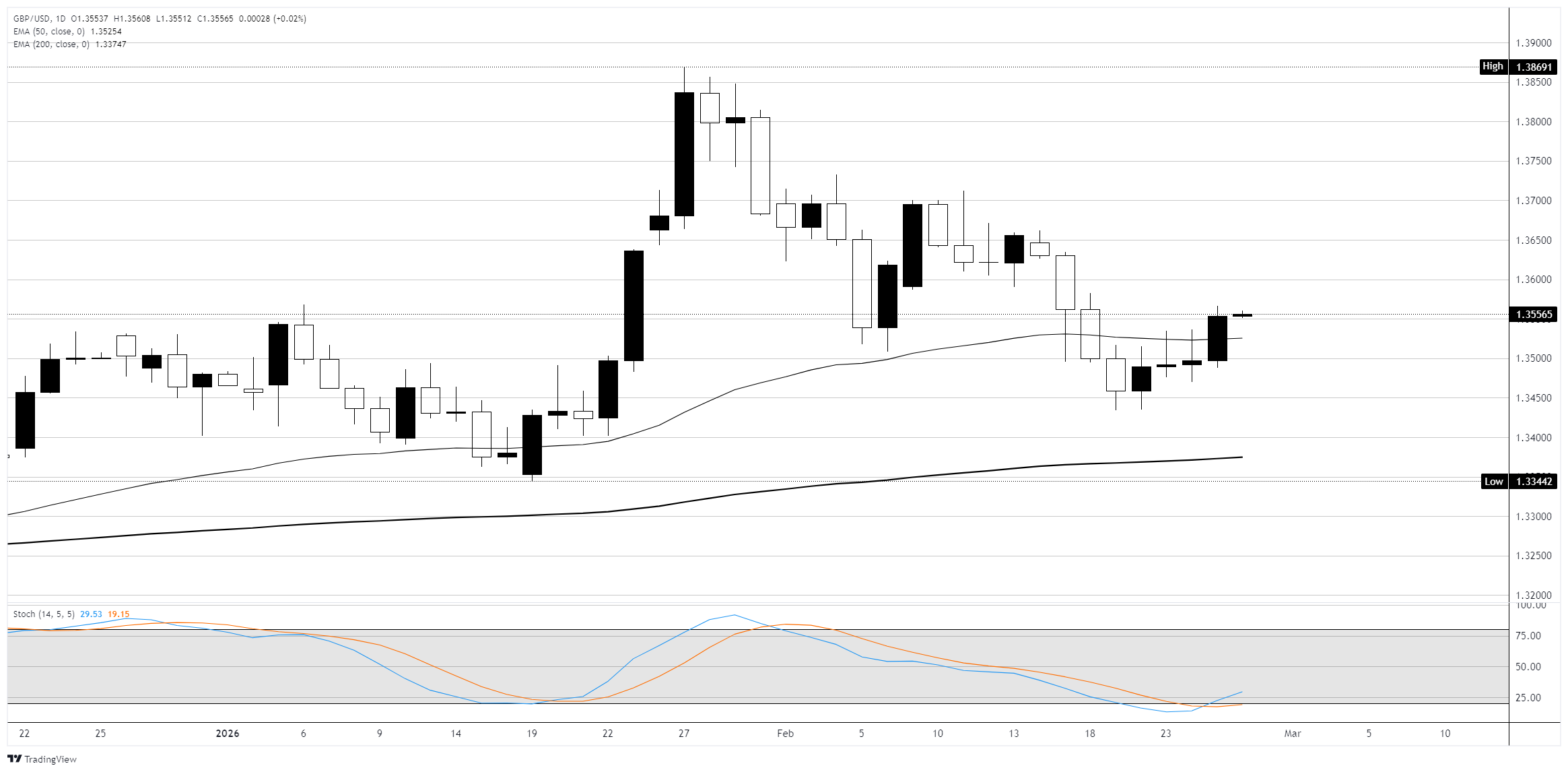
GBP/USD rose 0.42% on Wednesday, recovering toward 1.3600 in a session shaped by softer-than-expected UK inflation data and broad US Dollar weakness. The pair had been consolidating in a tight range between about 1.3450 and 1.3520 for the past few days following the sharp pullback from the late-January high near 1.3870, and Wednesday's move pushed price action back onto the high side of key moving averages.
The Office for National Statistics (ONS) reported that UK Consumer Price Index (CPI) inflation fell to 3.0% in January from 3.4% in December, a sharper decline than expected and the lowest reading since mid-2025. The drop bolstered expectations that the Bank of England (BoE) will cut rates at its March 19 meeting, with markets now pricing roughly 80% odds of a 25 basis point reduction. Governor Andrew Bailey, testifying before parliament's Treasury Committee on Tuesday, had already called a March cut "a genuinely open question," while noting that services price inflation at 4.4% has not eased as much as the BoE had forecast. Chief Economist Huw Pill echoed the caution, warning against being "beguiled" by headline inflation falling toward the 2% target. UK labor data earlier in the week showed unemployment rising to a five-year high of 5.2%, further supporting the case for easing.
The US Dollar side added a tailwind to Cable. The US Dollar Index slipped below 97.80 on Wednesday after President fTrump's State of the Union address on Tuesday night offered no indication of easing tariff policies. The Federal Reserve (Fed) is holding rates at 3.50% to 3.75%, with January minutes showing several officials discussed the possibility of rate hikes if inflation stays above target. US-Iran nuclear talks scheduled for Thursday in Geneva added further geopolitical caution.
Recovery from the 50-day EMA as Stochastic crosses bullish in oversold territory
The pair bounced from the 50-day Exponential Moving Average (EMA) near 1.3525, which has been acting as a pivot since the January rally. The 200-day EMA around 1.3380 continues to rise and is well below current price action, keeping the broader uptrend from late 2025 valid. The Stochastic Oscillator has crossed bullish in the oversold zone, suggesting the pullback from the 1.3870 high may be running out of steam. A sustained push above 1.3600 would be the first sign of buyers re-engaging toward the year-to-date high, while a failure to hold the 50-day EMA would shift focus toward 1.3430 and eventually the 200-day EMA.
GBP/USD daily chart
Pound Sterling FAQs
The Pound Sterling (GBP) is the oldest currency in the world (886 AD) and the official currency of the United Kingdom. It is the fourth most traded unit for foreign exchange (FX) in the world, accounting for 12% of all transactions, averaging $630 billion a day, according to 2022 data. Its key trading pairs are GBP/USD, also known as ‘Cable’, which accounts for 11% of FX, GBP/JPY, or the ‘Dragon’ as it is known by traders (3%), and EUR/GBP (2%). The Pound Sterling is issued by the Bank of England (BoE).
The single most important factor influencing the value of the Pound Sterling is monetary policy decided by the Bank of England. The BoE bases its decisions on whether it has achieved its primary goal of “price stability” – a steady inflation rate of around 2%. Its primary tool for achieving this is the adjustment of interest rates. When inflation is too high, the BoE will try to rein it in by raising interest rates, making it more expensive for people and businesses to access credit. This is generally positive for GBP, as higher interest rates make the UK a more attractive place for global investors to park their money. When inflation falls too low it is a sign economic growth is slowing. In this scenario, the BoE will consider lowering interest rates to cheapen credit so businesses will borrow more to invest in growth-generating projects.
Data releases gauge the health of the economy and can impact the value of the Pound Sterling. Indicators such as GDP, Manufacturing and Services PMIs, and employment can all influence the direction of the GBP. A strong economy is good for Sterling. Not only does it attract more foreign investment but it may encourage the BoE to put up interest rates, which will directly strengthen GBP. Otherwise, if economic data is weak, the Pound Sterling is likely to fall.
Another significant data release for the Pound Sterling is the Trade Balance. This indicator measures the difference between what a country earns from its exports and what it spends on imports over a given period. If a country produces highly sought-after exports, its currency will benefit purely from the extra demand created from foreign buyers seeking to purchase these goods. Therefore, a positive net Trade Balance strengthens a currency and vice versa for a negative balance.
Author

Joshua Gibson
FXStreet
Joshua joins the FXStreet team as an Economics and Finance double major from Vancouver Island University with twelve years' experience as an independent trader focusing on technical analysis.