GBP/JPY Price Forecast: Bulls guard 200.00 base while momentum stalls below 203.00
- GBP/JPY holds firm amid subdued trading as Japan observes a public holiday.
- Traders adopt a wait-and-see stance ahead of Thursday’s BoE interest rate decision.
- Technically, the 21-day SMA at 202.81 acts as an immediate resistance, capping intraday upside attempts.

The British Pound (GBP) holds firm against the Japanese Yen (JPY) on Monday amid holiday-thinned trading in Japan, with investors likely to refrain from large directional bets ahead of the Bank of England (BoE) interest rate decision due on Thursday. At the time of writing, GBP/JPY trades around 202.41, easing slightly from the intraday high of 202.79.
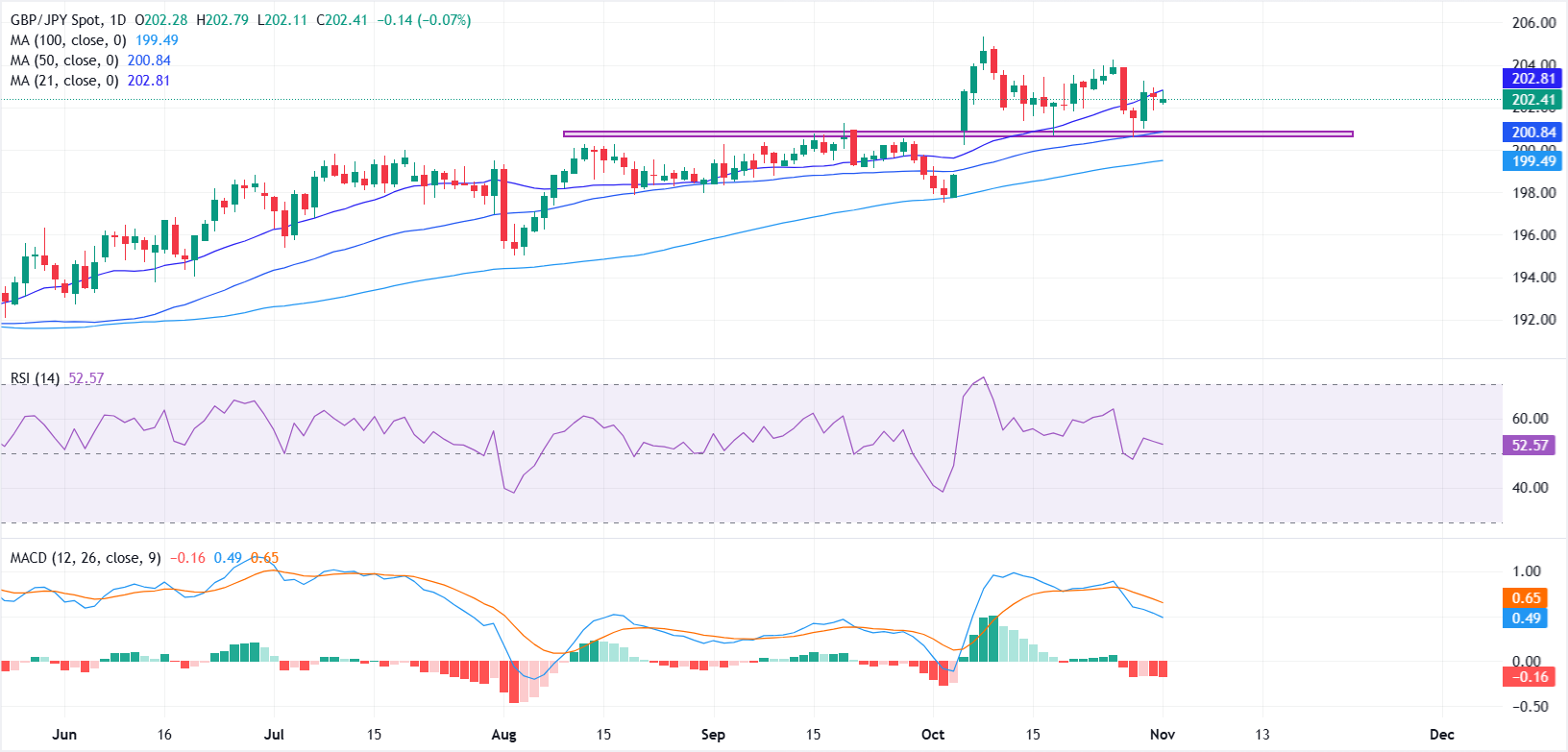
From a technical perspective, the pair bounced last week after testing a critical confluence zone near the 200.00 psychological handle, which aligns with the 50-day Simple Moving Average (SMA) and a horizontal support that previously acted as resistance. This area continues to act as a key floor for the cross, keeping the broader uptrend intact.
However, the 21-day SMA at 202.81 is capping immediate upside attempts, acting as a near-term barrier for bulls. A decisive break above this dynamic resistance could open the door toward 204.00, followed by the 205.00 area, which marks both the year-to-date high and the highest level since July 2024.
On the downside, a sustained move below the 200.00 confluence support would expose the pair to renewed bearish pressure, with the next target seen at the October 3 high near 198.87, also coinciding with an unfilled bullish gap from October 6. A daily close below that region could reinforce downside momentum, exposing the next support around 197.50.
The Relative Strength Index (RSI) hovers around 53, reflecting a neutral bias as the pair consolidates within its broader bullish structure.
BoE FAQs
The Bank of England (BoE) decides monetary policy for the United Kingdom. Its primary goal is to achieve ‘price stability’, or a steady inflation rate of 2%. Its tool for achieving this is via the adjustment of base lending rates. The BoE sets the rate at which it lends to commercial banks and banks lend to each other, determining the level of interest rates in the economy overall. This also impacts the value of the Pound Sterling (GBP).
When inflation is above the Bank of England’s target it responds by raising interest rates, making it more expensive for people and businesses to access credit. This is positive for the Pound Sterling because higher interest rates make the UK a more attractive place for global investors to park their money. When inflation falls below target, it is a sign economic growth is slowing, and the BoE will consider lowering interest rates to cheapen credit in the hope businesses will borrow to invest in growth-generating projects – a negative for the Pound Sterling.
In extreme situations, the Bank of England can enact a policy called Quantitative Easing (QE). QE is the process by which the BoE substantially increases the flow of credit in a stuck financial system. QE is a last resort policy when lowering interest rates will not achieve the necessary result. The process of QE involves the BoE printing money to buy assets – usually government or AAA-rated corporate bonds – from banks and other financial institutions. QE usually results in a weaker Pound Sterling.
Quantitative tightening (QT) is the reverse of QE, enacted when the economy is strengthening and inflation starts rising. Whilst in QE the Bank of England (BoE) purchases government and corporate bonds from financial institutions to encourage them to lend; in QT, the BoE stops buying more bonds, and stops reinvesting the principal maturing on the bonds it already holds. It is usually positive for the Pound Sterling.
Author

Vishal Chaturvedi
FXStreet
I am a macro-focused research analyst with over four years of experience covering forex and commodities market. I enjoy breaking down complex economic trends and turning them into clear, actionable insights that help traders stay ahead of the curve.


![How Wall Street rigs the game [Video]](https://editorial.fxsstatic.com/images/i/market-chaos-01.jpg)