GBP/JPY Price Analysis: An inverted head-and-shoulders targeting 167.00
- The GBP/JPY begins the week on a higher note, up by 1.15%.
- The GBP/JPY rallies courtesy of a positive mood and an ultra-dovish Bank of Japan (BoJ).
- GBP/JPY Price Forecast: The pair is upward biased and would climb towards 167.00, before consolidating.

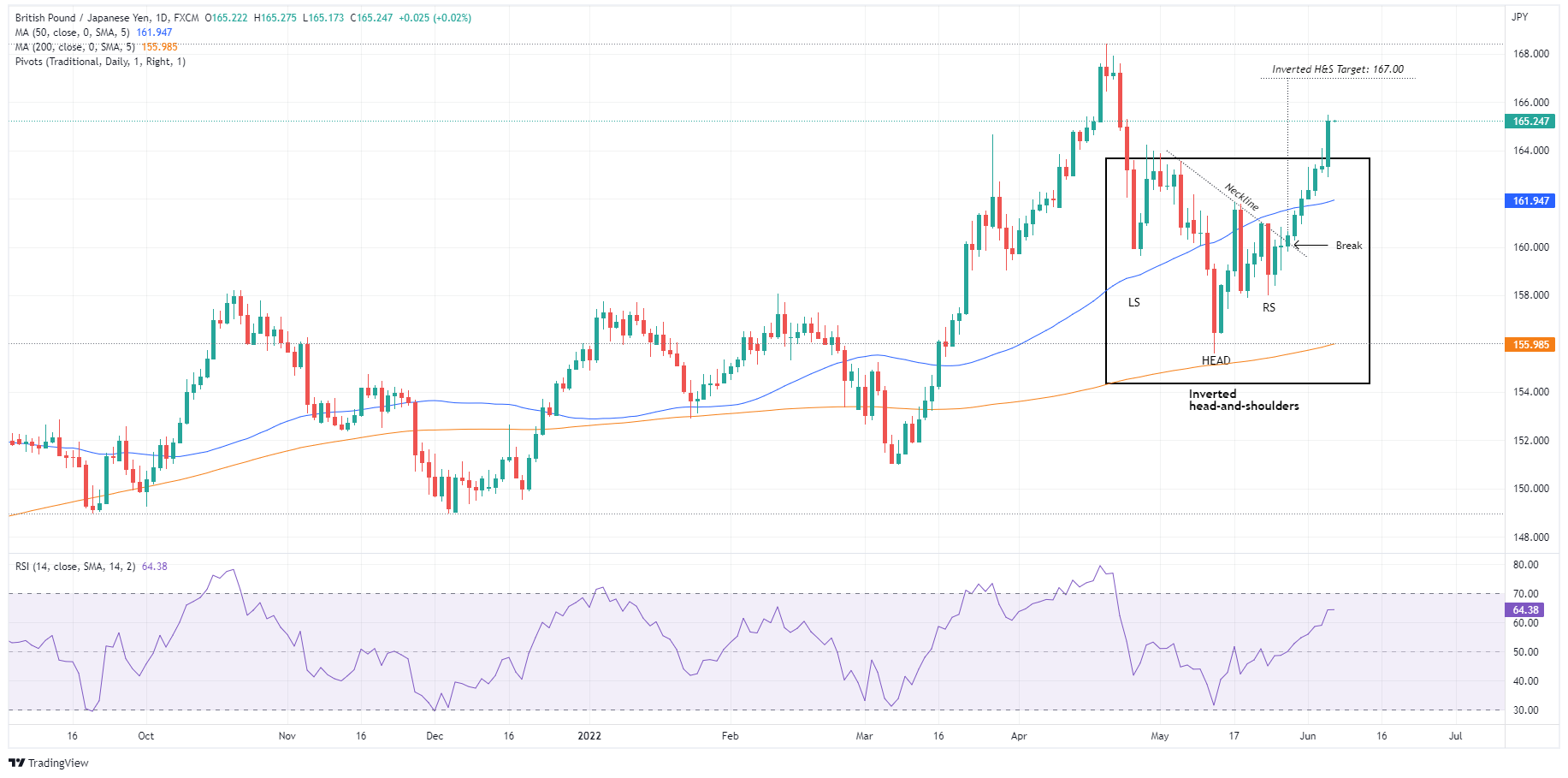
GBP/JPY soars for the eighth straight day and registers a fresh five-week high, above the 165.00, a level last seen since April 25. At 165.24, the GBP/JPY rallies as the Asian Pacific session is about to begin, up by 1.13%, due to a positive market mood and the Japanese yen weakness.
Sentiment and an ultra-dovish Bank of Japan (BoJ), propelled the GBP/JPY up
Alongside the aforementioned, Beijing’s lifting of restrictions was cheered by market players. Also, Bank of Japan (BoJ) board members, led by Governor Haruiko Kuroda, reiterated the ultra-dovish stance and maintained a weak yen. He emphasized that the BOJ will be unwavering in its posture of maintaining monetary easing to ensure the recent rise in inflation expectations lead to a sustained price increase.
Hence, the GBP/JPY continued surging since May 12, when the GBP/JPY began its 900-plus pip rally from 155.50s towards 165.20s.
GBP/JPY Price Forecast: Technical outlook
The cross-currency pair is upward biased from the GBP/JPY’s daily chart perspective. Confirmation of the previously-mentioned is the daily moving averages (DMAs) below the exchange rate, alongside the RSI at bullish territory, aiming higher. Additionally, an inverted head-and-shoulders formed, which targets 167.00, as measured from the May 12 swing low 155.58, to the neckline around 162.20.
Therefore, If that scenario plays out, the GBP/JPY’s first resistance would be the June 6 high at 165.57. Break above would expose the 166.00 mark. Once cleared, the next supply zone would be the inverted head-and-shoulders target at 167.00.
Author
Christian Borjon Valencia
FXStreet
Markets analyst, news editor, and trading instructor with over 14 years of experience across FX, commodities, US equity indices, and global macro markets.