|

GBP/CAD Price Forecast: Possibly extending higher in Rising Wedge pattern

  • GBP/CAD is climbing higher within what could be a Rising Wedge price configuration. 
  • It is currently finding support at the 50-day SMA. 
  • A decisive break lower could signal substantial further weakness. 

GBP/CAD continues trading higher in what looks like a Rising Wedge pattern. Within the confines of the pattern’s borders the pair is finding support at the (red) 50-day Simple Moving Average (SMA) at about 1.7879. 

GBP/CAD Daily Chart 
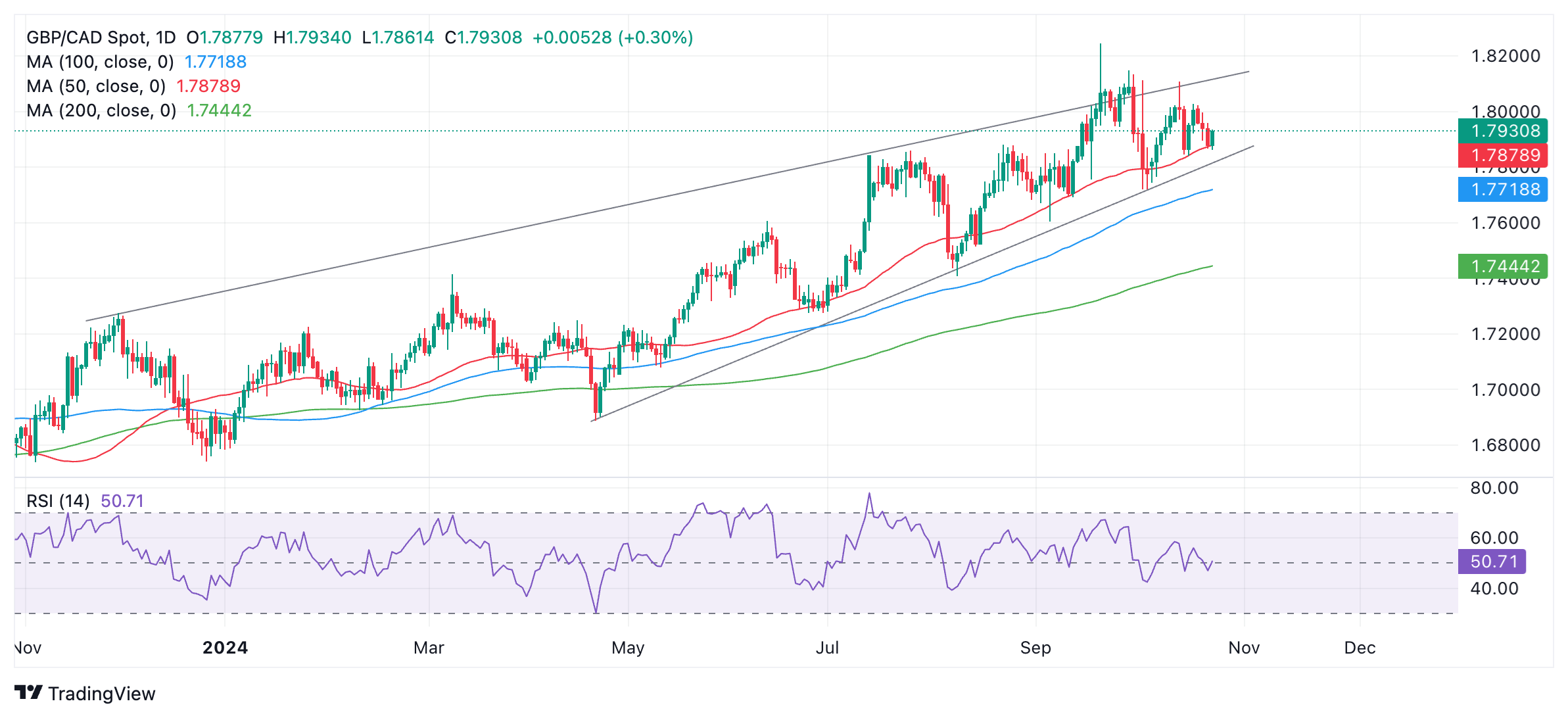
GBP/CAD will probably respect the borders of the pattern and continue rising in line with the medium and long-term bull trend. The short-term trend is less clear and could be classed more specifically as sideways. 

A decisive break below the lower trendline of the Rising Wedge would probably signal the start of a steeper descent. Such a breakout lower would be confirmed by a close below 1.7700, and would probably result in a move down to support at the 200-day SMA at around 1.7445. 

Author

Joaquin Monfort

Joaquin Monfort is a financial writer and analyst with over 10 years experience writing about financial markets and alt data. He holds a degree in Anthropology from London University and a Diploma in Technical analysis.


More from Joaquin Monfort
Share:

Editor's Picks

AUD/USD pulls back from monthly high but holds above 0.7000

AUD/USD retreats from the monthly high set earlier this Thursday, sliding back to 0.7000 during the Asian session as a further escalation of tensions in the Middle East undermines the risk-sensitive Aussie. However, recent hawkish comments from RBA officials could support the Australian Dollar. Furthermore, the prevailing US Dollar selling bias, despite Fed hike bets and geopolitical uncertainties, could limit losses for the pair.

USD/JPY declines to a one-week low; eyes trading range support near 157.50 on weaker USD

USD/JPY drops to a one-week low during Thursday’s Asian session, with bears now awaiting a break below multi-week range support near mid-157.00s before placing fresh bets amid a broadly weaker US Dollar. Despite bets for a December Fed rate hike and Middle East jitters, the recent decline in US bond yields keeps USD depressed near a three-week low. Moreover, hawkish BoJ expectations and intervention risks underpin the Japanese Yen, further weighing on the currency pair.

Gold bounces off monthly low as USD selling remains unabated amid falling bond yields

Gold pares heavy intraday losses to the monthly trough, though it retains an intraday bearish tone below $4,100 during Thursday’s early European session. The US Dollar selling bias remains unabated as Federal Reserve officials recently signaled there is no urgency to raise interest rates at the upcoming October 27–28 meeting. Furthermore, US bond yields extend their retracement slide from multi-year highs, keeping USD bulls on the back foot and offering some support to the precious metal.

Dogecoin stays weak despite whales and new deal

Dogecoin price remains under pressure, trading below $0.081 despite a modest rebound earlier this week. Santiment data shows signs of accumulation, and Wednesday’s announcement of a Dogecoin Labs partnership with the Dogecoin Foundation adds a mildly bullish sentiment. Meanwhile, mixed derivatives metrics and weakening momentum indicators continue to limit the meme coin recovery.

Dow Jones Industrial Average climbs with the AI trade, led by a bank

The Dow Jones Industrial Average got most of its share of Wednesday's artificial intelligence (AI) rally from a bank and a bulldozer maker. The index closed near 52,800, its highest close since early September. SpaceX (SPCX) reported 161% revenue growth and the Nasdaq Composite rose more than 1%, but under price weighting the gains that counted most belonged to Goldman Sachs (GS) and Caterpillar (CAT).

The US Dollar fell. Gold didn't rally. That tells you everything
Gold (XAU/USD) is struggling to capitalize on a weaker US Dollar (USD), after repeatedly failing to establish itself above the $4,200 level. The precious metal remains confined to a relatively narrow trading range despite a combination of developments that would normally support higher prices.