"Downward momentum is increasing": Analysts say British Pound risks downturn unless it recovers soon
The British Pound (GBP) is trading relatively subdued against the US Dollar, shifting into a corrective and range-bound phase. A combination of soft economic indicators i the United Kingdom (UK), such as a marginally contractionary services PMI, and conflicting signals from Bank of England (BoE) policymakers has left the currency struggling to sustain its recent gains. As momentum turns slightly negative, analysts are keeping a close eye on key technical boundaries to see whether the currency will break lower or continue consolidating.
Short-term momentum turns bearish
Analysts at UOB observe that the British Pound has started drifting downward after failing to clear overhead resistance levels. Although the rapid nature of the recent decline has left intraday conditions somewhat oversold, the broader short-term indicators suggest that the path of least resistance remains to the downside unless the currency can stage a firm recovery.
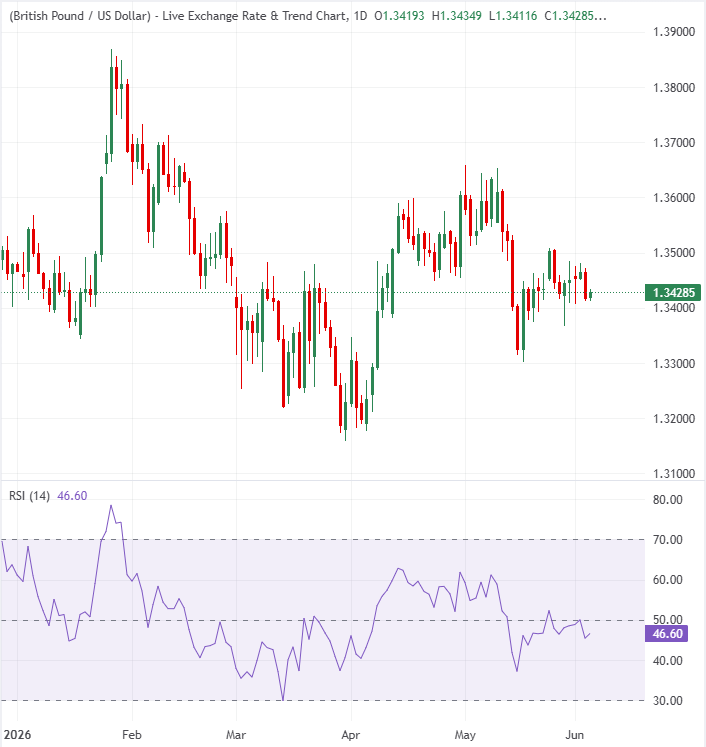
Downward momentum is increasing, but currently, it is not sufficient to indicate a sustained decline. However, as long as GBP holds below 1.3470 (‘strong resistance’ level), the risk of GBP breaking below 1.3390 will increase over the next few days.
Mixed central bank messaging and flat data leave the Pound range-bound
Looking at the broader fundamental picture, the strategy team at Scotiabank points out that the lack of clear directional drivers is keeping the British Pound anchored. While a cooling labor market has drawn dovish remarks from some central bank officials, hawkish pushback from other members has balanced out interest rate expectations, trapping the currency pair within a tight technical congestion zone.
The RSI is close to neutral at 50, and recent price action has been closing congestion centered around the 50-day MA (1.3450). We await a break of the local range roughly bound between 1.3300 and 1.3500.
Banks anticipate consolidation phase with underlying downside bias
Analysts expect a capped, neutral-to-soft trend for the British Pound. UOB flags an escalating risk of a technical breakdown past short-term support lines if the currency continues to trade beneath its immediate ceilings. Meanwhile, Scotiabank projects that the British Pound will remain confined within a well-defined 1.3300 to 1.3500 trading band while the market awaits clearer economic data or a unified policy signal from the BoE.
(This article was created with the help of an Artificial Intelligence tool and reviewed by an editor.)
Author

FXStreet Insights Team
FXStreet
The FXStreet Insights Team is a group of journalists that handpicks selected market observations published by renowned experts. The content includes notes by commercial as well as additional insights by internal and external analysts.

















