|

EUROSTOXX (SX5E) Elliott Wave: Bearish sequences called for the decline

In this technical blog, we’ll take a closer look at our Elliott Wave charts for the EUROSTOXX (SX5E), published in the members’ area of our website. We identified incomplete bearish sequences within the cycle from the August 12 peak, calling for further downside. In the following analysis, we’ll review the Elliott Wave structure and see how the market followed our outlook.

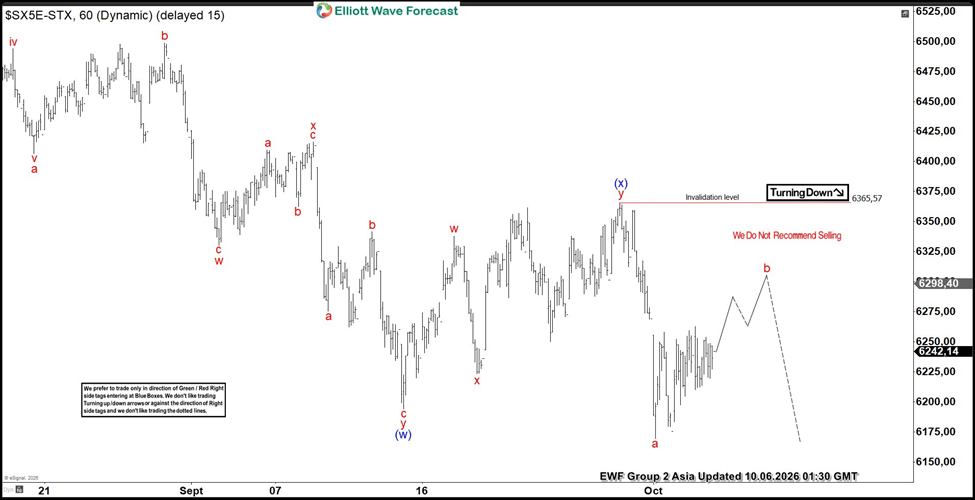
EUROSTOXX Elliott Wave one-hour chart 10.06.2026

The break below the August 15 low, marked as (w) blue, confirmed the incomplete bearish sequences within the cycle from the August 12 peak at 6577. These types of price structures are very important, because incomplete swing structures can help us anticipate the market’s next move with greater accuracy.

The current view suggests further short-term weakness in the coming days. The index remains bearish against the 6365.57 peak, marked as (x) blue on the chart. As long as the price stays below this level, we expect further downside.

The cycle is forming an Elliott Wave Double Three pattern. Therefore, we identify the potential downside target by measuring the (w)-(x) Equal Legs area using the Fibonacci Extension tool. In this case, the Equal Legs target zone comes at 5979–5743.
Chart

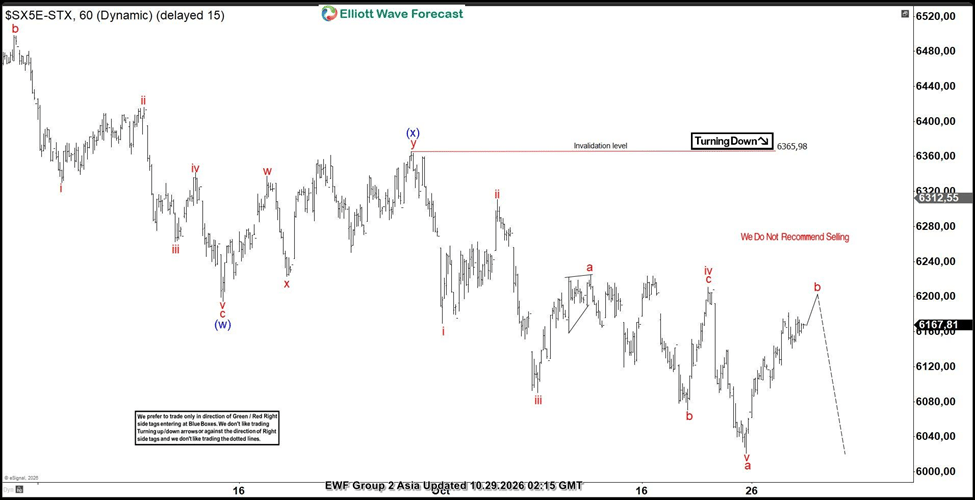
EUROSTOXX Elliott Wave one-hour chart 10.29.2026

The index has continued to trade lower, as expected. However, the Equal Legs target area has not yet been reached. The primary view suggests that another leg down remains possible toward the previously mentioned target zone of 5979–5743. Alternatively, a break of the 6365.98 pivot would suggest that the cycle has already completed as a truncation.
Chart

Author

Elliott Wave Forecast Team

Elliott Wave Forecast Team

ElliottWave-Forecast.com

More from Elliott Wave Forecast Team
Share:

Editor's Picks

AUD/USD consolidates near 0.7000 as USD stays weak

AUD/USD holds steady above 0.7000 during Thursday’s Asian session, consolidating the previous day’s recovery gains from a near three-week low as the Democratic sweep in the US midterm elections and Iran diplomacy hopes continue to weigh on the US Dollar. Bulls, however, seem hesitant as focus shifts to Friday’s crucial US NFP report.

USD/JPY drifts lower to 158.25 on hawkish BoJ Minutes, weak USD

USD/JPY trades with a negative bias for the second straight day on Thursday as hawkish BoJ Minutes, showing members agreed to keep raising rates, and intervention risks support the Japanese Yen. Meanwhile, US midterm election results and hopes for Iran diplomacy keep the US Dollar depressed as focus shifts to Friday’s US NFP report.

Gold consolidates gains around $4,100

Gold now surrenders part of its initial bull run, although it sticks to the $4,100 region per troy ounce on Thursday. The yellow metal extends it recovery on the back of the lacklustre performance of the US Dollar and declining US Treasury yields following the US midterms elections.

The memory trade collapses as Sandisk sheds 17%, Micron sinks to May levels
If Wednesday's stock market rally was a broad vote of confidence in the Democratic sweep of the US midterm elections, Thursday is the other side of that coin. While the AI sell-off already began on Wednesday, it has kicked into higher gear on Thursday. The NASDAQ Composite has swung to a 4% loss in the morning regular session, while the S&P 500 and Dow Jones also shed Wednesday's gains.
NFP stress test: Six payrolls releases, measured in daily-loss limits

Friday's US employment report is usually previewed in terms of the headline number and the reaction in the Dollar. For a growing group of traders, those running funded or evaluation accounts with a fixed daily loss limit, there is a more practical question: how much of that limit can the first hour consume, regardless of direction?

US Dollar breaks below 101.50 as Democrats sweep Congress
The US Dollar (USD) comes under heavy selling pressure on Wednesday, with the US Dollar Index (DXY) falling around 0.5% to trade near 101.35 after sliding below the 101.50 level. The Greenback retreats to its lowest level in four weeks as investors reassess the political and economic outlook following the Democratic Party's sweeping victory in the United States (US) midterm elections.