NASDAQ 100 leads Wall Street lower as the AI trade comes apart
- AI-focused stocks fall again on moratorium worries following a Democratic sweep in the midterms.
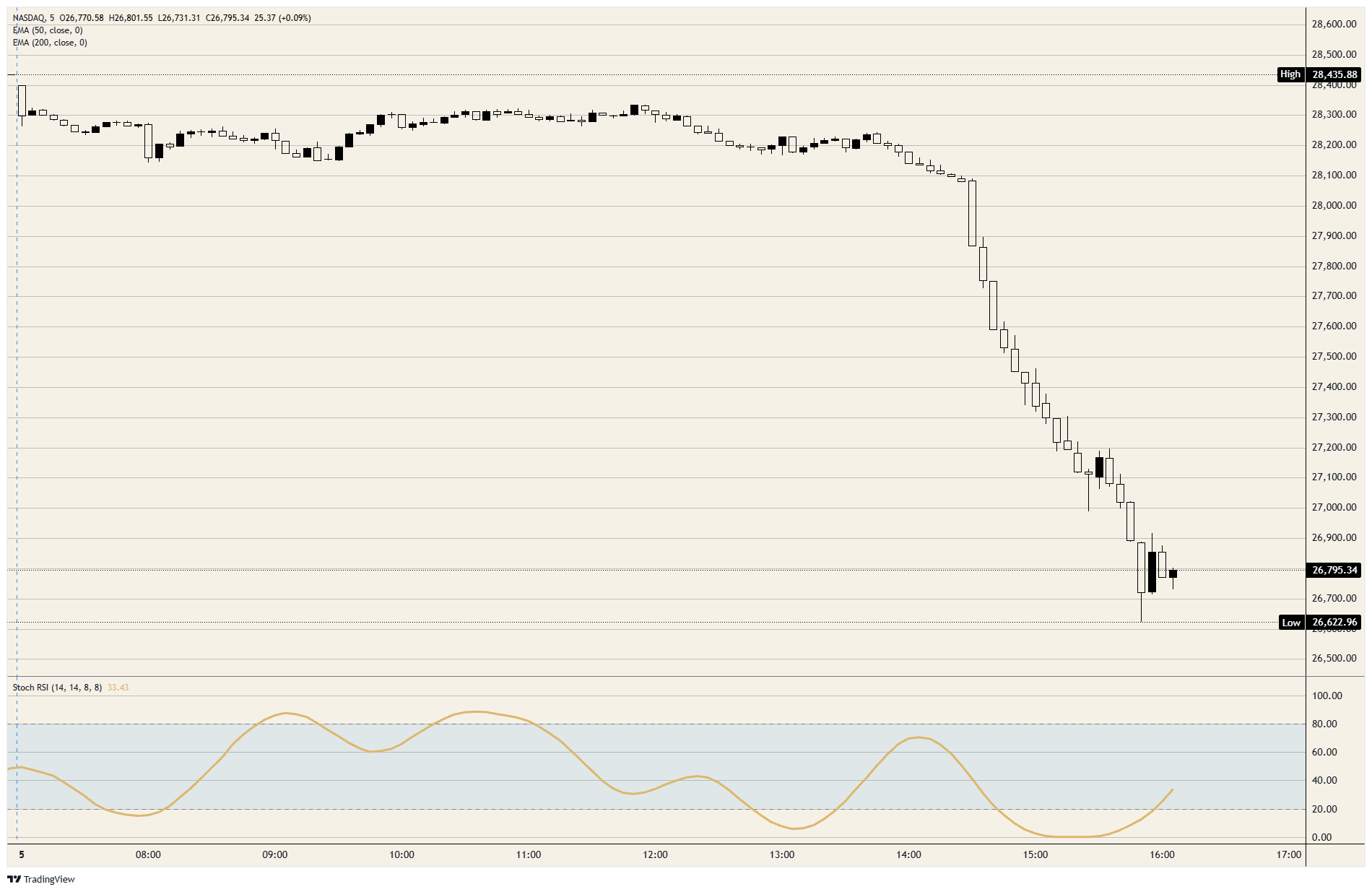
- NASDAQ has given back Wednesday's gains as the broader market pivots into the defensive side.

A fresh wave of selling in AI-linked stocks is pulling Wall Street into one of its worst days in recent memory. A Democratic win in both the upper and lower houses has added fresh worries that AI data center projects could face renewed moratoriums and regulatory pressures.
The AI segment's 'pick and shovel' layer is getting blown out, and knock-on fears are spreading into the microchip and semiconductor sectors, dragging broader markets into the red. The Nasdaq tech index is down 5%, falling around 1,400 points, while the S&P 500 and Dow Jones Industrial Average have shed roughly 3% and 2%, respectively.
Fitch says a major share of planned data centre capacity may face regulatory hurdles under incoming governors in Texas, Georgia, and Ohio, capacity the NASDAQ 100's biggest companies build or sell into.
Nasdaq 100 5-minute chart
Nasdaq FAQs
The Nasdaq is a stock exchange based in the US that started out life as an electronic stock quotation machine. At first, the Nasdaq only provided quotations for over-the-counter (OTC) stocks but later it became an exchange too. By 1991, the Nasdaq had grown to account for 46% of the entire US securities’ market. In 1998, it became the first stock exchange in the US to provide online trading. The Nasdaq also produces several indices, the most comprehensive of which is the Nasdaq Composite representing all 2,500-plus stocks on the Nasdaq, and the Nasdaq 100.
The Nasdaq 100 is a large-cap index made up of 100 non-financial companies from the Nasdaq stock exchange. Although it only includes a fraction of the thousands of stocks in the Nasdaq, it accounts for over 90% of the movement. The influence of each company on the index is market-cap weighted. The Nasdaq 100 includes companies with a significant focus on technology although it also encompasses companies from other industries and from outside the US. The average annual return of the Nasdaq 100 has been 17.23% since 1986.
There are a number of ways to trade the Nasdaq 100. Most retail brokers and spread betting platforms offer bets using Contracts for Difference (CFD). For longer-term investors, Exchange-Traded Funds (ETFs) trade like shares that mimic the movement of the index without the investor needing to buy all 100 constituent companies. An example ETF is the Invesco QQQ Trust (QQQ). Nasdaq 100 futures contracts allow traders to speculate on the future direction of the index. Options provide the right, but not the obligation, to buy or sell the Nasdaq 100 at a specific price (strike price) in the future.
Many different factors drive the Nasdaq 100 but mainly it is the aggregate performance of the component companies revealed in their quarterly and annual company earnings reports. US and global macroeconomic data also contributes as it impacts on investor sentiment, which if positive drives gains. The level of interest rates, set by the Federal Reserve (Fed), also influences the Nasdaq 100 as it affects the cost of credit, on which many corporations are heavily reliant. As such the level of inflation can be a major driver too as well as other metrics which impact on the decisions of the Fed.
Author

Joshua Gibson
FXStreet
Joshua joins the FXStreet team as an Economics and Finance double major from Vancouver Island University with twelve years' experience as an independent trader focusing on technical analysis.