EUR/USD slips as Greenback gains on data surge, trade fears rattle markets
- EUR/USD falls to 1.1379 as the US labor market shows strength, boosting DXY after recent weakness.
- Trump set to speak with Xi; plans to double steel and aluminum tariffs fuel global trade fears.
- Soft Eurozone inflation reinforces expectations for ECB rate cut at upcoming policy meeting.

EUR/USD retreats after hitting a six-week peak of 1.1454 on Tuesday amid increasing concerns of market participants regarding the trade war ignited by the United States (US). The Greenback’s appreciation weighs on the pair, which trades at 1.1379, down 0.52%.
Wall Street remains in the green as news emerged that US President Donald Trump is reportedly set to speak with Chinese President Xi Jinping this week, according to Reuters sources.
Data from the United States lifted the US Dollar (USD), which has been battered and lost nearly 2% this week, according to the US Dollar Index (DXY). April’s US Job Openings and Labor Turnover Survey (JOLTS) was better than expected, hinting that the labor market is solid. Meanwhile, Factory Orders fell sharply in April as manufacturing activity is pressured due to US President Donald Trump’s tariffs.
Uncertainty about US trade policies is also a reason behind the decline of the EUR/USD pair. The White House Press Secretary Karoline Leavitt said that the trade offer deadlines can confirm the letter is authentic and on track to good deals. She added that President Trump will sign an executive order to double tariffs on steel and aluminum on Tuesday, which will take effect on Wednesday.
Across the pond, the Eurozone Harmonized Index of Consumer Prices (HICP) inflation data for May fell below the European Central Bank (ECB) objective. This reaffirms expectations that the ECB might cut rates this week, a path that began last June.
In the Eurozone, the docket will feature the European Central Bank monetary policy decision and ECB President Christine Lagarde’s press conference. In the US, the schedule is packed with employment data, with the ADP National Employment Change for May awaited on Wednesday, followed by Initial Jobless Claims for the week ending May 31 and May’s Nonfarm Payrolls figures.
EUR/USD daily market movers: Euro retreats below 1.1400 on US JOLTS report
- EUR/USD uptrend remains intact, but it would be adrift to US and Eurozone economic data during the week.
- The US JOLTS Job Openings unexpectedly rose to 7.39 million in April, up from 7.20 million (revised) in March, defying expectations for a drop to 7.10 million, signaling ongoing labor market resilience.
- US Factory orders dropped 3.7% in April, down from a 4.3% jump in March, the US Commerce Department revealed on Tuesday. Economists surveyed by Reuters expected orders to drop by 3.1%.
- Federal Reserve officials crossed the wires. Governor Lisa Cook said that the policy is well-positioned for a range of scenarios and anticipates higher inflation and slower activity due to tariffs. Chicago’s Fed President, Austan Goolsbee, said the Fed has to wait and see if the impact of tariffs on inflation is small or big.
- The Eurozone HICP in May fell by 1.9%, below the ECB’s 2% target for the first time in eight months. Excluding volatile items, the so-called core HICP fell by 2.3% YoY, down from 2.7% in the previous month.
- Financial market players had fully priced in the expectation that the ECB would reduce its Deposit Facility Rate by 25 basis points (bps) to 2% at the upcoming monetary policy meeting.
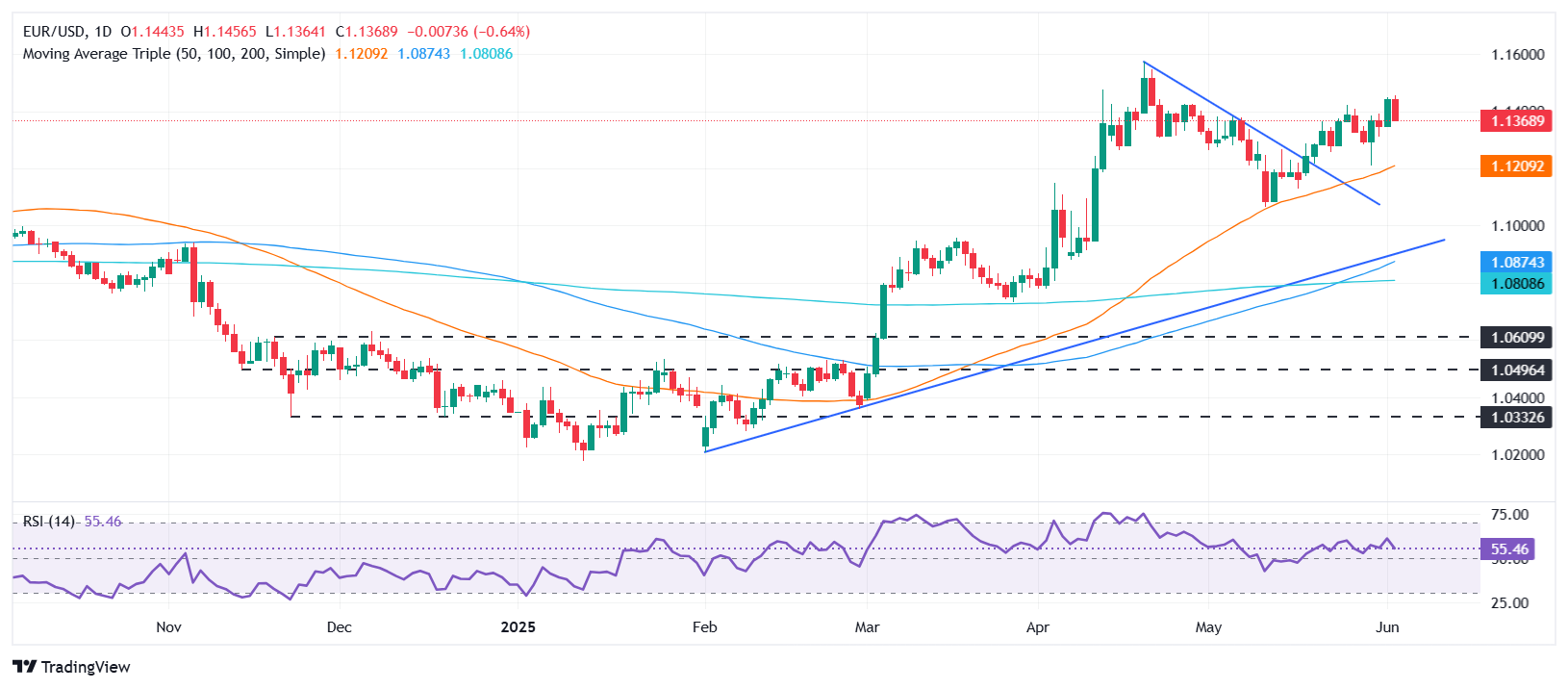
Euro technical outlook: EUR/USD cracks below 1.1400, bears eye 1.1300
EUR/USD is upward biased, as depicted by the daily chart, despite the ongoing pullback. The Relative Strength Index (RSI) is bullish, but it begins to show signs that it’s losing steam, opening the door for a deeper retracement.
If EUR/USD falls below the June 2 daily low of 1.1344, it could clear the path to challenge the 1.1300 level. A breach of the latter would expose the 20-day Simple Moving Average (SMA) at 1.1278, followed by the 50-day SMA at 1.1218. On further weakness, expect a test of 1.1200.
Conversely, if EUR/USD climbs past 1.1400,buyers could test the weekly peak of 1.1454, followed by the April 21 year-to-date (YTD) peak at 1.1573.
ECB FAQs
The European Central Bank (ECB) in Frankfurt, Germany, is the reserve bank for the Eurozone. The ECB sets interest rates and manages monetary policy for the region. The ECB primary mandate is to maintain price stability, which means keeping inflation at around 2%. Its primary tool for achieving this is by raising or lowering interest rates. Relatively high interest rates will usually result in a stronger Euro and vice versa. The ECB Governing Council makes monetary policy decisions at meetings held eight times a year. Decisions are made by heads of the Eurozone national banks and six permanent members, including the President of the ECB, Christine Lagarde.
In extreme situations, the European Central Bank can enact a policy tool called Quantitative Easing. QE is the process by which the ECB prints Euros and uses them to buy assets – usually government or corporate bonds – from banks and other financial institutions. QE usually results in a weaker Euro. QE is a last resort when simply lowering interest rates is unlikely to achieve the objective of price stability. The ECB used it during the Great Financial Crisis in 2009-11, in 2015 when inflation remained stubbornly low, as well as during the covid pandemic.
Quantitative tightening (QT) is the reverse of QE. It is undertaken after QE when an economic recovery is underway and inflation starts rising. Whilst in QE the European Central Bank (ECB) purchases government and corporate bonds from financial institutions to provide them with liquidity, in QT the ECB stops buying more bonds, and stops reinvesting the principal maturing on the bonds it already holds. It is usually positive (or bullish) for the Euro.
Author

Christian Borjon Valencia
FXStreet
Markets analyst, news editor, and trading instructor with over 14 years of experience across FX, commodities, US equity indices, and global macro markets.