EUR/USD hits fresh highs as trade rifts, political tensions hit the Dollar
- EUR/USD resumes its uptrend and tests fresh long-term highs past 1.1920
- Trump's tariffs on South Korea and the US government shutdown concerns are likely to keep US Dollar rallies limited.
- Bears should break below 1.1830 to confirm a downside reversal.

The Euro (EUR) has reversed previous losses and rallied to test September 2025 highs at the 1.1920 area, which are under pressure at the time of writing. US trade uncertainty, market expectations of further Federal Reserve (Fed) easing, and the growing chances of a US government shutdown are keeping the Greenback in the doldrums on Tuesday.
A new tariff salvo, this time to South Korea, highlights the erratic US trade policies, while in the US, the risk of a Government shutdown rises as tensions simmer in Minnesota after two people were killed in immigration raids. All this happens on the day the Fed starts its two-day meeting to decide its monetary policy amid unprecedented political pressures.
Against this backdrop, the US Dollar rallies are likely to be short-lived, with the Euro likely to remain relatively steady, not far from mid-term highs in the area of 1.1920. Market sentiment is positive on Tuesday, which is another positive factor for the Euro.
In the economic calendar, the US Consumer Confidence might provide some fundamental guidance later on the day, ahead of the speeches of European Central Bank (ECB) President Christine Lagarde and Bundesbank President Joachim Nagel.
Daily Digest Market Movers: Trade uncertainty and political tensions are weighing on the US Dollar
- US President Donald Trump announced on Monday that he will increase tariffs on South Korea to 25%, from the current 15%, for failing to commit to the terms of the trade agreement reached last year. Asian markets have brushed off this news. The South Korean Kospi Index has risen 2.75%, but the uncertainty about US international trade is acting as a headwind for US Dollar recovery.
- In the US, Senate Democrats have threatened to block a government funding bill unless severe restrictions are imposed on the Trump administration's anti-immigration operations. This would cause a partial government shutdown from Saturday, adding pressure on an already weak US Dollar.
- Apart from that, news that the Fed and the Bank of Japan (BoJ) requested USD/JPY quotes from major banks on Friday has boosted speculation of a coordinated intervention to support the Japanese Yen (JPY), which prompted investors to scale back their USD long positions.
- In the economic calendar on Monday, US Durable Goods Orders surged by 5.3% in November, well above the 0.5% increase expected and following a 2.1% contraction in October. The US Dollar, however, was little moved following the data release.
- On Tuesday, the focus will be on the US Consumer Confidence, although investors will keep an eye on Wednesday's Fed monetary policy decision. The bank is widely expected to leave its benchmark interest rate unchanged in the current 3.50%-3.75% range. Trump might be tempted to steal the show, with comments about Chairman Jerome Powell's successor.
Technical Analysis: EUR/USD bulls are testing resistance at the 1.1920 area
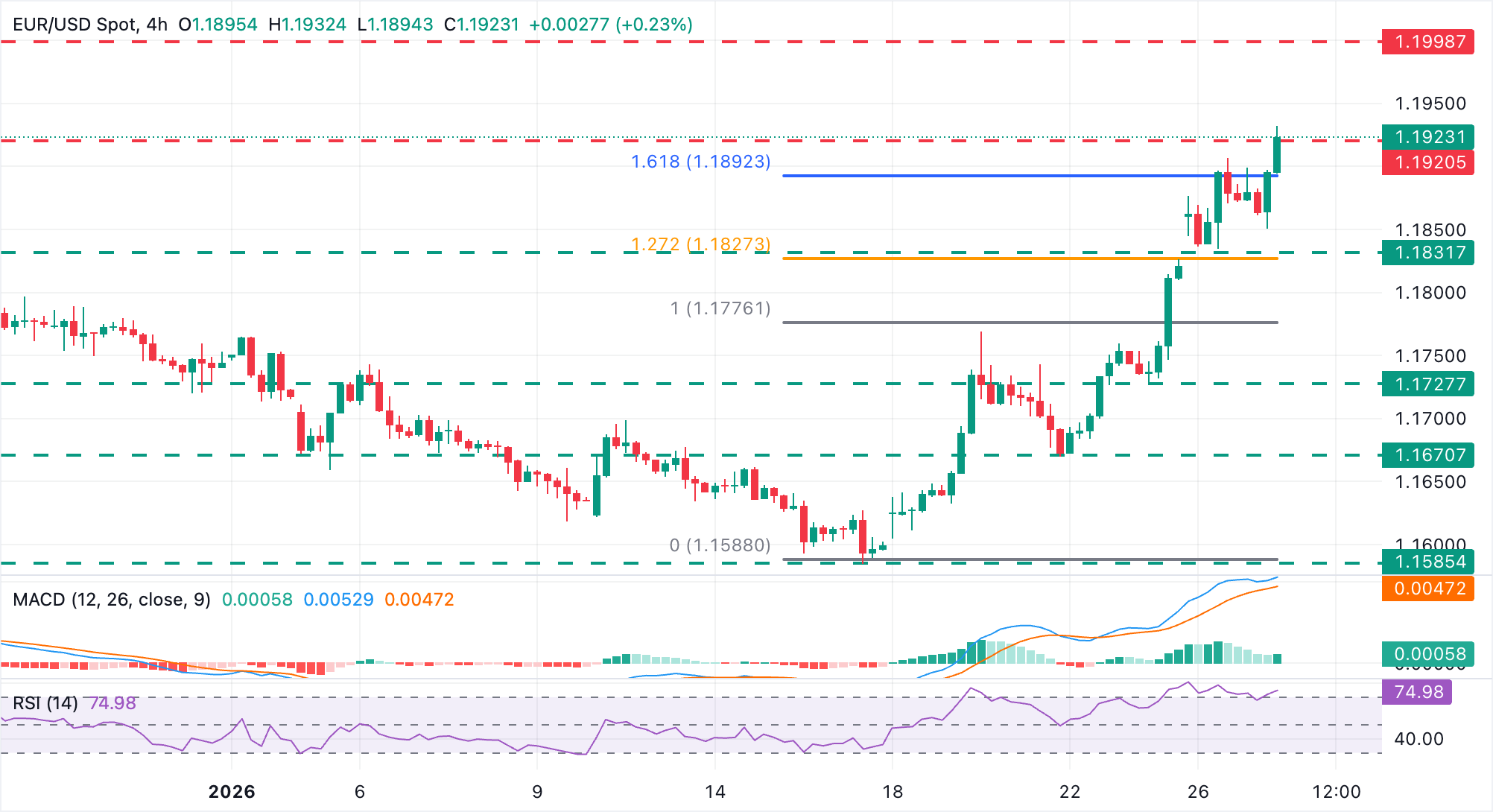
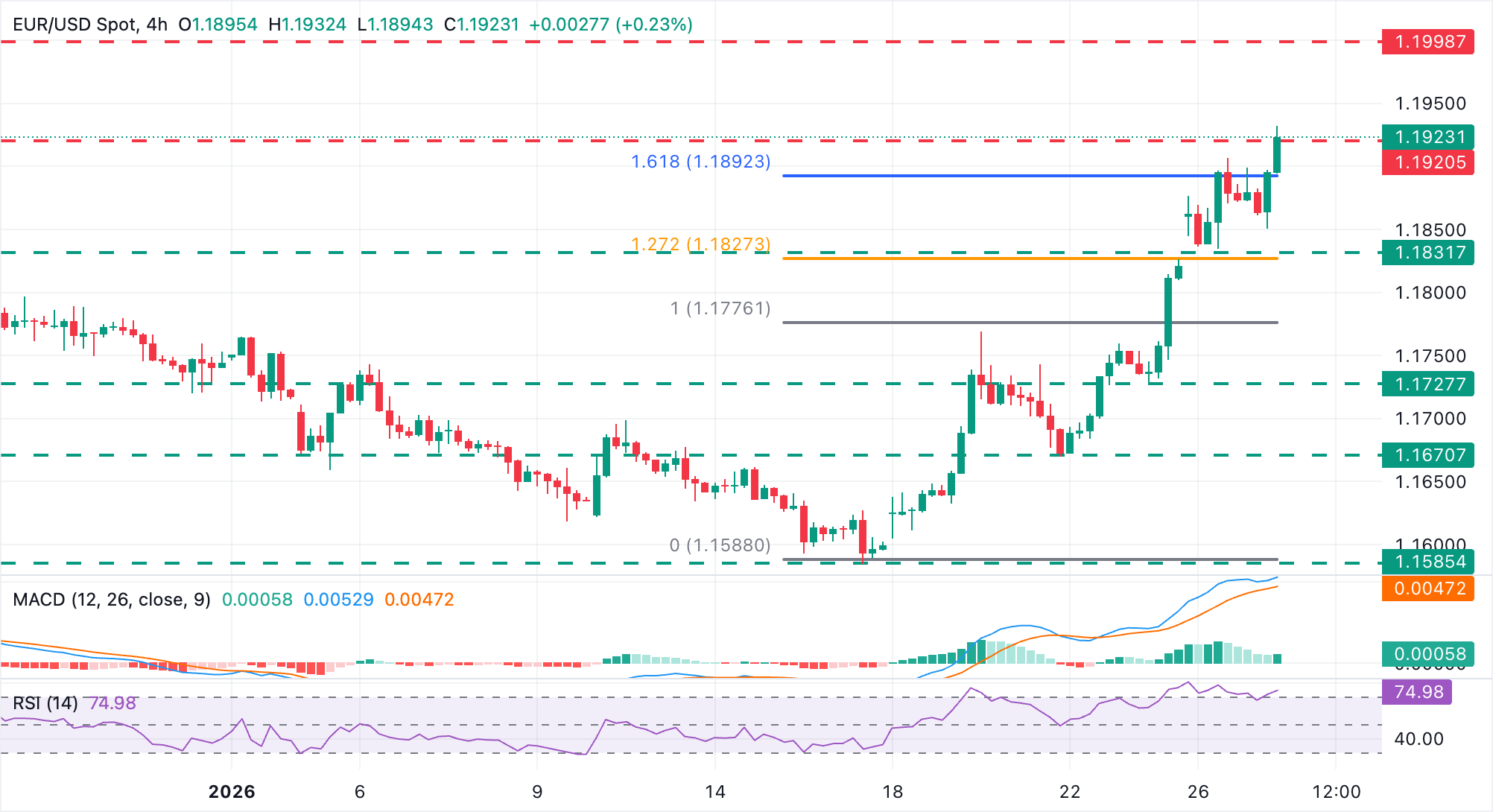
EUR/USD has resumed its bullish trend and is testing 2025 highs in the 1.1920 area. Technical indicators are picking up momentum with the 4-hour Moving Average Convergence Divergence (MACD) histogram expanding again, although the Relative Strength Index (RSI) has returned to overbought levels.
On the upside, a confirmation above the mentioned September 2025 high of 1.1918 would shift the focus toward the 1.2000 psychological level. A bearish reaction, on the contrary, ¡might find support at Monday's low around 1.1830, which is the prime support, ahead of Friday's low near 1.1725.
(The technical analysis of this story was written with the help of an AI tool.)
Economic Indicator
Consumer Confidence
The Consumer Confidence index, released on a monthly basis by the Conference Board, is a survey gauging sentiment among consumers in the United States, reflecting prevailing business conditions and likely developments for the months ahead. The report details consumer attitudes, buying intentions, vacation plans and consumer expectations for inflation, labor market, stock prices and interest rates. The data shows a picture of whether or not consumers are willing to spend money, a key factor as consumer spending is a major driver of the US economy. Generally, a high reading is bullish for the US Dollar (USD), while a low reading is bearish. Note: Because of restrictions from the Conference Board, FXStreet Economic Calendar does not provide this indicator's figures.
Read more.Next release: Tue Jan 27, 2026 15:00
Frequency: Monthly
Consensus: -
Previous: -
Source: Conference Board
Economic Indicator
ECB's President Lagarde speech
The European Central Bank's President Christine Lagarde, born in 1956 in France, has formerly served as Managing Director of the International Monetary Fund, and minister of finance in France. She began her eight-year term at the helm of the ECB in November 2019. As part of her job in the Governing Council, Lagarde holds press conferences in detailing how the ECB observes the current and future state of the European economy. Her comments may positively or negatively the Euro's trend in the short term. Usually, a hawkish outlook boosts the Euro (bullish), while a dovish one weighs on the common currency (bearish).
Read more.Next release: Tue Jan 27, 2026 17:00
Frequency: Irregular
Consensus: -
Previous: -
Source: European Central Bank
Author

Guillermo Alcala
FXStreet
Graduated in Communication Sciences at the Universidad del Pais Vasco and Universiteit van Amsterdam, Guillermo has been working as financial news editor and copywriter in diverse Forex-related firms, like FXStreet and Kantox.