EUR/USD dives to fresh multi-month lows weighed by risk aversion
- The Euro reverses previous gains before diving below 1.1500 against the US Dollar.
- Investors' cautious mood and dwindling hopes of Fed cuts continue to underpin the US Dollar.
- In the absence of key releases on Tuesday, the focus is on Wednesday's US ADP Employment report.

EUR/USD broke below the 1.1500 psychological level, following a mild recovery attempt earlier on the day, which was rejected at 1.1530. The pair has depreciated about 1.5% over the last five trading days, with the US Dollar (USD) drawing support from Fed hawkishness and a dismal market mood.
On Monday, the US Dollar continued strengthening, unfazed by downbeat manufacturing activity data in the United States (US). October's ISM Manufacturing Purchasing Managers' Index (PMI) showed that the sector's economic activity contracted for the eighth consecutive month, weighed by a decline in orders and highlighting low employment levels.
In addition, Federal Reserve (Fed) policymakers reiterated their division on the path forward, with San Francisco Fed President Mary Daly and Chicago Fed President Austan Golsbee showing a cautious stance, while Governor Stephen Miran said that current policy is too restrictive.
In the Eurozone economic calendar, European Central Bank (ECB) President Christine Lagarde will speak later in the day, although she is unlikely to say anything new on monetary policy. In the US, the government shutdown will deprive markets of the US JOLTS Job Openings and Factory Orders data for September, while investors will be looking to Wednesday's ADP Employment Change release for October for further insight into the labour market trends.
Euro Price Today
The table below shows the percentage change of Euro (EUR) against listed major currencies today. Euro was the strongest against the New Zealand Dollar.
| USD | EUR | GBP | JPY | CAD | AUD | NZD | CHF | |
|---|---|---|---|---|---|---|---|---|
| USD | 0.27% | 0.60% | -0.41% | 0.18% | 0.67% | 0.82% | 0.19% | |
| EUR | -0.27% | 0.34% | -0.67% | -0.09% | 0.40% | 0.55% | -0.08% | |
| GBP | -0.60% | -0.34% | -1.02% | -0.42% | 0.07% | 0.22% | -0.41% | |
| JPY | 0.41% | 0.67% | 1.02% | 0.60% | 1.09% | 1.23% | 0.60% | |
| CAD | -0.18% | 0.09% | 0.42% | -0.60% | 0.49% | 0.62% | 0.00% | |
| AUD | -0.67% | -0.40% | -0.07% | -1.09% | -0.49% | 0.14% | -0.47% | |
| NZD | -0.82% | -0.55% | -0.22% | -1.23% | -0.62% | -0.14% | -0.63% | |
| CHF | -0.19% | 0.08% | 0.41% | -0.60% | -0.00% | 0.47% | 0.63% |
The heat map shows percentage changes of major currencies against each other. The base currency is picked from the left column, while the quote currency is picked from the top row. For example, if you pick the Euro from the left column and move along the horizontal line to the US Dollar, the percentage change displayed in the box will represent EUR (base)/USD (quote).
Daily digest market movers: The US Dollar stands tall in cautious markets
- The US Dollar Index (DXY) is pulling back from highs, but downside attempts remain limited so far, as a moderate risk-aversion and receding bets that the Federal Reserve will cut rates further in December have offset the negative impact from downbeat manufacturing activity figures.
- On Monday, October's ISM Manufacturing PMI declined to 48.7 from September's 49.1 reading, falling short of market expectations of a mild improvement to 49.5. The New Orders Index improved to 49.4 from 48.9 in September, and the Employment sub-index rose to 46.0 from 45.3. In both cases, showing contraction at levels below 50.0.
- San Francisco Fed President, Mary Daly, defended October's rate cut, but she expressed concerns about the high inflationary levels and highlighted the need to keep policy "moderately restrictive."
- Chicago Fed President, Austan Goolsbee, was more concerned about inflation than the labor market and defended the need to keep interest rates in a position where they help to combat the higher price pressures.
- On the other side of the spectrum, US President Donald Trump's latest pick to the committee, Stephen Miran, affirmed that the current monetary policy is too restrictive and that he will continue advocating for rate cuts.
- Futures markets, however, have reduced the chances of a rate cut in December to 67% from above 90% one week ago, which is keeping US Treasury yields and the US Dollar steady near highs.
- In Europe, Eurozone HCOB Manufacturing PMI figures confirmed the preliminary estimations that the sector's activity improved to a standstill, at 50.0, up from September's 49.8 reading.
Technical Analysis: EUR/USD drifts lower with 1.1440 support coming into focus
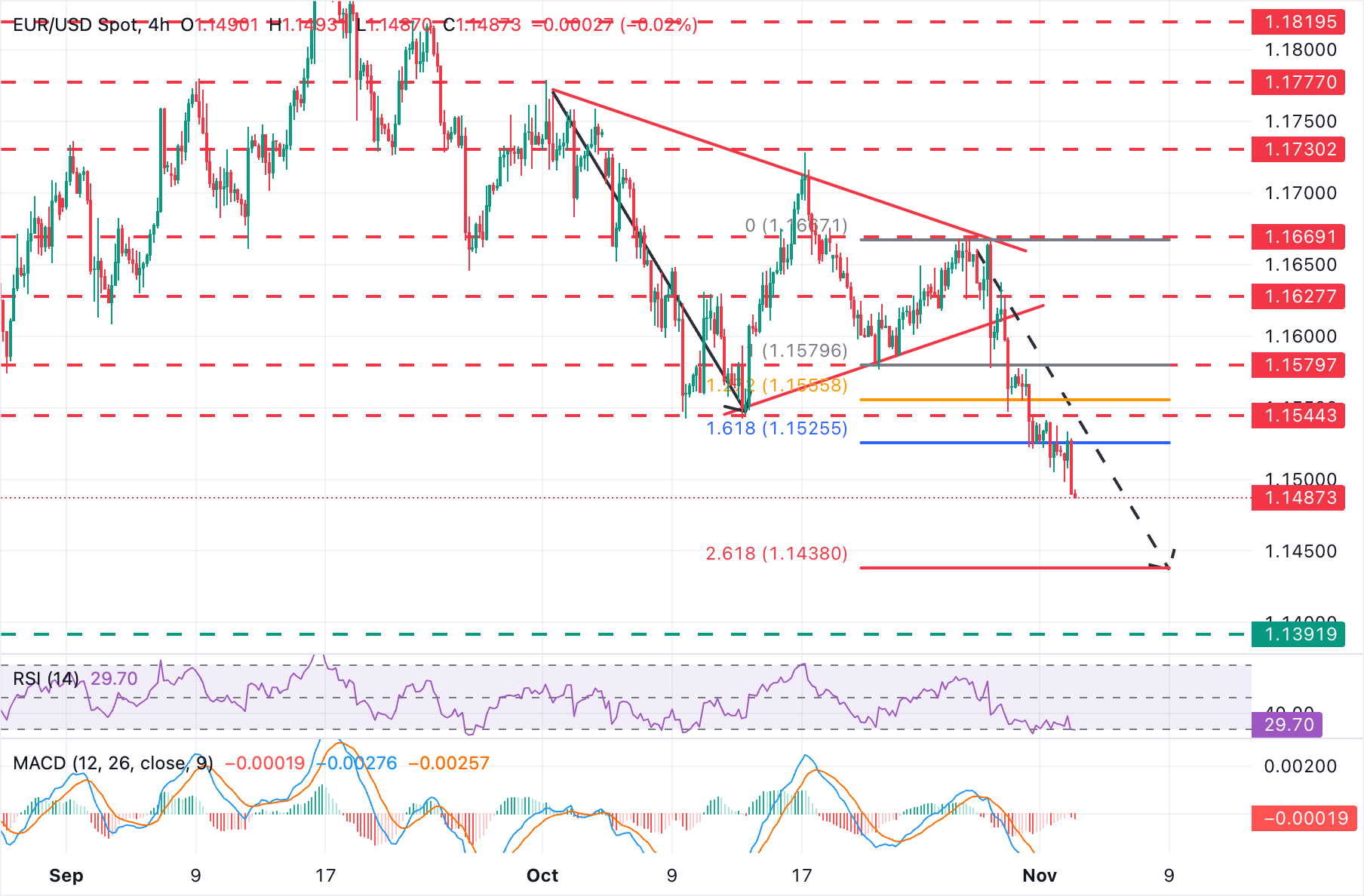
The EUR/USD failed to find acceptance above 1.1530 earlier on the day, and the pair resumed its decline to levels right below 1.1500. The 4-hour Relative Strength Index (RSI) indicator is approaching oversold levels, which might keep the pair from falling much lower on Tuesday. Nevertheless, Tuesday's price action validates the broader bearish bias.
If the pair confirms below 1.1500, there is no clear support until the measured target of the broken triangle pattern, which meets the price at the 261.8% Fibonacci retracement of the late October rally, near 1.1450. Further down, August through comes at 1.1390, although that level seems out of reach for today.
To the upside, the pair should return above the 1.1500 area to ease bearish pressure and shift the focus towards the session high at 1.1530 and the previous support area near 1.1545 (October 14, 30 lows). Further up, the next target is the October 22 and 23 lows at 1.1580
Risk sentiment FAQs
In the world of financial jargon the two widely used terms “risk-on” and “risk off'' refer to the level of risk that investors are willing to stomach during the period referenced. In a “risk-on” market, investors are optimistic about the future and more willing to buy risky assets. In a “risk-off” market investors start to ‘play it safe’ because they are worried about the future, and therefore buy less risky assets that are more certain of bringing a return, even if it is relatively modest.
Typically, during periods of “risk-on”, stock markets will rise, most commodities – except Gold – will also gain in value, since they benefit from a positive growth outlook. The currencies of nations that are heavy commodity exporters strengthen because of increased demand, and Cryptocurrencies rise. In a “risk-off” market, Bonds go up – especially major government Bonds – Gold shines, and safe-haven currencies such as the Japanese Yen, Swiss Franc and US Dollar all benefit.
The Australian Dollar (AUD), the Canadian Dollar (CAD), the New Zealand Dollar (NZD) and minor FX like the Ruble (RUB) and the South African Rand (ZAR), all tend to rise in markets that are “risk-on”. This is because the economies of these currencies are heavily reliant on commodity exports for growth, and commodities tend to rise in price during risk-on periods. This is because investors foresee greater demand for raw materials in the future due to heightened economic activity.
The major currencies that tend to rise during periods of “risk-off” are the US Dollar (USD), the Japanese Yen (JPY) and the Swiss Franc (CHF). The US Dollar, because it is the world’s reserve currency, and because in times of crisis investors buy US government debt, which is seen as safe because the largest economy in the world is unlikely to default. The Yen, from increased demand for Japanese government bonds, because a high proportion are held by domestic investors who are unlikely to dump them – even in a crisis. The Swiss Franc, because strict Swiss banking laws offer investors enhanced capital protection.
Author

Guillermo Alcala
FXStreet
Graduated in Communication Sciences at the Universidad del Pais Vasco and Universiteit van Amsterdam, Guillermo has been working as financial news editor and copywriter in diverse Forex-related firms, like FXStreet and Kantox.

















