EUR/USD regains lost ground on risk appetite, Fed easing hopes
- The Euro extends gains against the US Dollar and hits session highs nearing 1.1550.
- German Business Climate deteriorated against expectations in November
- A moderate risk appetite and higher hopes of Fed easing are weighing on the US Dollar on Monday

EUR/USD is trimming losses on Monday, following a sharp decline last week. The pair is trading near 1.1540 after bouncing at 1.1490 on Friday, favoured by a moderate risk appetite in an otherwise calm start of the week. Data released by the German IFO revealed that the business climate deteriorated in November, but it was unable to dent the Euro's (EUR) recovery.
The positive market mood triggered by the dovish comments by the New York Federal Reserve (Fed) President, John Williams, continues driving markets on Monday, and keeps the US Dollar on the defensive. Williams cheered investors on Friday, boosting hopes of further interest rate cuts in the coming months.
In the macroeconomic front, the US preliminary S&P Global Purchasing Managers' Index (PMI) and the Michigan Consumer Sentiment Index showed fairly positive readings for November, in contrast with the Eurozone PMIs, which revealed that manufacturing activity contracted against expectations, while the services sector slowed down.
Euro Price Today
The table below shows the percentage change of Euro (EUR) against listed major currencies today. Euro was the strongest against the Japanese Yen.
| USD | EUR | GBP | JPY | CAD | AUD | NZD | CHF | |
|---|---|---|---|---|---|---|---|---|
| USD | -0.22% | 0.02% | 0.30% | 0.13% | 0.12% | 0.05% | -0.06% | |
| EUR | 0.22% | 0.24% | 0.49% | 0.35% | 0.33% | 0.26% | 0.16% | |
| GBP | -0.02% | -0.24% | 0.27% | 0.11% | 0.10% | 0.01% | -0.08% | |
| JPY | -0.30% | -0.49% | -0.27% | -0.14% | -0.16% | -0.23% | -0.33% | |
| CAD | -0.13% | -0.35% | -0.11% | 0.14% | -0.01% | -0.09% | -0.19% | |
| AUD | -0.12% | -0.33% | -0.10% | 0.16% | 0.01% | -0.08% | -0.18% | |
| NZD | -0.05% | -0.26% | -0.01% | 0.23% | 0.09% | 0.08% | -0.10% | |
| CHF | 0.06% | -0.16% | 0.08% | 0.33% | 0.19% | 0.18% | 0.10% |
The heat map shows percentage changes of major currencies against each other. The base currency is picked from the left column, while the quote currency is picked from the top row. For example, if you pick the Euro from the left column and move along the horizontal line to the US Dollar, the percentage change displayed in the box will represent EUR (base)/USD (quote).
Daily digest market movers: A favourable market mood buoys the Euro
- The Euro (EUR) is regaining some losses on Monday, favoured by a mild appetite for risk, with European equity markets posting gains. Hopes of a peace deal in Ukraine are contributing to lifting investors' sentiment, although macroeconomic data is not particularly supportive.
- Earlier on Monday, the German IFO Business Climate eased to 88.1 in November, from 88.4 in October, against the market consensus of a slight improvement to 88.5. The Index measuring the current economic situation improved to 85.6 from 85.6, but the economic expectations deteriorated by a whole point, to 90.6 in November from 91.6 in October.
- On Friday, the Eurozone preliminary HCOB PMIs revealed an unexpected contraction in the manufacturing sector's activity, to a level of 49.7 from the previous month's 50 level, compared to expectations of an improvement to 50.2. The Services PMI ticked up to 53.1 from 53.0 in October, but the Composite Index eased to 52.4 from 52.5 in October.
- Likewise, German Manufacturing activity contracted further in November, with the preliminary HCOB Manufacturing PMI declining to 48.4 from October's 49.6, while services activity eased to 52.7 from 54.6, well below market expectations of a 53.9 reading, highlighting the soft momentum of the region's leading economy.
- In the US, the S&P Global preliminary Manufacturing PMI slowed down to 51.9 in November from 52.5 in October, below the 52.0 expected, but Services PMI beat expectations with a 55.0 reading against the market consensus of a steady 54.8 reading. The composite Index rose to 54.8 from 54.6.
- Furthermore, the US Michigan Consumer Sentiment Index improved to 51 in November, from 50.3 in October, exceeding the market consensus of a 50.5 reading. The index measuring the economic expectations also rose, to 51 from 49 in the previous month.
- The impact of the positive macroeconomic figures was offset by Fed William's comments hinting at the possibility of further monetary easing "in the near term" as, in his opinion, the bank has margin to cut interest rates further without risking its inflation goal.
- Later on the day, European Central Bank President Christine Lagarde is expected to speak about Artificial Intelligence and Education at a forum in Bratislava, Slovakia.
Technical Analysis: EUR/USD resistance at 1.1550 will challenge bulls
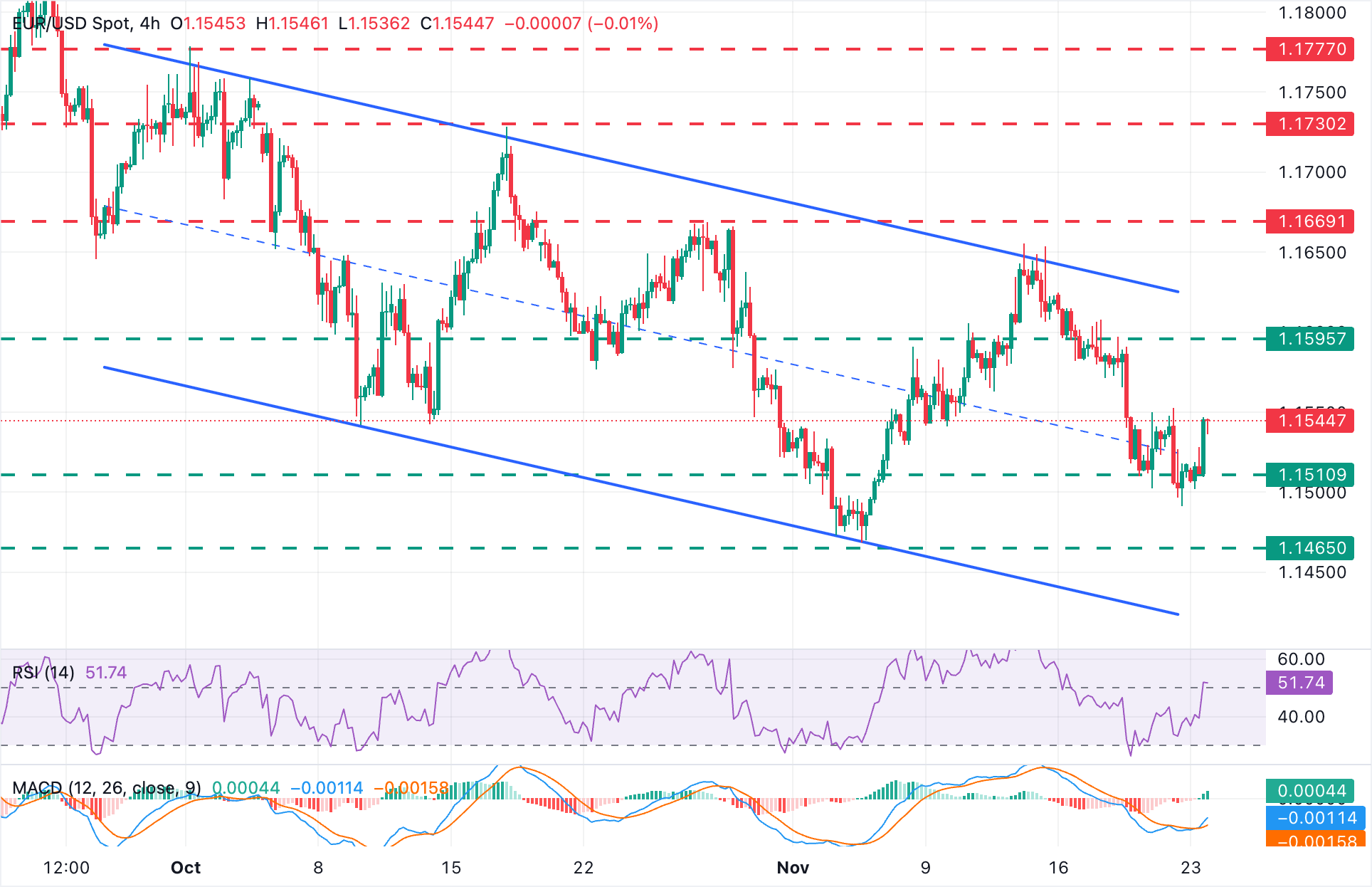
The EUR/USD is gathering momentum on Monday, although the broader bearish trend is still in play. The 4-hour Relative Strength Index (RSI) has popped up above the 50 level, and the Moving Average Convergence Divergence (MACD) indicator crossed above the signal line, highlighting an incipient bullish momentum.
Bulls are likely to meet resistance at the 1.1550 level, which held bulls on Thursday and Friday. The pair should break that level to confirm a bullish reaction and aim for the November 18 and 19 highs near 1.1600 and to the top of a descending channel from the mid-October highs, which is now around 1.1625.
On the downside, the 1.1500 psychological level remains at a dangerously short distance. Further down, the next targets would be the November 5 lows, near 1.1470, and the mentioned channel support, around 1.1425.
Euro FAQs
The Euro is the currency for the 20 European Union countries that belong to the Eurozone. It is the second most heavily traded currency in the world behind the US Dollar. In 2022, it accounted for 31% of all foreign exchange transactions, with an average daily turnover of over $2.2 trillion a day. EUR/USD is the most heavily traded currency pair in the world, accounting for an estimated 30% off all transactions, followed by EUR/JPY (4%), EUR/GBP (3%) and EUR/AUD (2%).
The European Central Bank (ECB) in Frankfurt, Germany, is the reserve bank for the Eurozone. The ECB sets interest rates and manages monetary policy. The ECB’s primary mandate is to maintain price stability, which means either controlling inflation or stimulating growth. Its primary tool is the raising or lowering of interest rates. Relatively high interest rates – or the expectation of higher rates – will usually benefit the Euro and vice versa. The ECB Governing Council makes monetary policy decisions at meetings held eight times a year. Decisions are made by heads of the Eurozone national banks and six permanent members, including the President of the ECB, Christine Lagarde.
Eurozone inflation data, measured by the Harmonized Index of Consumer Prices (HICP), is an important econometric for the Euro. If inflation rises more than expected, especially if above the ECB’s 2% target, it obliges the ECB to raise interest rates to bring it back under control. Relatively high interest rates compared to its counterparts will usually benefit the Euro, as it makes the region more attractive as a place for global investors to park their money.
Data releases gauge the health of the economy and can impact on the Euro. Indicators such as GDP, Manufacturing and Services PMIs, employment, and consumer sentiment surveys can all influence the direction of the single currency. A strong economy is good for the Euro. Not only does it attract more foreign investment but it may encourage the ECB to put up interest rates, which will directly strengthen the Euro. Otherwise, if economic data is weak, the Euro is likely to fall. Economic data for the four largest economies in the euro area (Germany, France, Italy and Spain) are especially significant, as they account for 75% of the Eurozone’s economy.
Another significant data release for the Euro is the Trade Balance. This indicator measures the difference between what a country earns from its exports and what it spends on imports over a given period. If a country produces highly sought after exports then its currency will gain in value purely from the extra demand created from foreign buyers seeking to purchase these goods. Therefore, a positive net Trade Balance strengthens a currency and vice versa for a negative balance.
Author

Guillermo Alcala
FXStreet
Graduated in Communication Sciences at the Universidad del Pais Vasco and Universiteit van Amsterdam, Guillermo has been working as financial news editor and copywriter in diverse Forex-related firms, like FXStreet and Kantox.














