EUR/USD hovers near weekly lows amid strong US data, India trade deal
- EUR/USD retreats below 1.1800 and is testing one-week lows at the 1.1770 area.
- News of a trade deal with India and upcoming talks with Iran are supporting the US Dollar.
- A partial US government shutdown will delay key US labour data scheduled for this week.

The Euro (EUR) has given away previous gains against the US Dollar (USD) on Tuesday, returning below 1.1800, and trading at 1.1780 at the time of writing. Strong manufacturing data in the US and news of a trade deal between the US and India provided additional support to the US Dollar on Monday and eased concerns about a partial US government shutdown.
US President Donald Trump announced a deal with India that will reduce tariffs on Indian products to 18% from the current 50%. Beyond that, Iran's president, Masoud Pezeshkian, said on Tuesday that Tehran will start nuclear negotiations with the US, which has contributed to easing tensions in the region, and provided additional support to the Greenback.
Macroeconomic data was also US Dollar supportive on Monday. The US ISM Manufacturing Purchasing Managers' Index (PMI) improved beyond expectations, offsetting concerns about a partial government shutdown that will delay Friday's Nonfarm Payrolls (NFP) report.
In the economic calendar on Tuesday, the main focus will be on the speeches of Richmond Federal Reserve (Fed) President Thomas Barkin and Governor Michelle Bowman. Investors, however, are likely to maintain a "wait-and-see stance", ahead of Wednesday's US ADP Employment report, which will be observed with particular interest, and Thursday's European Central Bank (ECB) monetary policy decision.
Euro Price Today
The table below shows the percentage change of Euro (EUR) against listed major currencies today. Euro was the strongest against the Japanese Yen.
| USD | EUR | GBP | JPY | CAD | AUD | NZD | CHF | |
|---|---|---|---|---|---|---|---|---|
| USD | 0.04% | 0.07% | 0.25% | 0.07% | -0.75% | -0.45% | -0.13% | |
| EUR | -0.04% | 0.03% | 0.20% | 0.03% | -0.80% | -0.49% | -0.17% | |
| GBP | -0.07% | -0.03% | 0.19% | 0.00% | -0.82% | -0.51% | -0.19% | |
| JPY | -0.25% | -0.20% | -0.19% | -0.16% | -0.99% | -0.69% | -0.36% | |
| CAD | -0.07% | -0.03% | -0.00% | 0.16% | -0.82% | -0.52% | -0.20% | |
| AUD | 0.75% | 0.80% | 0.82% | 0.99% | 0.82% | 0.31% | 0.63% | |
| NZD | 0.45% | 0.49% | 0.51% | 0.69% | 0.52% | -0.31% | 0.32% | |
| CHF | 0.13% | 0.17% | 0.19% | 0.36% | 0.20% | -0.63% | -0.32% |
The heat map shows percentage changes of major currencies against each other. The base currency is picked from the left column, while the quote currency is picked from the top row. For example, if you pick the Euro from the left column and move along the horizontal line to the US Dollar, the percentage change displayed in the box will represent EUR (base)/USD (quote).
Daily Digest market Movers: The Dollar strengthens further on upbeat US data
- A firmer US Dollar drew additional support from factory data released on Monday. The US ISM Manufacturing PMI rose to 52.6 in January, its best reading in more than three years, from 47.9 in December and beating expectations of a 48.5 reading.
- Likewise, the US S&P Global Manufacturing PMI was revised up to 52.4 in January from the 51.9 reading released by preliminary estimations.
- Also on Monday, Trump announced a trade deal with China, by which the Asian country commits to buy US Oil, defence goods, and aircraft, and partially open its agriculture sector to US products in exchange for reduced trade tariffs.
- Investors have shrugged off a partial government shutdown after Congress failed to approve funding for some of the federal agencies. The Senate has approved the bill to reopen these agencies, which now heads to the House of Representatives, which is expected to vote on Tuesday. Labour data for this week, including JOTLS Job Openings and the Nonfarm Payrolls reports, will be delayed.
Technical Analysis: EUR/USD remains weak with 1.1770 support in play
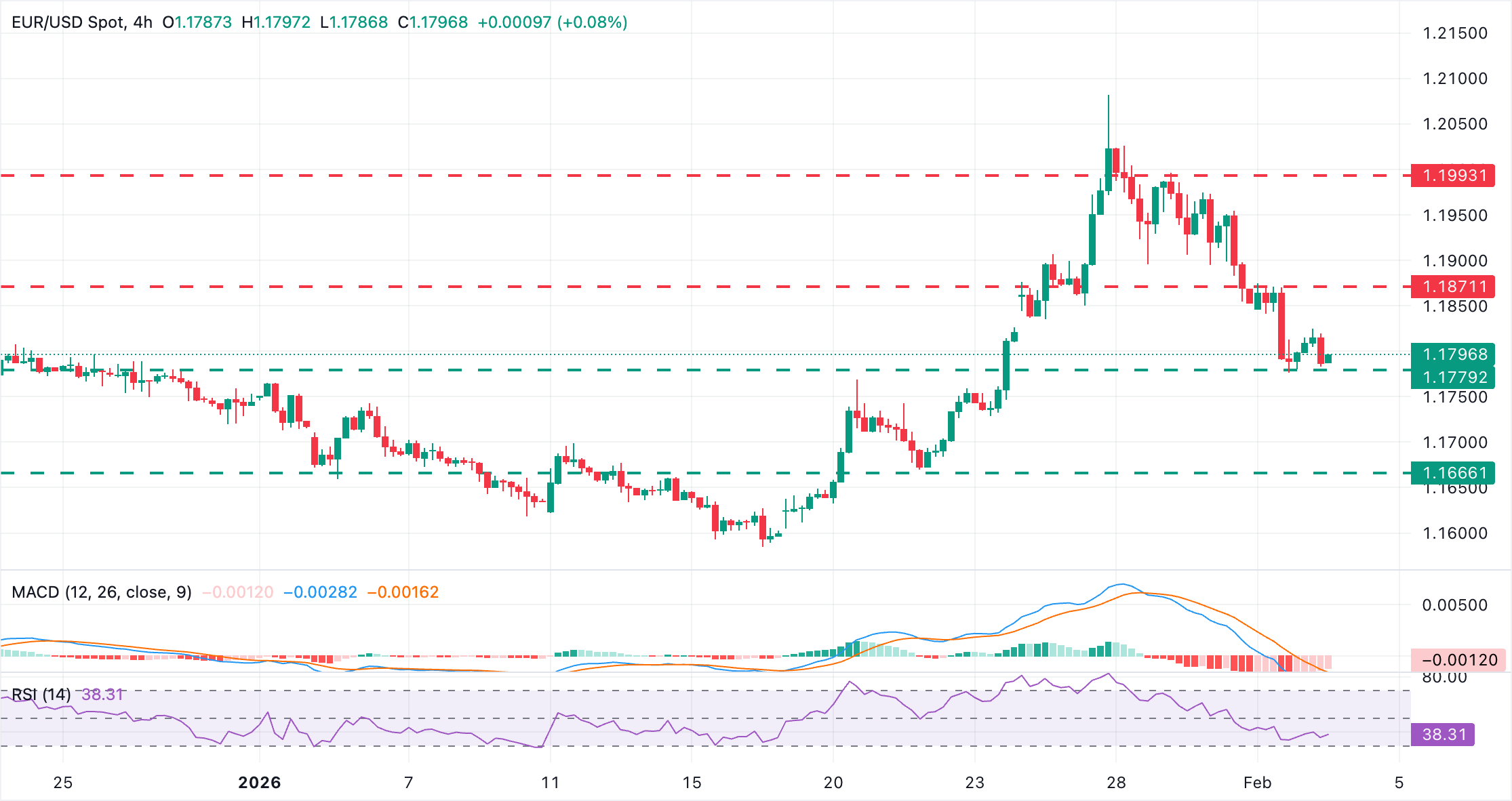
The EUR/USD languishes near recent lows following a 2.5% reversal from last week's lows. The immediate trend remains bearish. The Relative Strength Index (RSI) in the 4-hour chart remains capped below 40, highlighting moderate bearish momentum. The Moving Average Convergence Divergence (MACD) histogram, on the other hand, features contracting red bars, which suggests that selling pressure is easing.
The pair has found some footing, although bulls are likely to be challenged at Monday's high of 1.1875. Further up, the target is the January 30 high near 1.1975, ahead of the 1.2000 round level.
On the downside, support at the 1.1770 area (January 20 high) remains on the bears' focus. A confirmation below that level would add pressure towards the January 21, 22 lows near the 1.1665 area.
Economic Indicator
Fed's Barkin speech
Thomas I. Barkin became the eighth president and CEO of the Federal Reserve Bank of Richmond on January 1, 2018. He served on the executive committee of the Metro Atlanta Chamber of Commerce, Emory University Board of Trustees member, and was also a former board member and chairman of the Federal Reserve Bank of Atlanta.
Read more.Next release: Tue Feb 03, 2026 13:00
Frequency: Irregular
Consensus: -
Previous: -
Source: Federal Reserve
Economic Indicator
Fed's Bowman speech
Michelle W. Bowman" is an American attorney and the Vice Chair for Supervision on the Board of Governors of the Federal Reserve. Bowman has served as a member of the Board of Governors since taking office on November 26, 2018, and her term ends on January 31, 2034.
Read more.Next release: Tue Feb 03, 2026 14:40
Frequency: Irregular
Consensus: -
Previous: -
Source: Federal Reserve
Author

Guillermo Alcala
FXStreet
Graduated in Communication Sciences at the Universidad del Pais Vasco and Universiteit van Amsterdam, Guillermo has been working as financial news editor and copywriter in diverse Forex-related firms, like FXStreet and Kantox.
















