EUR/USD briefly surges after Fed cuts interest rates
- The Fed has finally cut interest rates for the first time since December.
- SEP sees more rate moves lower than previous, sparking risk appetite.
- Fed Chair Powell cautioned that rates aren't on a preset course.


The Federal Reserve (Fed) delivered a quarter-point interest rate cut, as markets had widely predicted. With the Fed moving to make its first rate cut in nine months, investors are immediately moving the goalposts to focus on how many rate cuts the Fed is expected to deliver through the remainder of 2025.
The Fed's Summary of Economic Projections (SEP) also showed Fed officials expect further Fed rate moves looking forward. According to the dot plot, the majority of Fed policymakers expect interest rates to land somewhere around 3.5-3.75% by year's end, paving the way for two additional rate trims through December.
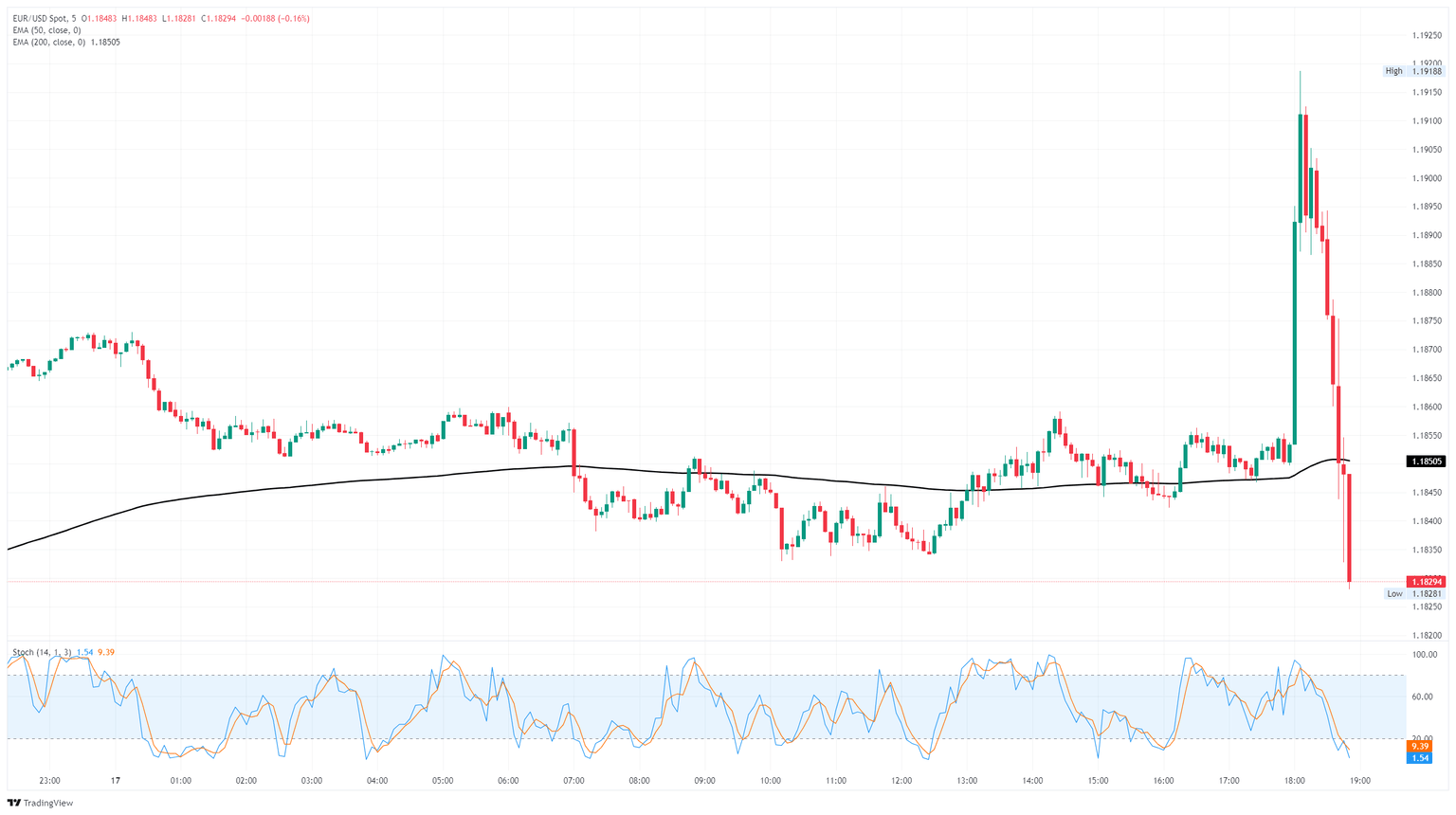
EUR/USD briefly lurched into fresh highs on reaction, clawing toward 1.1900 and vaulting into four-year highs. However, Fed Chair Jerome Powell cautioned during his post-rate call press conference that the Fed is still tracking data from one release to the next, warning that the SEP is not a "preset course".
EUR/USD 5-minute chart
Fed FAQs
Monetary policy in the US is shaped by the Federal Reserve (Fed). The Fed has two mandates: to achieve price stability and foster full employment. Its primary tool to achieve these goals is by adjusting interest rates. When prices are rising too quickly and inflation is above the Fed’s 2% target, it raises interest rates, increasing borrowing costs throughout the economy. This results in a stronger US Dollar (USD) as it makes the US a more attractive place for international investors to park their money. When inflation falls below 2% or the Unemployment Rate is too high, the Fed may lower interest rates to encourage borrowing, which weighs on the Greenback.
The Federal Reserve (Fed) holds eight policy meetings a year, where the Federal Open Market Committee (FOMC) assesses economic conditions and makes monetary policy decisions. The FOMC is attended by twelve Fed officials – the seven members of the Board of Governors, the president of the Federal Reserve Bank of New York, and four of the remaining eleven regional Reserve Bank presidents, who serve one-year terms on a rotating basis.
In extreme situations, the Federal Reserve may resort to a policy named Quantitative Easing (QE). QE is the process by which the Fed substantially increases the flow of credit in a stuck financial system. It is a non-standard policy measure used during crises or when inflation is extremely low. It was the Fed’s weapon of choice during the Great Financial Crisis in 2008. It involves the Fed printing more Dollars and using them to buy high grade bonds from financial institutions. QE usually weakens the US Dollar.
Quantitative tightening (QT) is the reverse process of QE, whereby the Federal Reserve stops buying bonds from financial institutions and does not reinvest the principal from the bonds it holds maturing, to purchase new bonds. It is usually positive for the value of the US Dollar.
Author
Joshua Gibson
FXStreet
Joshua joins the FXStreet team as an Economics and Finance double major from Vancouver Island University with twelve years' experience as an independent trader focusing on technical analysis.