EUR/USD falls back as US Dollar rebounds, US stagflation risks remain intact
- EUR/USD retreats as the US Dollar rebounds despite an escalating US-China trade war.
- US consumer sentiment has deteriorated, and one-year forward inflation expectations have accelerated in April.
- The ECB is expected to cut interest rates on Thursday.

EUR/USD surrenders a majority of intraday gains and falls back from the high of 1.1400 to near 1.1330 in Monday’s North American session. The major currency pair struggles to reclaim the over-three-year high of 1.1474, which it posted on Friday. The pair gives up gains as the US Dollar (USD) bounces back despite growing fears of United States (US) stagflation, a situation in which inflation increases, the economy deteriorates, and employment cools down.
The US Dollar Index (DXY), which gauges the Greenback’s value against six major currencies, rebounds to near 100.00 after revisiting the recent lows of 99.00.
Financial market participants are anticipating US stagflation amid deteriorating consumer sentiment and de-anchoring consumer inflation expectations. The University of Michigan (UoM) showed on Friday that the preliminary Consumer Sentiment Index came in significantly lower at 50.8 in April, the lowest level seen since June 2022. US households are worried about the deepening risks of a recession due to the escalating tariff war with China.
On Friday, China raised counter-tariffs on US goods imports to 125%, effective on Saturday. The Asian giant retaliated after US President Donald Trump increased tariffs on Chinese imports to 145%. Market participants expect the scenario of retaliation and countermeasures by both nations to hinder plans of fresh investments by business owners, which eventually would result in moderate economic growth.
Meanwhile, flash 12-month forward UoM Consumer Inflation Expectations accelerated to 6.7% in April from 5% in March. Declining consumer sentiment and soaring consumer inflation expectations are expected to dampen the Federal Reserve’s (Fed) efforts to bring price pressures down in the last few years.
On Friday, St. Louis Fed Bank President Alberto Musalem said that if the public begins to expect “inflation will remain high over the long term”, the job of restoring “price stability and maximum employment would be much more difficult".
Daily digest market movers: EUR/USD surrenders gains as US Dollar strives to gain ground
- EUR/USD flattens amid uncertainty over the Euro's (EUR) outlook at the start of monetary policy week. The European Central Bank (ECB) is scheduled to announce its interest rate decision on Thursday, and it is expected to cut its Deposit Facility Rate by 25 basis points (bps) to 2.25%. This would be the seventh 25 bps interest rate reduction by the ECB since June.
- Traders have become increasingly confident that the ECB will cut interest rates again amid expectations that the Trump-driven trade war will not be inflationary for the Eurozone. Investors expect that the escalating tariff war between the US and China would force the latter to export its products to the old continent. Eurozone importers would prefer Chinese products over domestically produced goods, given China’s low-cost competitive advantage. Such a scenario would offset the impact of Trump’s tariff-led inflation.
- Last week, ECB Governing Council member Gediminas Šimkus said that a “25 bps rate cut is needed in April.” Šimkus added that the US tariff announcement warrants “more accommodative” monetary policy, and therefore, we need to move to a “less restrictive policy stance”.
- On trade relations with the US, European Union (EU) finance ministers have pledged unity in negotiating a trade deal with Washington. The unified response from the Euro area would slightly improve their position while discussing trade talks with the White House. The comments from White House Economic Adviser Kevin Hasset in his interview with Fox Business have indicated positive development in trade deal with the shared continent. Hassett said that Washington is making enormous progress" on tariff talks with the EU.
Technical Analysis: EUR/USD holds all short-to-long term EMAs
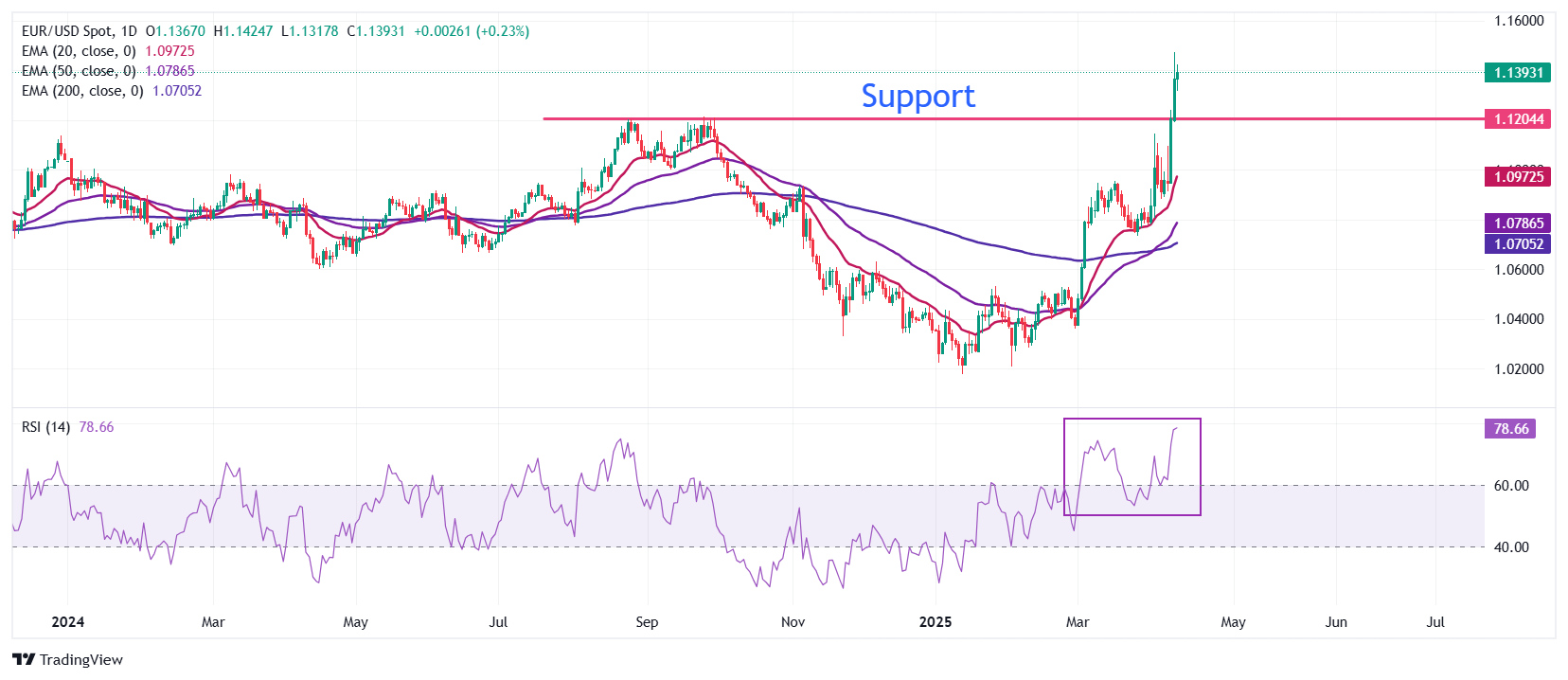
EUR/USD rises to near 1.1400 during North American trading hours on Monday. The major currency pair trades firmly as all short-to-long Exponential Moving Averages (EMAs) slope higher, suggesting a strong uptrend.
The 14-day Relative Strength Index (RSI) jumps to near 80.00, indicating a strong bullish momentum.
Looking up, the psychological resistance of 1.1500 will be the major resistance for the pair. Conversely, the 1.1200 region, which limited the EUR/USD advance in August and September, will be the key support for the Euro bulls.
Economic Indicator
Michigan Consumer Sentiment Index
The Michigan Consumer Sentiment Index, released on a monthly basis by the University of Michigan, is a survey gauging sentiment among consumers in the United States. The questions cover three broad areas: personal finances, business conditions and buying conditions. The data shows a picture of whether or not consumers are willing to spend money, a key factor as consumer spending is a major driver of the US economy. The University of Michigan survey has proven to be an accurate indicator of the future course of the US economy. The survey publishes a preliminary, mid-month reading and a final print at the end of the month. Generally, a high reading is bullish for the US Dollar (USD), while a low reading is bearish.
Read more.Last release: Fri Apr 11, 2025 14:00 (Prel)
Frequency: Monthly
Actual: 50.8
Consensus: 54.5
Previous: 57
Source: University of Michigan
Consumer exuberance can translate into greater spending and faster economic growth, implying a stronger labor market and a potential pick-up in inflation, helping turn the Fed hawkish. This survey’s popularity among analysts (mentioned more frequently than CB Consumer Confidence) is justified because the data here includes interviews conducted up to a day or two before the official release, making it a timely measure of consumer mood, but foremost because it gauges consumer attitudes on financial and income situations. Actual figures beating consensus tend to be USD bullish.
BRANDED CONTENT
Finding the right broker for trading EUR/USD is crucial, and we've identified the top choices for this major currency pair. Read about their unique features to make an informed decision.
Author

Sagar Dua
FXStreet
Sagar Dua is associated with the financial markets from his college days. Along with pursuing post-graduation in Commerce in 2014, he started his markets training with chart analysis.

















