EUR/USD steady near 1.1485 as Fed caps gains, Trump delays Iran decision
- EUR/USD remains flat as markets digest the Fed’s pause and rising Middle East uncertainty.
- White House says Trump to decide on Iran action within the next two weeks.
- ECB officials warn about the Euro's global role as traders await German and US data.


EUR/USD is virtually unchanged on Thursday amid deteriorating risk appetite and growing speculation that the United States (US) could become involved in the Middle East conflict. The White House poured cold water on those rumors, stating that Trump will decide on attack Iran "within the next two weeks." At the time of writing, the pair trades at 1.1485, unmoved since late in the European session.
US markets remain closed in observance of the Juneteenth holiday. Still, US equity futures are pointing downwards, hinting that sentiment remains sour amid uncertainty over the Middle East conflict. This, along with a pause in trade talks between the US and its peers, keeps investors on their toes, assessing what is to come next.
The Federal Reserve (Fed) decided to keep rates unchanged on Wednesday and updated its economic projections. Regarding inflation, officials have noted prices above the 3% threshold, which has prevented the central bank from implementing rate cuts. In 2025, policymakers project 50 basis points (bps) of easing, and for 2026, just 25 bps.
The slight hawkish tilt by the Fed capped the Euro’s advance. Meanwhile, Fed Chair Jerome Powell said they’re in wait-and-see mode, adding that policy is modestly restrictive. He added that as long as the labor market remains solid and inflation cools down, holding rates is the “right thing to do.”
Across the pond, European Central Bank (ECB) officials crossed the wires, amid an anemic schedule. They made comments about the risks associated with monetary policy, as well as the Euro's status as a global currency, similar to the US Dollar.
Up next, the US economic docket will feature the Philadelphia Fed Manufacturing Index survey. In the Eurozone, investors will eye German Industrial Production for May.
Euro PRICE This week
The table below shows the percentage change of Euro (EUR) against listed major currencies this week. Euro was the strongest against the Canadian Dollar.
| USD | EUR | GBP | JPY | CAD | AUD | NZD | CHF | |
|---|---|---|---|---|---|---|---|---|
| USD | 0.37% | 0.72% | 0.58% | 0.85% | 0.12% | 0.46% | 0.61% | |
| EUR | -0.37% | 0.23% | 0.20% | 0.48% | -0.13% | 0.09% | 0.24% | |
| GBP | -0.72% | -0.23% | -0.02% | 0.25% | -0.36% | -0.14% | 0.00% | |
| JPY | -0.58% | -0.20% | 0.02% | 0.26% | -0.77% | -0.48% | -0.38% | |
| CAD | -0.85% | -0.48% | -0.25% | -0.26% | -0.65% | -0.39% | -0.25% | |
| AUD | -0.12% | 0.13% | 0.36% | 0.77% | 0.65% | 0.22% | 0.38% | |
| NZD | -0.46% | -0.09% | 0.14% | 0.48% | 0.39% | -0.22% | 0.15% | |
| CHF | -0.61% | -0.24% | -0.01% | 0.38% | 0.25% | -0.38% | -0.15% |
The heat map shows percentage changes of major currencies against each other. The base currency is picked from the left column, while the quote currency is picked from the top row. For example, if you pick the Euro from the left column and move along the horizontal line to the US Dollar, the percentage change displayed in the box will represent EUR (base)/USD (quote).
Daily digest market movers: EUR/USD holds firm despite the Fed leaning hawkish
- Geopolitics will continue to drive price action, which so far has benefited further US Dollar appreciation. Hence, a risk-off environment is most likely to push the EUR/USD downwards, even though the 'Sell America' trade remains intact.
- Fed Chair Jerome Powell signals that rates could remain on hold for some time due to the unknown effects of tariffs and uncertainty. He said, “The effects of tariffs will depend on the level.” Powell added, “As long as we have the kind of labor market we have and inflation coming down, the right thing to do is hold rates.”
- The Summary of Economic Projections (SEP) showed a slight downgrade in the 2025 GDP growth outlook to 1.4% from 1.7% in March. The unemployment rate forecast was revised up to 4.5% from 4.4%, while the core PCE inflation projection rose to 3.1% from 2.8%.
- ECB Rehn says the European Union (EU) risks a stagflation shock if the Israel-Iran crisis deepens. Villeroy added that normalization of monetary policy is a “very positive step”, but keeps the door open for further adjustments.
- ECB’s Nagel added that more can be done to make the Euro more attractive for investors.
- The latest rise in Oil prices, sparked by the Middle East conflict, could trigger an inflation spiral, pushing prices higher and prompting central banks to become slightly hawkish.
- Financial market players do not expect that the ECB will reduce its Deposit Facility Rate by 25 basis points (bps) at the July monetary policy meeting.
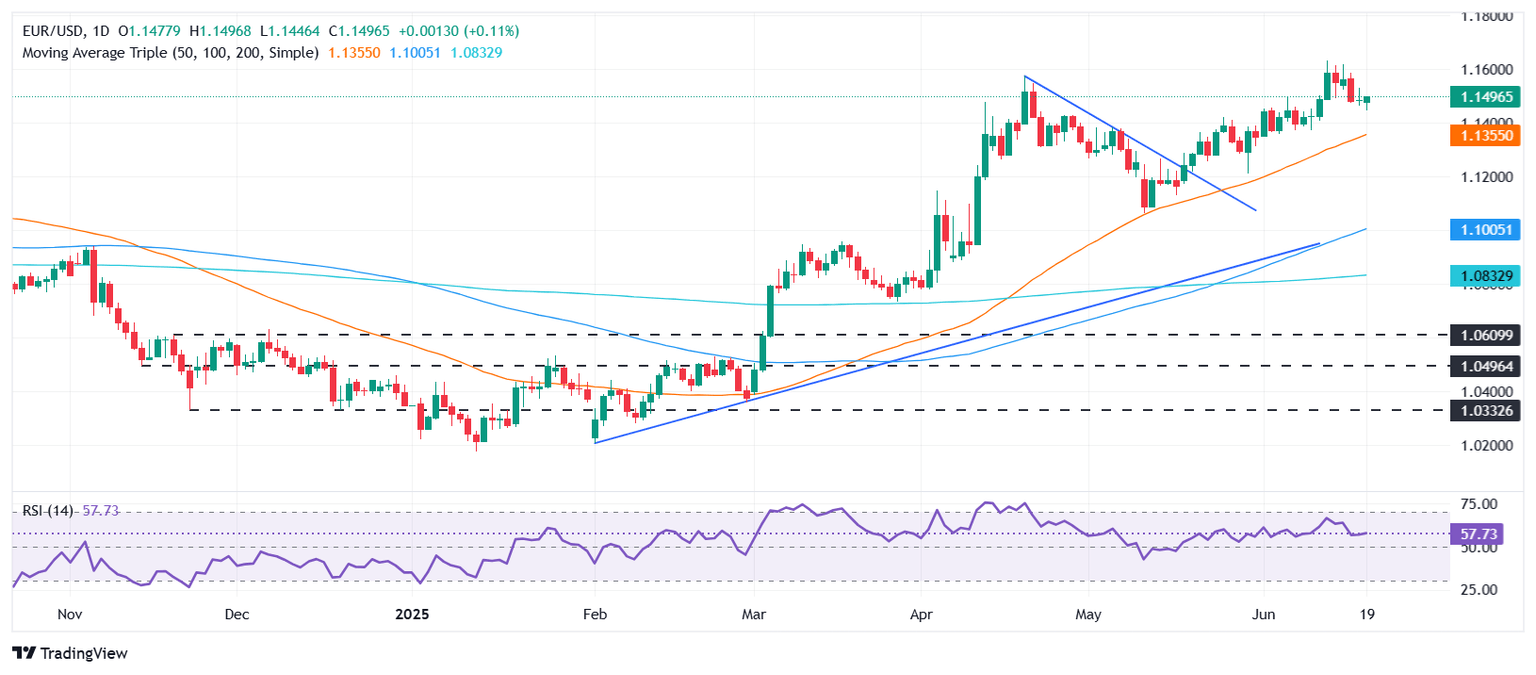
EUR/USD technical outlook: Consolidates near 1.1500 after testing weekly lows of 1.1458
The EUR/USD uptrend remains in play. Earlier, the pair tested the 20-day Simple Moving Average (SMA) at 1.1430 but bounced off the day’s low of 1.1458 and climbed towards the 1.1500 mark.
For a bullish continuation, the pair needs to clear 1.1500 and the June 17 high of 1.1578. If surpassed, the next stop would be 1.1600, followed by the yearly high of 1.1631. Conversely, a daily close below 1.1500 paves the way for a challenge of 1.1450. The next key support would be the 20-day Simple Moving Average (SMA) at 1.1419, followed by 1.1400.
Euro FAQs
The Euro is the currency for the 19 European Union countries that belong to the Eurozone. It is the second most heavily traded currency in the world behind the US Dollar. In 2022, it accounted for 31% of all foreign exchange transactions, with an average daily turnover of over $2.2 trillion a day. EUR/USD is the most heavily traded currency pair in the world, accounting for an estimated 30% off all transactions, followed by EUR/JPY (4%), EUR/GBP (3%) and EUR/AUD (2%).
The European Central Bank (ECB) in Frankfurt, Germany, is the reserve bank for the Eurozone. The ECB sets interest rates and manages monetary policy. The ECB’s primary mandate is to maintain price stability, which means either controlling inflation or stimulating growth. Its primary tool is the raising or lowering of interest rates. Relatively high interest rates – or the expectation of higher rates – will usually benefit the Euro and vice versa. The ECB Governing Council makes monetary policy decisions at meetings held eight times a year. Decisions are made by heads of the Eurozone national banks and six permanent members, including the President of the ECB, Christine Lagarde.
Eurozone inflation data, measured by the Harmonized Index of Consumer Prices (HICP), is an important econometric for the Euro. If inflation rises more than expected, especially if above the ECB’s 2% target, it obliges the ECB to raise interest rates to bring it back under control. Relatively high interest rates compared to its counterparts will usually benefit the Euro, as it makes the region more attractive as a place for global investors to park their money.
Data releases gauge the health of the economy and can impact on the Euro. Indicators such as GDP, Manufacturing and Services PMIs, employment, and consumer sentiment surveys can all influence the direction of the single currency. A strong economy is good for the Euro. Not only does it attract more foreign investment but it may encourage the ECB to put up interest rates, which will directly strengthen the Euro. Otherwise, if economic data is weak, the Euro is likely to fall. Economic data for the four largest economies in the euro area (Germany, France, Italy and Spain) are especially significant, as they account for 75% of the Eurozone’s economy.
Another significant data release for the Euro is the Trade Balance. This indicator measures the difference between what a country earns from its exports and what it spends on imports over a given period. If a country produces highly sought after exports then its currency will gain in value purely from the extra demand created from foreign buyers seeking to purchase these goods. Therefore, a positive net Trade Balance strengthens a currency and vice versa for a negative balance.
Author
Christian Borjon Valencia
FXStreet
Christian Borjon began his career as a retail trader in 2010, mainly focused on technical analysis and strategies around it. He started as a swing trader, as he used to work in another industry unrelated to the financial markets.