EUR/USD steady beneath 1.16, traders await US shutdown vote, Fed clarity
- EUR/USD consolidates near 1.1590 as investors await House vote on stopgap bill to end prolonged US shutdown.
- Fed officials deliver mixed messages, with Williams signaling balance-sheet expansion and Bostic stressing price stability.
- German inflation holds steady near ECB’s 2% goal as traders gauge diverging central bank policy paths.

The Euro consolidates for the second straight day unable to crack the 1.1600 figure as risk appetite improve due to the imminent re-opening of the US government as the House of Representatives votes on the stopgap funding bill.
Euro holds firm amid optimism for government reopening while mixed Fed rhetoric clouds December rate-cut outlook
Late on Sunday, the US Senate passed a bill aimed to lift the shutdown, which now its on is way to the lower house. According to Steve Scalise, leader of the Republicans, the vote will be featured near 7:00 PM ET he said on CNBC.
Approval of the bill will release a tranche of economic data pending to be released, except for October’s inflation and jobs data according to the White House press secretary.
Federal Reserve officials are grabbing the headline amid a scarce economic docket. New York Fed John Williams talked about a resumption of the balance sheet expansion, while Atlanta’s Fed Raphael Bostic was hawkish favoring price stability over jobs, commenting that there’s no evidence of a sharp deterioration on the labor market.
Regarding monetary policy, a Wall Street Journal headline read “The Fed is Increasingly Torn Over a December Interest-Rate Cut,” hinting that the Federal Open Market Committee (FOMC) division between supporting the labor market or battling stubbornly sticky high inflation.
Across the pond, inflation in Germany was steady in October, close to the European Central Bank (ECB) 2% goal.
Daily market movers: EUR/USD holds firm around 1.1580
- The US Dollar Index (DXY), which tracks the performance of the American currency against other six, holds firm at around 99.49 up my a modest 0.02%.
- Boston Fed President Susan Collins said that “Elevated inflation warrants still mildly restrictive policy,” adding that she have not seen “increase in downside employment risks since the Summer.”
- The latest US employment data gave hints of weakness in the labor market. ADP revealed that private companies slashed an average of 11,250 jobs a week, in the four weeks ending October 25. At the same time, Challenger, Gray & Christmas announced that US employers slashed 153,074 jobs in October, up from the 55,597 cuts announced in October 2024, the highest level for that month in two decades.
- Regarding monetary policy, money markets now see a 60% probability of a quarter of a percentage cut at the Fed's meeting in December, according to CME Group's FedWatch tool.
- ECB policymaker Isabel Schnabel said there is “positive underlying momentum” in the euro area economy but noted that services inflation remains sticky. She added that inflation risks are “tilted slightly to the upside,” emphasizing that policymakers should focus on core inflation dynamics.
- Meanwhile, German inflation data released Wednesday confirmed that HICP rose 0.3% month-on-month in October and 2.3% year-on-year — a touch below September’s 2.4% annual reading — signaling a mild easing in price pressures.
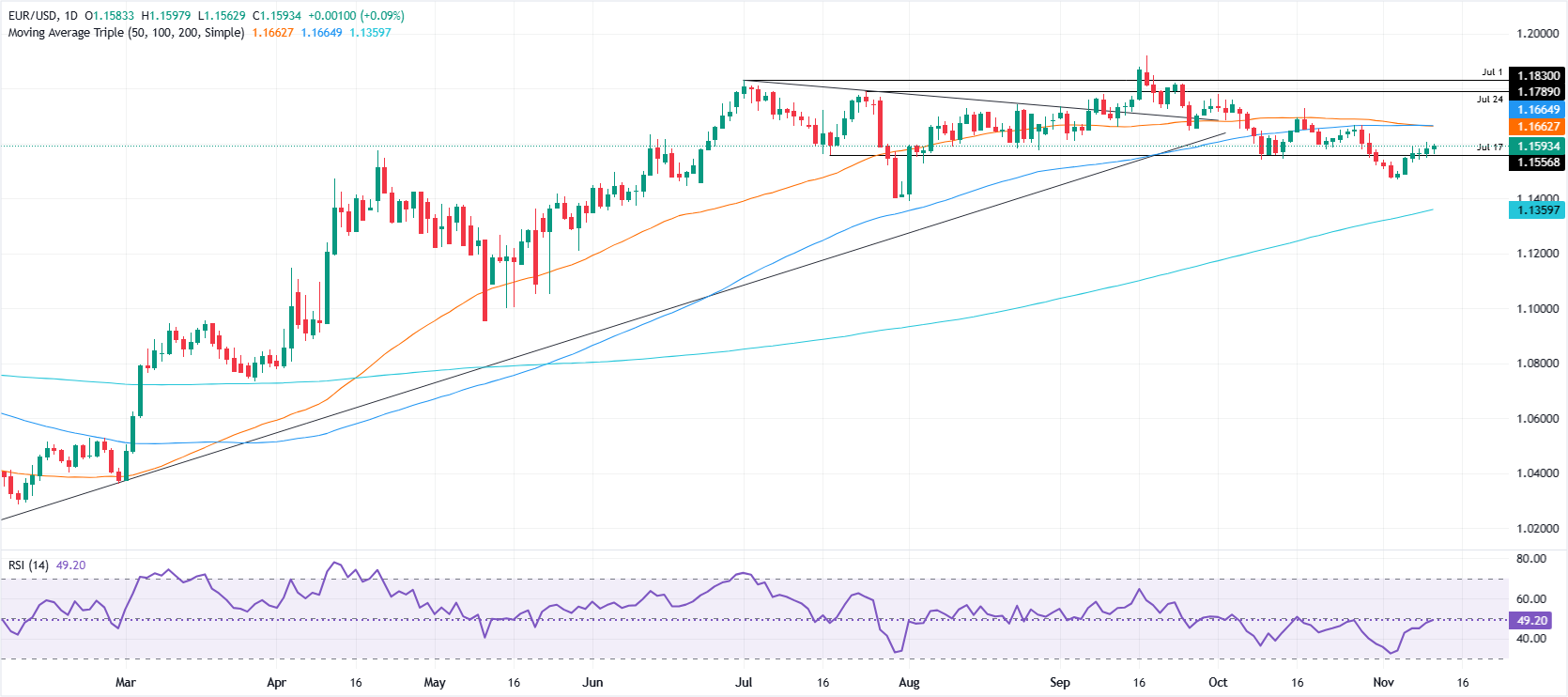
Technical outlook: EUR/USD remains subdued around 1.1600
EUR/USD retains a bearish tone, even as sellers struggle to push the pair toward the 200-day Simple Moving Average (SMA) at 1.1368. The Relative Strength Index (RSI) shows buyers regaining some traction but remains below the neutral 50 line, flattish, an indication that bears are still in control.
A sustained move below 1.1500 would expose the August 1 cycle low at 1.1391, reinforcing the broader downtrend. Conversely, a clear break above 1.1600 would shift near-term sentiment and open the door for a move toward 1.1700.
Euro FAQs
The Euro is the currency for the 20 European Union countries that belong to the Eurozone. It is the second most heavily traded currency in the world behind the US Dollar. In 2022, it accounted for 31% of all foreign exchange transactions, with an average daily turnover of over $2.2 trillion a day. EUR/USD is the most heavily traded currency pair in the world, accounting for an estimated 30% off all transactions, followed by EUR/JPY (4%), EUR/GBP (3%) and EUR/AUD (2%).
The European Central Bank (ECB) in Frankfurt, Germany, is the reserve bank for the Eurozone. The ECB sets interest rates and manages monetary policy. The ECB’s primary mandate is to maintain price stability, which means either controlling inflation or stimulating growth. Its primary tool is the raising or lowering of interest rates. Relatively high interest rates – or the expectation of higher rates – will usually benefit the Euro and vice versa. The ECB Governing Council makes monetary policy decisions at meetings held eight times a year. Decisions are made by heads of the Eurozone national banks and six permanent members, including the President of the ECB, Christine Lagarde.
Eurozone inflation data, measured by the Harmonized Index of Consumer Prices (HICP), is an important econometric for the Euro. If inflation rises more than expected, especially if above the ECB’s 2% target, it obliges the ECB to raise interest rates to bring it back under control. Relatively high interest rates compared to its counterparts will usually benefit the Euro, as it makes the region more attractive as a place for global investors to park their money.
Data releases gauge the health of the economy and can impact on the Euro. Indicators such as GDP, Manufacturing and Services PMIs, employment, and consumer sentiment surveys can all influence the direction of the single currency. A strong economy is good for the Euro. Not only does it attract more foreign investment but it may encourage the ECB to put up interest rates, which will directly strengthen the Euro. Otherwise, if economic data is weak, the Euro is likely to fall. Economic data for the four largest economies in the euro area (Germany, France, Italy and Spain) are especially significant, as they account for 75% of the Eurozone’s economy.
Another significant data release for the Euro is the Trade Balance. This indicator measures the difference between what a country earns from its exports and what it spends on imports over a given period. If a country produces highly sought after exports then its currency will gain in value purely from the extra demand created from foreign buyers seeking to purchase these goods. Therefore, a positive net Trade Balance strengthens a currency and vice versa for a negative balance.
Author

Christian Borjon Valencia
FXStreet
Markets analyst, news editor, and trading instructor with over 14 years of experience across FX, commodities, US equity indices, and global macro markets.