EUR/USD steadies near 1.1720 as trader shrugs off Venezuela jitters
- EUR/USD rebounds from 1.1710 lows as risk appetite improves despite Venezuela-related geopolitical developments.
- Soft US manufacturing data pressures the US Dollar despite Kashkari’s hawkish tone.
- Traders await Eurozone PMIs, inflation data, and key US releases including NFPs for fresh directional cues.

The EUR/USD recovered some ground on Monday even though it bounced off daily lows near 1.1710 and finished the session unchanged at around 1.1718 as risk appetite improved, despite rising geopolitical tensions.
Euro trims losses as weaker US data offsets geopolitical tensions, Kashkari stance
Geopolitical developments surprised the world as the US military captured the Venezuelan President Nicolas Maduro and his wife, on January 3, to face US justice. Maduro faces charges of drug trafficking and alliances with the Sinaloa Cartel and the Tren of Aragua organization.
Aside from this, US economic data showed that business manufacturing activity contracted for the tenth straight month, yet it remains above a level seen by the Institute for Supply Management (ISM) as a floor which indicates the economy could continue to expand at a slow pace.
The data weakened the Greenback, which was slightly underpinned by hawkish comments of Minneapolis Fed President Neel Kashkari, who reaffirmed that inflation remains high.
Across the pond, the Eurozone docket was scarce, yet it would gain traction on Tuesday January 6. HCOB Composite and Services PMIs would be revealed for the bloc and most countries, along with the release of German and Eurozone inflation figures.
In the US, the economic schedule would feature the release of the ISM Services PMI, Initial Jobless Claims for the week ending January 3 and December’s Nonfarm Payrolls.
Euro Price This Month
The table below shows the percentage change of Euro (EUR) against listed major currencies this month. Euro was the strongest against the Canadian Dollar.
| USD | EUR | GBP | JPY | CAD | AUD | NZD | CHF | |
|---|---|---|---|---|---|---|---|---|
| USD | 0.30% | -0.41% | 0.05% | 0.53% | -0.59% | 0.06% | -0.05% | |
| EUR | -0.30% | -0.76% | -0.18% | 0.30% | -0.52% | -0.17% | -0.27% | |
| GBP | 0.41% | 0.76% | 0.57% | 1.08% | 0.25% | 0.59% | 0.50% | |
| JPY | -0.05% | 0.18% | -0.57% | 0.41% | -0.53% | -0.45% | 0.04% | |
| CAD | -0.53% | -0.30% | -1.08% | -0.41% | -0.93% | -0.86% | -0.57% | |
| AUD | 0.59% | 0.52% | -0.25% | 0.53% | 0.93% | 0.35% | 0.25% | |
| NZD | -0.06% | 0.17% | -0.59% | 0.45% | 0.86% | -0.35% | -0.10% | |
| CHF | 0.05% | 0.27% | -0.50% | -0.04% | 0.57% | -0.25% | 0.10% |
The heat map shows percentage changes of major currencies against each other. The base currency is picked from the left column, while the quote currency is picked from the top row. For example, if you pick the Euro from the left column and move along the horizontal line to the US Dollar, the percentage change displayed in the box will represent EUR (base)/USD (quote).
Daily digest market movers: EUR/USD aims higher as US PMI contracts
- The US ISM Manufacturing PMI slipped to 47.9 in December 2025, missing expectations of 48.4 and signaling a further deterioration in factory activity. The reading marked the tenth consecutive month in contraction, easing from 48.2 in November and highlighting persistent weakness across the sector.
- Within the report, the Employment Index edged higher to 44.9 from 44.0, though it remained firmly in contractionary territory. The New Orders Index also stayed below the expansion threshold, contracting for a fourth straight month despite a modest uptick to 47.7 from 47.4.
- The Minneapolis Fed President Neel Kashkari said inflation remains too high, noting that monetary policy is now closer to neutral. He described the labor market as a “low-hiring, low-firing” environment, pointing to limited churn rather than a sharp deterioration.
- The Eurozone HCOB Composite PMI reading in November was 51.9. A reading below the latter would indicate that the economy is deteriorating in the bloc. The last print for the EU’s largest economy was 51.5, but for the Services PMI was 52.6.
- The Consumer Price Index (CPI) in Germany on an annual basis in November was 2.3%. Meanwhile, the Harmonized Index of Consumer Prices (HICP) expected for December is expected to rise from -0.5% MoM to 0.4%. For the 12 months to December reading, the HICP is projected to dip from 2.6% to 2.2%.
- If the Eurozone inflation data comes aligned with the previous month’s reading, or estimates, it could reaffirm the European Central Bank (ECB) stance of keeping interest rates unchanged. Money markets expect the ECB to hold rates unchanged, yet traders are pricing in 4.7 basis points of rate hikes towards the end of 2026.
Technical outlook: Euro bulls forced to clear 1.1750 to extend the trend
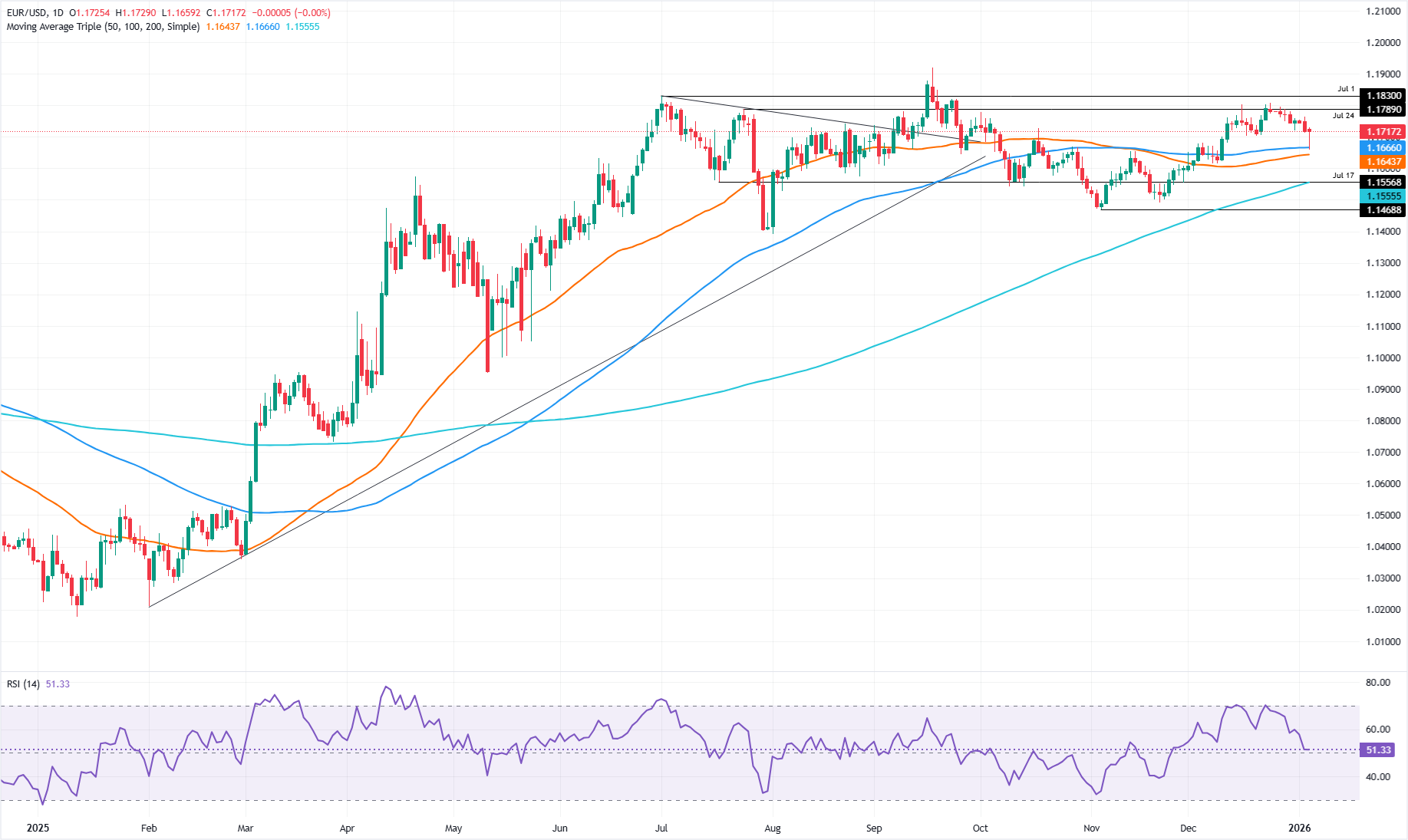
The technical picture for the EUR/USD remains neutral to upward biased, after forming a ‘dragonfly doji,’ an indication that traders bought the dip to 1.1713, pushing the pair to close above 1.1715. Nevertheless, bulls are not out of the woods as they must clear the 20-day Simple Moving Average (SMA) at 1.1731, ahead of 1.1750, which would clear the path towards 1.1800.
Conversely, if EUR/USD dives below 1.1700 it will expose key support levels like the 100-day SMA at 1.1668, followed by the 50-day SMA at 1.1640 and the 200-day SMA at 1.1553.
Euro FAQs
The Euro is the currency for the 20 European Union countries that belong to the Eurozone. It is the second most heavily traded currency in the world behind the US Dollar. In 2022, it accounted for 31% of all foreign exchange transactions, with an average daily turnover of over $2.2 trillion a day. EUR/USD is the most heavily traded currency pair in the world, accounting for an estimated 30% off all transactions, followed by EUR/JPY (4%), EUR/GBP (3%) and EUR/AUD (2%).
The European Central Bank (ECB) in Frankfurt, Germany, is the reserve bank for the Eurozone. The ECB sets interest rates and manages monetary policy. The ECB’s primary mandate is to maintain price stability, which means either controlling inflation or stimulating growth. Its primary tool is the raising or lowering of interest rates. Relatively high interest rates – or the expectation of higher rates – will usually benefit the Euro and vice versa. The ECB Governing Council makes monetary policy decisions at meetings held eight times a year. Decisions are made by heads of the Eurozone national banks and six permanent members, including the President of the ECB, Christine Lagarde.
Eurozone inflation data, measured by the Harmonized Index of Consumer Prices (HICP), is an important econometric for the Euro. If inflation rises more than expected, especially if above the ECB’s 2% target, it obliges the ECB to raise interest rates to bring it back under control. Relatively high interest rates compared to its counterparts will usually benefit the Euro, as it makes the region more attractive as a place for global investors to park their money.
Data releases gauge the health of the economy and can impact on the Euro. Indicators such as GDP, Manufacturing and Services PMIs, employment, and consumer sentiment surveys can all influence the direction of the single currency. A strong economy is good for the Euro. Not only does it attract more foreign investment but it may encourage the ECB to put up interest rates, which will directly strengthen the Euro. Otherwise, if economic data is weak, the Euro is likely to fall. Economic data for the four largest economies in the euro area (Germany, France, Italy and Spain) are especially significant, as they account for 75% of the Eurozone’s economy.
Another significant data release for the Euro is the Trade Balance. This indicator measures the difference between what a country earns from its exports and what it spends on imports over a given period. If a country produces highly sought after exports then its currency will gain in value purely from the extra demand created from foreign buyers seeking to purchase these goods. Therefore, a positive net Trade Balance strengthens a currency and vice versa for a negative balance.
Author

Christian Borjon Valencia
FXStreet
Markets analyst, news editor, and trading instructor with over 14 years of experience across FX, commodities, US equity indices, and global macro markets.