EUR/USD rallies hard as PPI print disappoints, tariffs fuel risk-off
- US PPI and CPI undershoot, reinforcing disinflation narrative and hammering the Greenback.
- Trump’s unilateral tariff threat deepens US Dollar rout and stokes fresh demand for higher-yielding currencies.
- ECB’s Schnabel signals easing cycle ending, sending Euro toward three-year highs despite soft data.

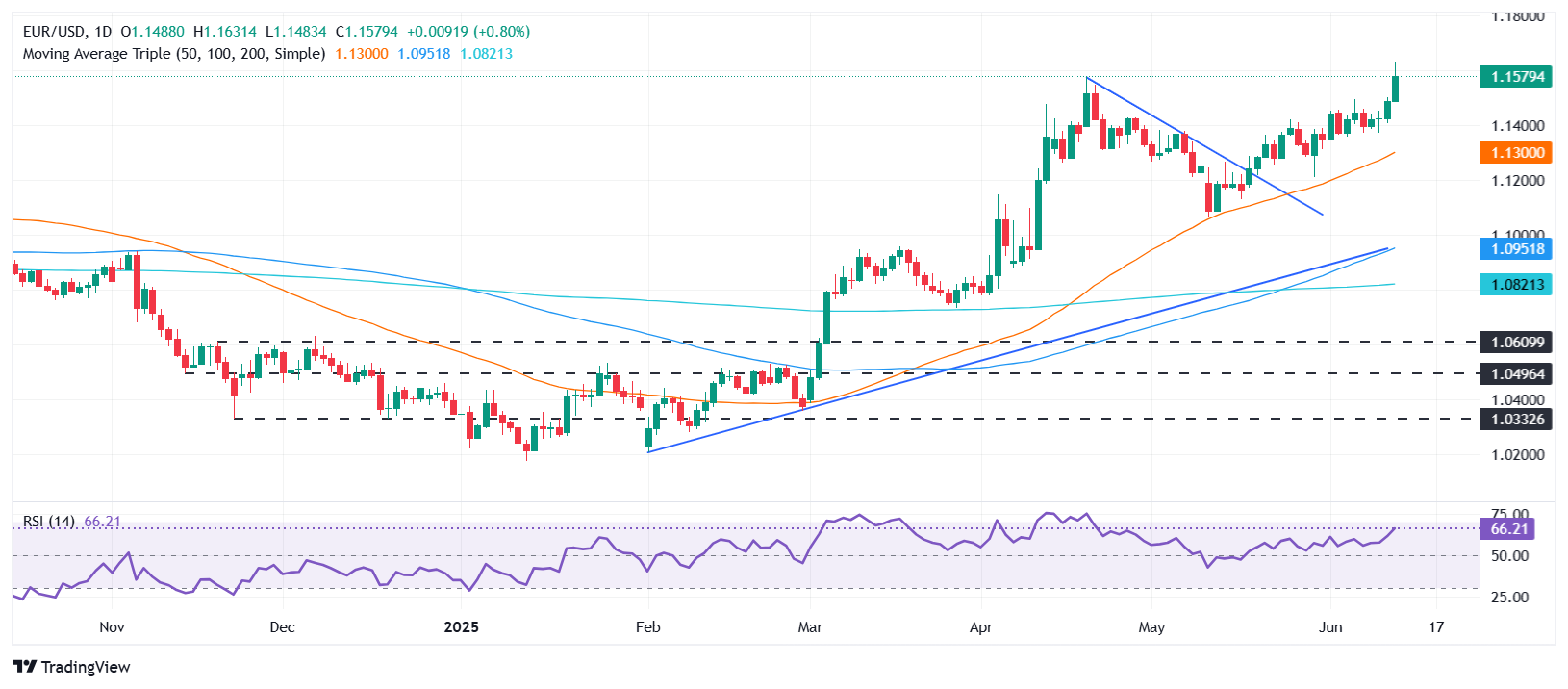
EUR/USD advances for the second consecutive day, posting gains of over 0.70% and trades below the three-year high of 1.1631 hit earlier, as traders digest the latest Producer Price Index (PPI) report in the United States (US), alongside jobs data.
At the time of writing, the pair trades at 1.1575 after the US Bureau of Labor Statistics (BLS) reported that the Producer Price Index (PPI) in May indicated continued disinflation, aligning with the Consumer Price Index (CPI) report released on Wednesday. Jobs data revealed that more people are applying for unemployment benefits in the US.
The US Dollar extended its losses on the data, with the EUR/USD climbing past 1.1600. Furthermore, US President Donald Trump rattled the financial markets as he said he would send letters to countries, setting unilateral tariff rates ahead of a July 9 deadline set on Liberation Day.
Across the pond, several European Central Bank (ECB) speakers were hawkish, led by Isabel Schnabel, who said the monetary policy [easing] cycle is coming to an end, adding that financial conditions are no longer restrictive.
On Friday, the Eurozone (EU) economic docket will feature the inflation reports for Germany and France for May. At the same time, EU Industrial Production is expected to continue slowing down in both yearly and monthly figures.
In the US, the schedule will feature the University of Michigan (UoM) Consumer Sentiment for June, alongside household inflation expectations.
Daily digest market movers: EUR/USD rallies on weak US Dollar, cool PPI report
- EUR/USD appears poised to remain within the 1.1500-1.600 range in the near term, as positive news about US-China talks could increase appetite for riskier assets. Trump’s controversial decisions triggered the “Sell America“ trade for the first time in the week.
- US Producer Price Index (PPI) rose 2.6% YoY in May, slightly above April’s 2.5%. Core PPI eased to 3% from 3.1%. On a monthly basis, headline and core PPI both rose 0.1%, below expectations, reflecting subdued inflation pressure.
- ECB's Villeroy says a 5.4% budget deficit in 2025 remains in reach, even with lowering forecasts. ECB's Patsalides says the ECB is flexible and agile on rates.
- ECB's Simkus says rates may still need to come down as the risk has increased that inflation will be below projections. He added that the ECB has arrived at a neutral rate.
- Financial market players do not expect that the ECB will reduce its Deposit Facility Rate by 25 basis points (bps) at the July monetary policy meeting.
Euro technical outlook: EUR/USD hit almost three-year high past 1.1600
The EUR/USD uptrend is in place, and clearing the 1.1600 figure has opened the door to challenge the 1.1650 figure, ahead of 1.1700. The pair has reached a series of successive higher highs and higher lows, while the Relative Strength Index (RSI) indicates that buyers are in control, suggesting further upside potential.
On the other hand, if the EUR/USD loses bullish momentum and drifts below 1.1550, expect a pullback toward 1.1500. A breach of the latter will expose 1.1450, clearing the path for further downside. The following key support levels to be tested are the 20-day Simple Moving Average (SMA) at 1.1366 and the 50-day SMA at 1.1304 ahead of 1.1300.
ECB FAQs
The European Central Bank (ECB) in Frankfurt, Germany, is the reserve bank for the Eurozone. The ECB sets interest rates and manages monetary policy for the region. The ECB primary mandate is to maintain price stability, which means keeping inflation at around 2%. Its primary tool for achieving this is by raising or lowering interest rates. Relatively high interest rates will usually result in a stronger Euro and vice versa. The ECB Governing Council makes monetary policy decisions at meetings held eight times a year. Decisions are made by heads of the Eurozone national banks and six permanent members, including the President of the ECB, Christine Lagarde.
In extreme situations, the European Central Bank can enact a policy tool called Quantitative Easing. QE is the process by which the ECB prints Euros and uses them to buy assets – usually government or corporate bonds – from banks and other financial institutions. QE usually results in a weaker Euro. QE is a last resort when simply lowering interest rates is unlikely to achieve the objective of price stability. The ECB used it during the Great Financial Crisis in 2009-11, in 2015 when inflation remained stubbornly low, as well as during the covid pandemic.
Quantitative tightening (QT) is the reverse of QE. It is undertaken after QE when an economic recovery is underway and inflation starts rising. Whilst in QE the European Central Bank (ECB) purchases government and corporate bonds from financial institutions to provide them with liquidity, in QT the ECB stops buying more bonds, and stops reinvesting the principal maturing on the bonds it already holds. It is usually positive (or bullish) for the Euro.
Author

Christian Borjon Valencia
FXStreet
Markets analyst, news editor, and trading instructor with over 14 years of experience across FX, commodities, US equity indices, and global macro markets.