EUR/USD remains fragile as traders brace for ECB policy meeting
- EUR/USD stays below 1.0900 as the ECB is expected to cut its borrowing rates by 25 bps on Thursday.
- Increasing speculation for Donald Trump’s victory in the US presidential elections has dampened the Eurozone’s economic outlook.
- Fed’s Waller advised a gradual reduction of interest rates over the next year.

EUR/USD falls further to near 1.0880 in Wednesday’s North American session. The major currency pair weakens as the Euro (EUR) underperforms on expectations that the European Central Bank (ECB) will cut interest rates again on Thursday.
The ECB is widely anticipated to reduce its Rate on Deposit Facility by 25 basis points (bps) to 3.25%. This would be the second straight interest rate cut by the ECB in a row. With strong confidence that the ECB will cut interest rates tomorrow, investors will pay close attention to the monetary policy statement and ECB President Christine Lagarde’s press conference to get fresh cues on the interest rate outlook.
The comments from Lagarde are expected to be dovish as price pressures in the Eurozone appear to be under control, and fears of an economic slowdown have grown significantly. According to the preliminary estimates, the Eurozone Harmonized Index of Consumer Prices (HICP) decelerated to 1.8% in September. Meanwhile, the second estimate for the monthly Consumer Price Index (CPI) (EU Norm) in France and Italy has shown that price pressures were slower than preliminary expectations.
Growing speculation about former US President Donald Trump winning the United States (US) presidential elections has also raised concerns over the European Union’s (EU) export outlook. Trump's victory is expected to result in tariff hikes on automotive imports to the US, which could dent exports from the old continent and lead to more weakness in economic growth.
Daily digest market movers: EUR/USD trades sideways as US Dollar consolidates
- EUR/USD faces pressure due to the US Dollar’s outperformance in the past few weeks. The US Dollar Index (DXY), which tracks the Greenback’s value against six major currencies, extends its upside to near 103.40. The Greenback strengthens as traders see the US Federal Reserve (Fed) gradually reducing interest rates in the remainder of the year.
- The Fed is expected to shift to a ‘moderate’ policy-easing stance from ‘aggressive’ as fears of an economic slowdown have waned after Nonfarm Payrolls (NFP) and the US Services Purchasing Managers Index (PMI) grew strongly, with price pressures rising faster than expected in September.
- According to the CME FedWatch tool, traders are confident that the central bank will cut interest rates by 25 bps in November and December.
- On the contrary, Fed Governor Christopher Waller cautioned over interest rate cuts this week in a speech at Stanford University, citing that "Whatever happens in the near term, my baseline still calls for reducing the policy rate gradually over the next year," Reuters reported. When asked about the current status of the job market, Waller said, “The labor market remains healthy, even as labor demand is moderating.”
- Going forward, the next trigger for the US Dollar will be the monthly Retail Sales data for September, which will be published on Thursday. Economists expect the Retail Sales data to have grown by 0.3% after rising 0.1% in August.
Technical Analysis: EUR/USD sees more downside below 200-day EMA
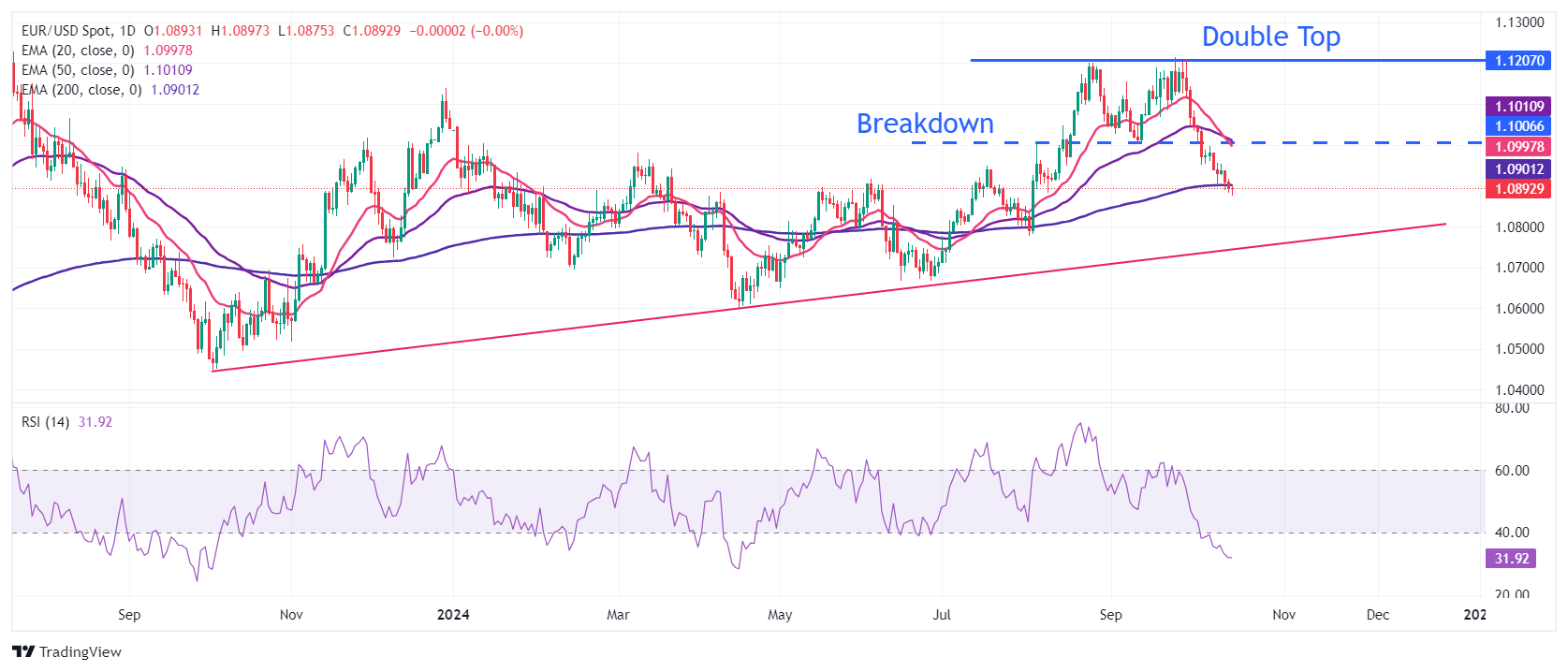
EUR/USD trades cautiously below the key resistance of 1.0900 in the North American trading hours. The major currency pair weakened after a breakdown of the Double Top formation on a daily timeframe on October 4, which resulted in a bearish reversal.
The shared currency pair wobbles near the 200-day Exponential Moving Average (EMA) around 1.0900. A bear cross, represented by the 20- and 50-day EMAs near 1.1020, suggests more weakness ahead.
The 14-day Relative Strength Index (RSI) dives to near 30.00, indicating a strong bearish momentum.
On the downside, the major could find support near the upward-sloping trendline at 1.0750, which is plotted from the October 3 low around 1.0450. Meanwhile, the psychological figure of 1.1000 will be the key resistance for the pair.
ECB FAQs
The European Central Bank (ECB) in Frankfurt, Germany, is the reserve bank for the Eurozone. The ECB sets interest rates and manages monetary policy for the region. The ECB primary mandate is to maintain price stability, which means keeping inflation at around 2%. Its primary tool for achieving this is by raising or lowering interest rates. Relatively high interest rates will usually result in a stronger Euro and vice versa. The ECB Governing Council makes monetary policy decisions at meetings held eight times a year. Decisions are made by heads of the Eurozone national banks and six permanent members, including the President of the ECB, Christine Lagarde.
In extreme situations, the European Central Bank can enact a policy tool called Quantitative Easing. QE is the process by which the ECB prints Euros and uses them to buy assets – usually government or corporate bonds – from banks and other financial institutions. QE usually results in a weaker Euro. QE is a last resort when simply lowering interest rates is unlikely to achieve the objective of price stability. The ECB used it during the Great Financial Crisis in 2009-11, in 2015 when inflation remained stubbornly low, as well as during the covid pandemic.
Quantitative tightening (QT) is the reverse of QE. It is undertaken after QE when an economic recovery is underway and inflation starts rising. Whilst in QE the European Central Bank (ECB) purchases government and corporate bonds from financial institutions to provide them with liquidity, in QT the ECB stops buying more bonds, and stops reinvesting the principal maturing on the bonds it already holds. It is usually positive (or bullish) for the Euro.
Author

Sagar Dua
FXStreet
Sagar Dua is associated with the financial markets from his college days. Along with pursuing post-graduation in Commerce in 2014, he started his markets training with chart analysis.
















