EUR/USD slips after US Services PMI outpaces both Germany and France
- EUR/USD fell below 1.08 after upbeat US Services PMI reading.
- Earlier this Monday, preliminary PMI data for March from Germany, France and the overall Eurozone comes in mixed.
- Markets brace for comments from US President Trump as another cabinet meeting is called for on Monday.

The EUR/USD tanks and breaks below 1.08 after the March preliminary United States (US) Purchase Manager's Index (PMI) reading came in stronger on the Services sector than expected. Overall, the pair is expected to stay around 1.08 for now after United States (US) officials commented on Monday that the upcoming reciprocal tariffs will rather be targeted by sector and country, not at all simply broad-based as US President Donald Trump had originally announced.
Meanwhile, on the economic data front, the preliminary Purchasing Managers Index (PMI) for March is being released on Monday. In the old continent, S&P Global and Hamburg Commercial Bank (HCOB) PMIs have been upbeat in France, beating estimates and February's readings in both the manufacturing and services sectors, but they still signal contraction. Meanwhile, results for Germany and the overall Eurozone have been mixed. The US PMI reading was an upbeat surprise for the Services sector while the Manufacturing sector fell into contraction.
Daily digest market movers: What about the contraction?
- European PMI data has already been released:
- For France, upbeat numbers with the Services component coming in at 46.6, beating the 46.3 expected and the previous reading of 45.3. The Manufacturing sector component jumped to 48.9, coming from 45.8 in February and beating the 46.2 expected.
- In Germany, the Services sector reading fell to 50.2, missing the 51.4 estimate and below the previous 51.1. The Manufacturing component popped to 48.3, beating the previous 46.5 and above the consensus of 47.7.
- In the overall Eurozone, Services PMI decreased to 50.4 from 50.6 previously, falling below the 51.0 expected. However, the Manufacturing reading accelerated to 48.7 from 47.6 in February, beating the 48.0 expected.
- The Chicago Fed National Activity Index for February came in as a surprise 0.18, beating the previous -0.03 which got revised even to -0.08.
- The US preliminary PMI data for March by S&P Global came in as a mixed surprise. The Services PMI jumped to 54.3, beating the 51.2 consensus, coming from 51.0. Manufacturing fell in contraction to 49.8, missing the 51.9 estimate and from 52.7.
- At 19:10 GMT, Vice Chair for Supervision of the Board of Governors of the Federal Reserve System Michael Barr will speak in a moderated discussion on small business lending at an event hosted at Advancing Innovation and Fairness in Small Business Finance, Washington, D.C.
- Equities are mixed with European equities flat while US equities are rallying over 1% higher.
- The CME Fedwatch Tool projects a 85.1% chance for the Federal Reserve (Fed) to keep interest rates unchanged in the May meeting while there is a slim 14.9% chance for a rate cut.
- The US 10-year yield trades around 4.32% and is looking for direction after the steep correction from last week.
Technical Analysis: Will this hold?
The EUR/USD pair is stuck in a very tight range on the weekly chart. The fact that EUR/USD closed below the 200-week Simple Moving Average (SMA) at 1.0854 last week means that a return to 1.10 is not in the cards immediately. On the other hand, the support from the 100-week SMA at 1.0782 and the 55-week SMA at 1.0740 reveal that a turnaround to 1.05 is not set to materialize quickly either.
On the upside, 1.1000 is the key level to look out for. Once that level is breached, the pair enters the famous 1.1000-1.1500 range, where it often tends to stay for quite some time. First, of course, the 200-week SMA at 1.0854 needs to be reclaimed.
On the downside, the support from the 100-week SMA at 1.0782 and the 55-week SMA at 1.0740 should be enough to support any selling pressure EUR/USD might face. In case it does not hold, 1.0667 and 1.06 are the next targets to the downside.
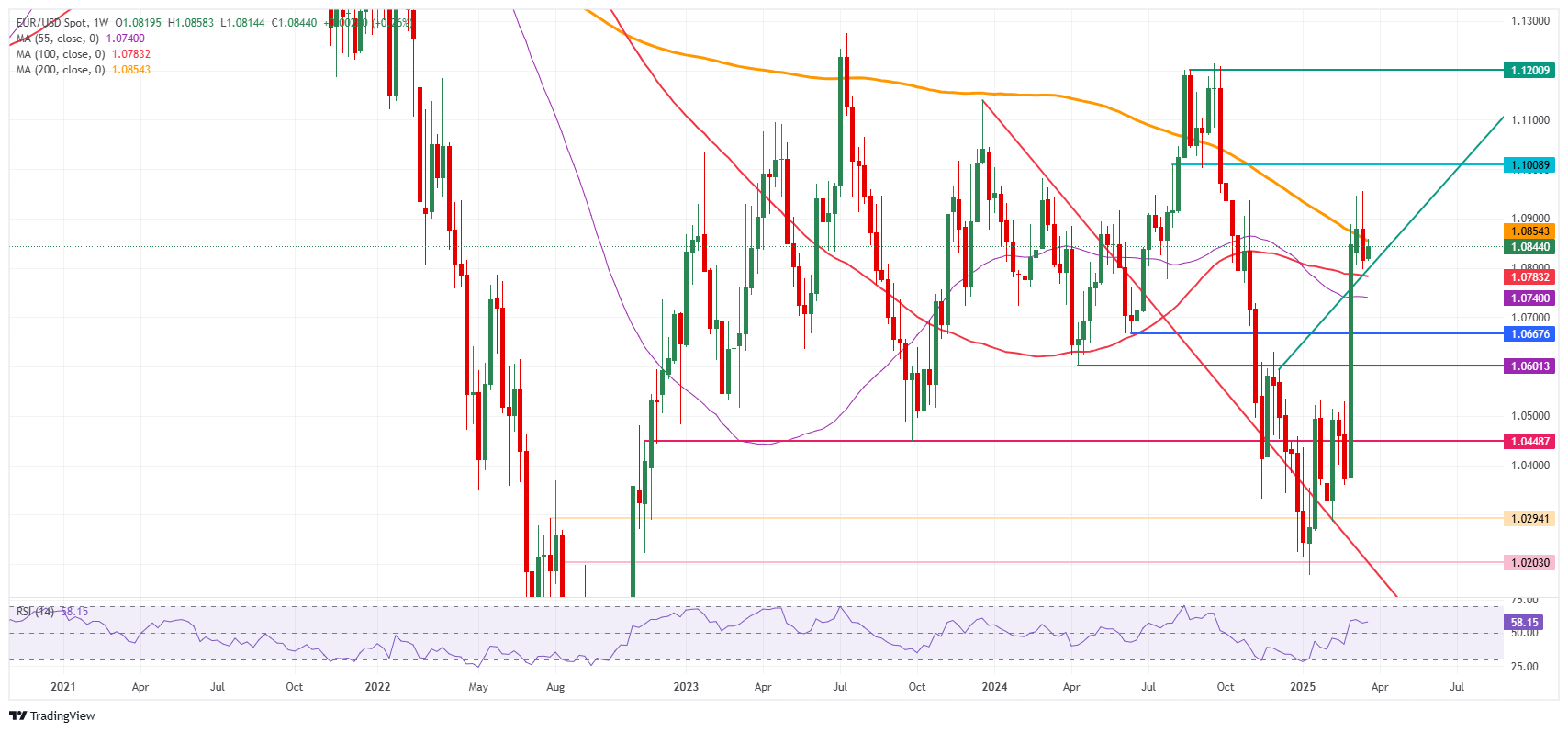
EUR/USD: Weekly Chart
Fed FAQs
Monetary policy in the US is shaped by the Federal Reserve (Fed). The Fed has two mandates: to achieve price stability and foster full employment. Its primary tool to achieve these goals is by adjusting interest rates. When prices are rising too quickly and inflation is above the Fed’s 2% target, it raises interest rates, increasing borrowing costs throughout the economy. This results in a stronger US Dollar (USD) as it makes the US a more attractive place for international investors to park their money. When inflation falls below 2% or the Unemployment Rate is too high, the Fed may lower interest rates to encourage borrowing, which weighs on the Greenback.
The Federal Reserve (Fed) holds eight policy meetings a year, where the Federal Open Market Committee (FOMC) assesses economic conditions and makes monetary policy decisions. The FOMC is attended by twelve Fed officials – the seven members of the Board of Governors, the president of the Federal Reserve Bank of New York, and four of the remaining eleven regional Reserve Bank presidents, who serve one-year terms on a rotating basis.
In extreme situations, the Federal Reserve may resort to a policy named Quantitative Easing (QE). QE is the process by which the Fed substantially increases the flow of credit in a stuck financial system. It is a non-standard policy measure used during crises or when inflation is extremely low. It was the Fed’s weapon of choice during the Great Financial Crisis in 2008. It involves the Fed printing more Dollars and using them to buy high grade bonds from financial institutions. QE usually weakens the US Dollar.
Quantitative tightening (QT) is the reverse process of QE, whereby the Federal Reserve stops buying bonds from financial institutions and does not reinvest the principal from the bonds it holds maturing, to purchase new bonds. It is usually positive for the value of the US Dollar.
Author

Filip Lagaart
FXStreet
Filip Lagaart is a former sales/trader with over 15 years of financial markets expertise under its belt.

















