EUR/USD rebounds to 1.1660 as weak US data fuels Fed cut bets
- Euro trims losses but stays below 1.1700 as JOLTS weakness and factory orders plunge weigh on the Greenback.
- Markets price over 90% probability of September Fed cut, according to Prime Market Terminal rate probabilities tool.
- Fed officials Kashkari, Bostic and Musalem stress inflation fight, while Waller keeps backing rate reduction.

EUR/USD trims on Wednesday some of Tuesday’s losses, though it remains shy of claiming the 1.1700 figure despite broad US Dollar weakness across the board. Economic data in the US strengthened the chances that the Federal Reserve (Fed) could resume its easing cycle at the September meeting. The pair trades at 1.1656, up 0.17%.
Euro advances amid Dollar softness, with markets eyeing NFPs despite hawkish Fed pushback on easing
An improvement in market mood prompted investors to buy the Euro, following a worse-than-expected Job Openings and Labor Turnover Survey (JOLTS) report for July. As the number of vacancies diminished and Factory Orders plunged, the Greenback depreciated against the single currency.
After the data, the chances that the Fed will cut rates as odds remain above 90%, according to the Prime Market Terminal interest rate probabilities tool.
Fed officials push back against rate cut pricing
Federal Reserve officials led by Minnesota’s Fed Neel Kashkari and Atlanta’s Fed Raphael Bostic were hawkish, saying that bringing inflation towards the Fed’s 2% goal is the priority, acknowledging that the labor market is cooling.
St. Louis Fed Alberto Musalem remains the most hawkish member of the board, said that the current restrictive monetary policy stance is in the right place. Meanwhile, Fed Governor Christopher Waller continued his campaign to reduce rates at the September meeting.
Traders’ eyes shift to Nonfarm Payroll figures on Friday, with economists expecting the economy to add 75K jobs in August. Before that, Initial Jobless Claims on Thursday and the ADP National Employment Change could be a prelude to what’s coming in the labor market.
Daily digest market movers: US Dollar weakness underpins Euro toward 1.1700
- The Bureau of Labor Statistics (BLS) reported that job vacancies slipped in July, with openings falling to 7.181 million from 7.357 million in the prior month. Hiring edged higher by 41,000, while layoffs climbed by 12,000. Economists linked the cooling labor market to tariffs introduced by President Donald Trump.
- Meanwhile, data from the US Census Bureau revealed that Factory Orders contracted by 1.3% MoM in July, slightly better than the forecasted 1.4% decline. Coupled with Tuesday’s ISM Manufacturing PMI, the figures underscored persistent weakness across the manufacturing sector.
- Consequently, the US Dollar Index (DXY), which tracks the performance of the buck’s value against a basket of six currencies, is down 0.16% at 98.16 as of writing.
- Broad Dollar weakness sponsored a leg up in EUR/USD as the latest HCOB Services PMI in August for the Eurozone missed forecasts of 50.7, coming in at 50.5.
- Other data in the Eurozone showed that Producer Prices increased by 0.4% MoM in July, down from the 0.8% print in June. In the twelve months to July, prices rose 0.2% down from 0.6% a year ago.
- Expectations that the Fed will reduce rates at the September meeting continued to trend higher. The Prime Market Terminal interest rate probability tool had priced in an 96% chance of the Fed easing policy by 25 basis points (bps) to 4.00%-–4.25%. The ECB is likely to keep rates unchanged, with a 90% probability, and only a 10% chance of a 25-bps cut.
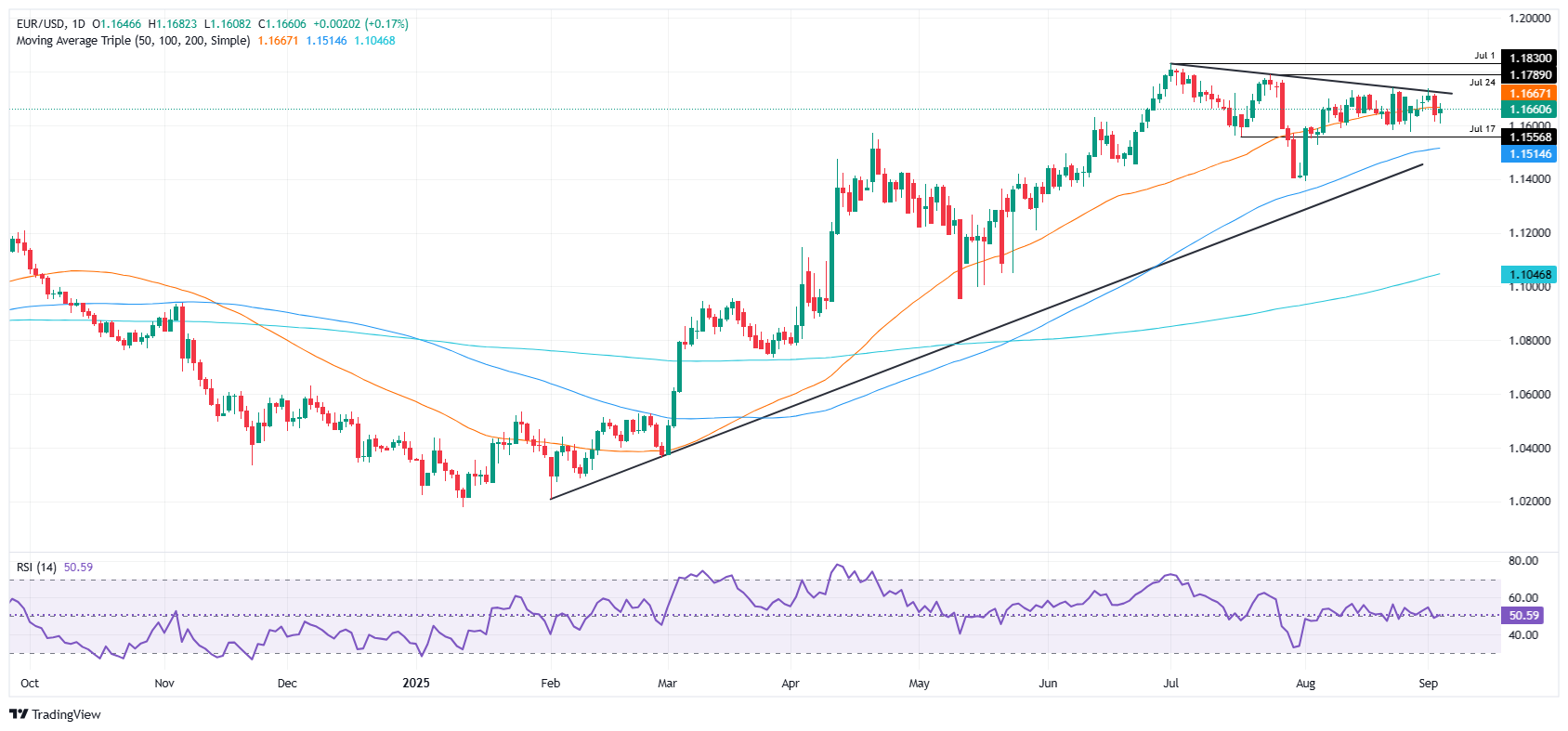
Technical outlook: EUR/USD poised to remain within the 1.1650-1.1700 range
EUR/USD has risen past 1.1650, which has opened the door for a test of 1.1700. Although the Relative Strength Index (RSI) has turned bullish, it remains far from clearing its latest peak, an indication that in the last 14 days, consolidation has been the name of the game.
Nevertheless, if EUR/USD climbs past the September 1 high of 1.1736, a test of 1.1800 and the year-to-date (YTD) high of 1.1829 is on the cards. Otherwise, a daily close below 1.1650 could put into play the 1.1600 mark ahead of the 100-day SMA at 1.1520.
Euro FAQs
The Euro is the currency for the 19 European Union countries that belong to the Eurozone. It is the second most heavily traded currency in the world behind the US Dollar. In 2022, it accounted for 31% of all foreign exchange transactions, with an average daily turnover of over $2.2 trillion a day. EUR/USD is the most heavily traded currency pair in the world, accounting for an estimated 30% off all transactions, followed by EUR/JPY (4%), EUR/GBP (3%) and EUR/AUD (2%).
The European Central Bank (ECB) in Frankfurt, Germany, is the reserve bank for the Eurozone. The ECB sets interest rates and manages monetary policy. The ECB’s primary mandate is to maintain price stability, which means either controlling inflation or stimulating growth. Its primary tool is the raising or lowering of interest rates. Relatively high interest rates – or the expectation of higher rates – will usually benefit the Euro and vice versa. The ECB Governing Council makes monetary policy decisions at meetings held eight times a year. Decisions are made by heads of the Eurozone national banks and six permanent members, including the President of the ECB, Christine Lagarde.
Eurozone inflation data, measured by the Harmonized Index of Consumer Prices (HICP), is an important econometric for the Euro. If inflation rises more than expected, especially if above the ECB’s 2% target, it obliges the ECB to raise interest rates to bring it back under control. Relatively high interest rates compared to its counterparts will usually benefit the Euro, as it makes the region more attractive as a place for global investors to park their money.
Data releases gauge the health of the economy and can impact on the Euro. Indicators such as GDP, Manufacturing and Services PMIs, employment, and consumer sentiment surveys can all influence the direction of the single currency. A strong economy is good for the Euro. Not only does it attract more foreign investment but it may encourage the ECB to put up interest rates, which will directly strengthen the Euro. Otherwise, if economic data is weak, the Euro is likely to fall. Economic data for the four largest economies in the euro area (Germany, France, Italy and Spain) are especially significant, as they account for 75% of the Eurozone’s economy.
Another significant data release for the Euro is the Trade Balance. This indicator measures the difference between what a country earns from its exports and what it spends on imports over a given period. If a country produces highly sought after exports then its currency will gain in value purely from the extra demand created from foreign buyers seeking to purchase these goods. Therefore, a positive net Trade Balance strengthens a currency and vice versa for a negative balance.
Author

Christian Borjon Valencia
FXStreet
Markets analyst, news editor, and trading instructor with over 14 years of experience across FX, commodities, US equity indices, and global macro markets.