EUR/USD rebounds as Fed rate cut bets strengthen after PCE
- Core PCE inflation remains under 3%, boosting the probability of Fed rate cuts to nearly 90% into year-end.
- Dovish Fed voices highlight a fragile labor market, and Barkin warns that inflation and unemployment trends remain concerning.
- Euro steadies despite NATO–Russia tensions, with traders eyeing US jobs data and upcoming Eurozone inflation prints.

EUR/USD recovers on Friday as traders’ confidence rises that the Federal Reserve (Fed) will reduce interest rates after the release of the latest inflation report in the United States (US). At the time of writing, the pair trades at 1.1697, up 0.27%.
Euro eyes 1.1700 as softer US inflation fuels confidence in further monetary easing
The week ended in a recovery mode for the shared currency after the US Bureau of Economic Analysis (BEA) reported that the Fed’s preferred inflation gauge, the core Personal Consumption Expenditures (PCE) Price Index, was aligned with estimates, but shy of the 3% threshold.
Following the announcement, bets on the Fed reducing borrowing costs increased from 84% the day before to 88%, as revealed by the Prime Market Terminal interest rate probability tool.
Federal Reserve officials crossed the wires. Fed Governor Michelle Bowman was dovish as she said that the labor market is fragile and that, should the conditions deteriorate, they would need to adjust policy at a faster pace. Earlier, Richmond Fed Thomas Barkin said both inflation and unemployment are moving in the wrong direction, but the downside is limited.
In Europe, a scarce economic docket left traders adrift to geopolitics. Tensions in Europe seem to weigh on the Euro as NATO warned Russia that it is prepared to intercept Russian aircraft. According to Bloomberg, European officials privately told Russia they are ready to shoot down jets and view Russia’s Estonia incursion as deliberate.
Next week, the US schedule will feature a flurry of Fed speakers, US ADP National Employment Change, the ISM Manufacturing PMI, Initial Jobless Claims and Nonfarm Payrolls for September.
Across the pond, the European schedule will feature Business Climate, Consumer Confidence, the Economic Sentiment Indicator, September inflation figures and a flurry of ECB speakers. Also, traders should be wary of Flash PMIs and German inflation and Retail Sales.
Daily market movers: Euro surges as US core PCE justifies Fed rate cut bets
- The US core Personal Consumption Expenditures (PCE) Price Index rose 2.9% YoY in August, matching forecasts and unchanged from July. Headline PCE edged up to 2.7% YoY from 2.6%, in line with projections.
- The University of Michigan’s final September Consumer Sentiment reading came in weaker than expected at 55.1 versus 55.4 anticipated. Inflation expectations eased slightly, with the one-year outlook slipping to 4.7% from 4.8%, and the five-year view falling to 3.7% from 3.9%.
- On the trade front, President Donald Trump announced new tariffs: 100% on pharmaceuticals, 50% on kitchen cabinets, bathroom vanities, and related products, 40% on upholstered furniture, and 25% on heavy trucks.
- In Europe, the ECB’s Consumer Expectations Survey showed households see inflation at 2.8% in one year. The five-year outlook ticked higher to 2.2% from 2.1%.
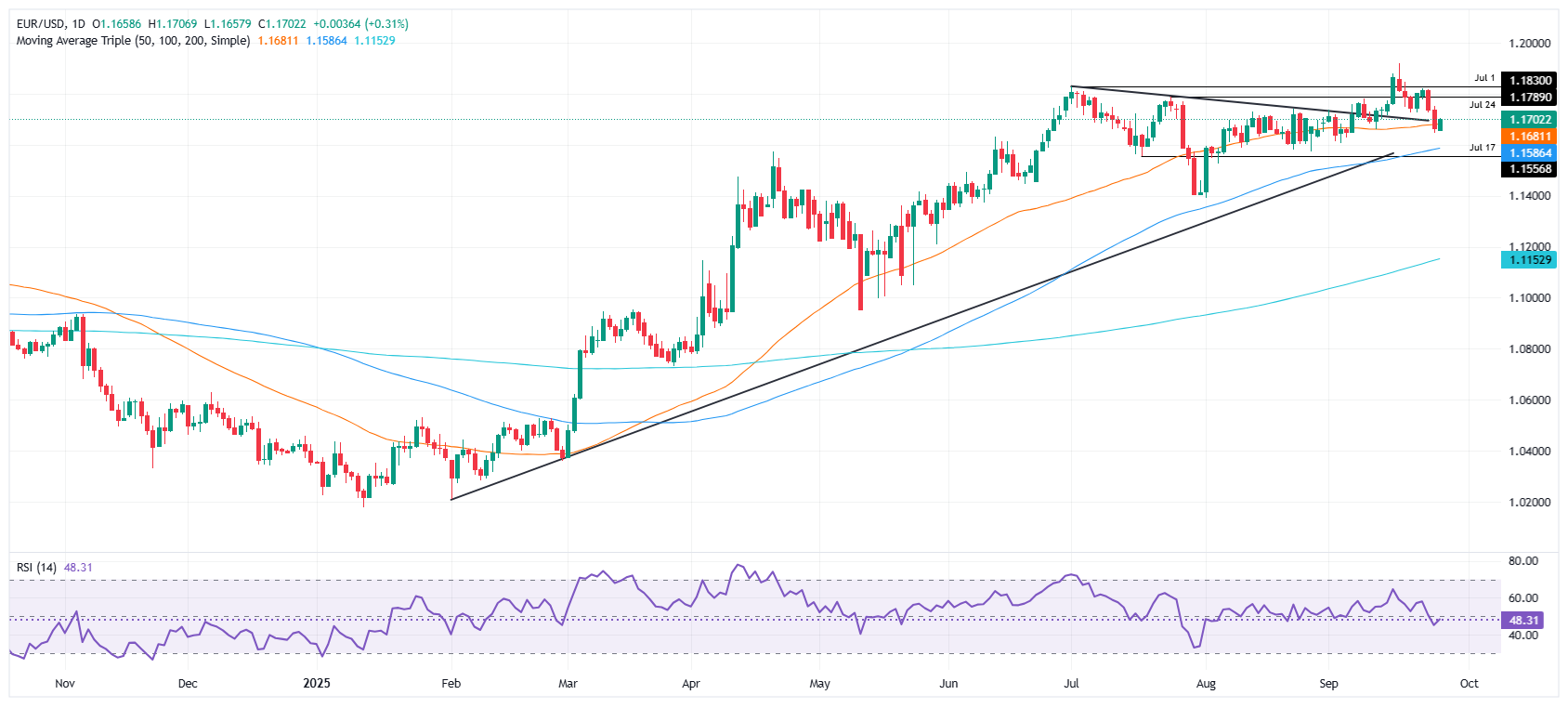
Technical outlook: EUR/USD recovers and meanders around 1.1700
EUR/USD ended the week on a lower note, yet it seems to have found its feet at around 1.1650. After reaching the latter, the pair edged back towards 1.1700 but failed to end the day/week above that price level.
The Relative Strength Index (RSI) remains bearish. This, and the EUR/USD failure at 1.1700, could clear the path for further downside.
The first support would be 1.1650, followed by 1.1600. If cleared, the next support would be the 100-day SMA at 1.1588. Conversely, if buyers reclaim 1.1700, the next resistance would be 1.1750, ahead of the 1.1800 mark.
Euro FAQs
The Euro is the currency for the 19 European Union countries that belong to the Eurozone. It is the second most heavily traded currency in the world behind the US Dollar. In 2022, it accounted for 31% of all foreign exchange transactions, with an average daily turnover of over $2.2 trillion a day. EUR/USD is the most heavily traded currency pair in the world, accounting for an estimated 30% off all transactions, followed by EUR/JPY (4%), EUR/GBP (3%) and EUR/AUD (2%).
The European Central Bank (ECB) in Frankfurt, Germany, is the reserve bank for the Eurozone. The ECB sets interest rates and manages monetary policy. The ECB’s primary mandate is to maintain price stability, which means either controlling inflation or stimulating growth. Its primary tool is the raising or lowering of interest rates. Relatively high interest rates – or the expectation of higher rates – will usually benefit the Euro and vice versa. The ECB Governing Council makes monetary policy decisions at meetings held eight times a year. Decisions are made by heads of the Eurozone national banks and six permanent members, including the President of the ECB, Christine Lagarde.
Eurozone inflation data, measured by the Harmonized Index of Consumer Prices (HICP), is an important econometric for the Euro. If inflation rises more than expected, especially if above the ECB’s 2% target, it obliges the ECB to raise interest rates to bring it back under control. Relatively high interest rates compared to its counterparts will usually benefit the Euro, as it makes the region more attractive as a place for global investors to park their money.
Data releases gauge the health of the economy and can impact on the Euro. Indicators such as GDP, Manufacturing and Services PMIs, employment, and consumer sentiment surveys can all influence the direction of the single currency. A strong economy is good for the Euro. Not only does it attract more foreign investment but it may encourage the ECB to put up interest rates, which will directly strengthen the Euro. Otherwise, if economic data is weak, the Euro is likely to fall. Economic data for the four largest economies in the euro area (Germany, France, Italy and Spain) are especially significant, as they account for 75% of the Eurozone’s economy.
Another significant data release for the Euro is the Trade Balance. This indicator measures the difference between what a country earns from its exports and what it spends on imports over a given period. If a country produces highly sought after exports then its currency will gain in value purely from the extra demand created from foreign buyers seeking to purchase these goods. Therefore, a positive net Trade Balance strengthens a currency and vice versa for a negative balance.
Author

Christian Borjon Valencia
FXStreet
Markets analyst, news editor, and trading instructor with over 14 years of experience across FX, commodities, US equity indices, and global macro markets.