EUR/USD declines to 1.1000 after release of US inflation data
- EUR/USD falls after the release of mixed US inflation data.
- The pair gives back gains made from US Dollar weakness following the Trump-Harris televised debate.
- USD fell because of the lower chance Trump will be able to implement Dollar-friendly policies.


EUR/USD is exchanging hands just above 1.1000 during Wednesday's US session, after the release of US Consumer Price Index data for August pushed the pair lower.
The US Consumer Price Index (CPI) rose by 2.5% on an annual basis in August, compared to the 2.9% in July, and below the 2.6% forecast by economists. Monthly CPI rose by 0.2% in line with forecasts and the same as previously, according to data from the US Bureau of Labor Statistics (BLS).
Core CPI (excluding food and energy) rose by 3.2% on an annual basis in August, the same as in July and as expected. Monthly core CPI rose by 0.3%, which was above the 0.2% in July and the 0.2% expected.
The US Dollar traded higher after the release and EUR/USD fell about a quarter of a percentage point following the news.
EUR/USD rose following Trump-Harris debate
EUR/USD gives up gains it made earlier on Wednesday amid a broad-based weakening in the US Dollar (USD) following the Trump-Harris televised presidential election debate.
Most analysts agree that Vice President Kamala Harris came out on top during the debate, and a recent poll from the BBC showed that she is ahead with 47% versus former President Donald Trump’s 43%.
The US Dollar (USD) was weakening – and as a result EUR/USD rising – because one of Trump’s policies is to protect the US Dollar’s status as the world’s reserve currency. This includes penalizing countries who refuse to trade in USD by imposing tariffs on their goods. The policy is a response to the growing influence of the BRICS trading bloc and its policy of de-dollarizing the global economy.
EUR/USD rises as investors debate chance of jumbo Fed rate cut
EUR/USD is further strengthening as investors continue to see a sizable chance of the US Federal Reserve (Fed) cutting interest rates by a larger-than-standard 50 basis points (bps) at its next meeting on September 17-18. Whilst a 25 bps (0.25%) cut is already expected, the probabilities of a larger 50 bps “jumbo cut” currently stand at around 30% according to the CME FedWatch tool, which bases its predictions on the price of 30-day fed funds futures. A double-dose 50 bps cut would weigh on USD by reducing foreign capital inflows, but would be bullish for EUR/USD.
ECB meeting in focus
EUR/USD upside is likely to be limited, however, by growth concerns in the Eurozone. Germany, in particular, is suffering from a much-publicized slowdown in manufacturing, especially in its key automobile sector, due to foreign competition.
The European Central Bank (ECB) is scheduled to conclude its policy meeting on Thursday, and the consensus expectation is for the bank to announce a 25 bps cut to its deposit facility rate in order to help stimulate growth. The deposit facility rate (DFR) is the rate it pays banks on the money they deposit with the ECB. Such a cut would bring it down from 3.75% to 3.50%.
Given the ECB has already announced plans to narrow the spread between the DFR and the main refinancing operations rate (MRO) from 50 bps to 15 bps (from September 18 onwards), the implication is that it will also slash the MRO – its headline rate – at Thursday’s meeting. Given the MRO currently sits at 4.25%, narrowing the spread with the DFR to only 15 bps would imply cutting the MRO by 0.60% to bring it down to 3.65%.
Although the changes have already been telegraphed to the market, there is still a risk the Euro could weaken after the announcement. However, it is the updated macroeconomic projections that could provide the most volatility, with a risk the ECB could cut its growth forecasts. Such a move would weigh on EUR/USD.
“Sluggish Eurozone economic activity suggests the risk is the ECB tweaks lower its inflation and real GDP growth forecasts. This can lead to a downward adjustment to Eurozone interest rate expectations against EUR,” says Elias Haddad, Senior Markets Strategist at Brown Brothers Harriman (BBH).
Technical Analysis: EUR/USD continues posting lower lows
EUR/USD has broadly declined since peaking at 1.1202 on August 26. Despite a reaction higher between September 3-6, the pair has continued posting lower lows, most recently on Wednesday, when it fell to 1.1017. The pair is, therefore, probably in a downtrend and, since “the trend is your friend,” it could be argued the odds favor lower prices to come, although the downtrend is not strong.
EUR/USD 4-hour Chart
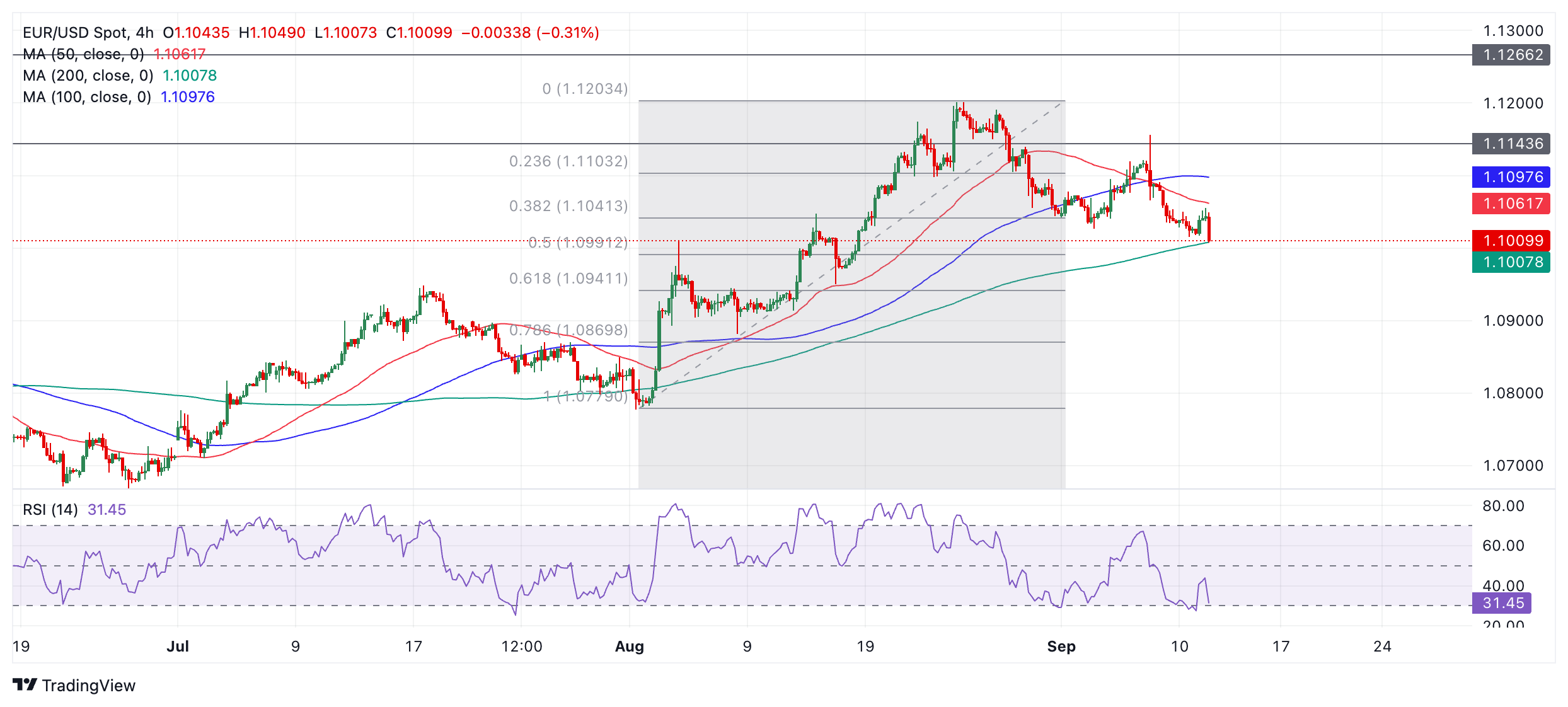
EUR/USD has broken below the previous swing lows at 1.1017 providing confirmation of more downside. The next major support level is 1.1000 – a whole number and key psychological barrier.
Further weakness could see the pair fall to the Fibonacci 0.618 retracement of the August rally at 1.0941, where it would also likely find firm support.
At the same time, risks of a recovery remain. The Relative Strength Index (RSI), for example, has risen sharply from the overbought zone, giving a buy signal, and it is still possible the pair could recover back up to the 1.1150 line of key resistance highs, if the counter-trend reaction currently underway persists.
Economic Indicator
Consumer Price Index ex Food & Energy (YoY)
Inflationary or deflationary tendencies are measured by periodically summing the prices of a basket of representative goods and services and presenting the data as the Consumer Price Index (CPI). CPI data is compiled on a monthly basis and released by the US Department of Labor Statistics. The YoY reading compares the prices of goods in the reference month to the same month a year earlier. The CPI Ex Food & Energy excludes the so-called more volatile food and energy components to give a more accurate measurement of price pressures. Generally speaking, a high reading is bullish for the US Dollar (USD), while a low reading is seen as bearish.
Read more.Last release: Wed Sep 11, 2024 12:30
Frequency: Monthly
Actual: 3.2%
Consensus: 3.2%
Previous: 3.2%
Source: US Bureau of Labor Statistics
The US Federal Reserve has a dual mandate of maintaining price stability and maximum employment. According to such mandate, inflation should be at around 2% YoY and has become the weakest pillar of the central bank’s directive ever since the world suffered a pandemic, which extends to these days. Price pressures keep rising amid supply-chain issues and bottlenecks, with the Consumer Price Index (CPI) hanging at multi-decade highs. The Fed has already taken measures to tame inflation and is expected to maintain an aggressive stance in the foreseeable future.
Author
Joaquin Monfort
FXStreet
Joaquin Monfort is a financial writer and analyst with over 10 years experience writing about financial markets and alt data. He holds a degree in Anthropology from London University and a Diploma in Technical analysis.

















