EUR/USD rallies to three-day highs above 1.0870s as the US Dollar weakens on Fed hike expectations
- US Job Openings missed estimates while Consumer Confidence declined.
- After US data, the Fed rate hike expectations lowered.
- Germany’s economic data, alongside the US ADP report, to provide direction on the EUR/USD pair.

The Euro (EUR) is rallying sharply vs. the US Dollar (USD), reaching a three-day high above 1.0870 after economic data from the United States (USD) elevated chances the US Federal Reserve (Fed) would refrain from tightening monetary conditions in September. Hence, the EUR/USD is trading at 1.0876 after hitting a low of 1.0782.
EUR/USD rallies to 1.0876 as US JOLTs dropped, alongside a worsening Consumer Confidence
Data from the US Bureau of Labor Statistics (BLS) showed that Job openings for July missed estimates of 9.465M by a large amount, coming at 8.827M, and below June’s 9.165M. That, alongside a drop in quits rate, implies that Americans are less confident of finding another job. Other data revealed at the same time, the Conference Board (CB) released its Consumer Confidence poll, showing that sentiment is worsening, as displayed by August’s report, with figures at 106.1, below forecasts of 116 and July’s 114.
Dana Peterson, the chief economist at the Conference Board, said, “Consumers were once again preoccupied with rising prices in general and for groceries and gasoline in particular.”
That said, the labor market in the US is beginning to loosen, not as quickly as expected by the Federal Reserve. Powell’s remarks about the tightness of the jobs market, justifying rate increases, could be pushed aside for the September meeting. Nevertheless, the upcoming US Nonfarm Payrolls report for August, with estimates of around 170K, suggests that caution is warranted. An uptick could trigger volatility amongst the financial markets as traders pared bets on further Fed rate hikes.
The CME FedWatch Tool odds for a rate hike to the 5.50%-5.75% range at the September meeting are lowering, at 13.5%, while for the November meeting, remain at around 43.3%.
In the meantime, the EUR/USD continues to print gains, but it has retreated from daily highs around the 1.0870s area. The Greenback (USD) remains the laggard in the session amongst G10 FX currencies, as depicted by the US Dollar Index (DXY) dropping 0.42%, at 103.545, weighed by falling US bond yields. Market participants are expecting a less aggressive Fed after today’s data.
On Tuesday, the Eurozone (EU) economic agenda was empty, but as the week advances, so do economic releases. Germany would reveal its GfK Consumer Confidence, expected to deteriorate further, while the Consumer Price Index (CPI) is expected to fall. The EU will also reveal its Consumer Confidence.
Across the pond, the US ADP Employment Change for August is expected, as well as PCE Prices for the second quarter (Q2) 2023.
EUR/USD Price Analysis: Technical outlook
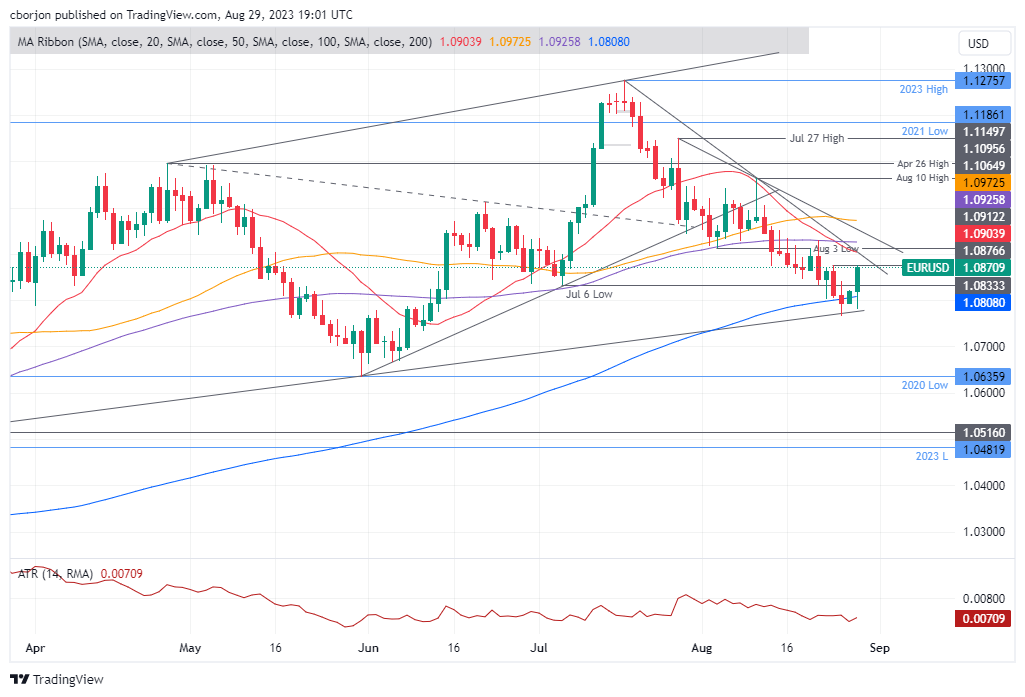
The EUR/USD remains neutral to downward bias, well below the 20, 100, and 50-day Simple Moving Averages (DMAs) as potential resistance levels. To change the pair direction, buyers must reclaim the 1.0900 figure and the 20-DMA at 1.0903, with a daily close. A decisive break of that area would expose the 100-DMA at 1.0925. On the flip side, sellers leaning into that area could use it to re-enter the market to drag prices back toward the 1.0800 mark.
Author

Christian Borjon Valencia
FXStreet
Markets analyst, news editor, and trading instructor with over 14 years of experience across FX, commodities, US equity indices, and global macro markets.
















