EUR/USD Price Forecast: Softens to near 1.1350, overbought RSI condition eyed
- EUR/USD weakens to around 1.1365 in Thursday’s early European session, down 0.28% on the day.
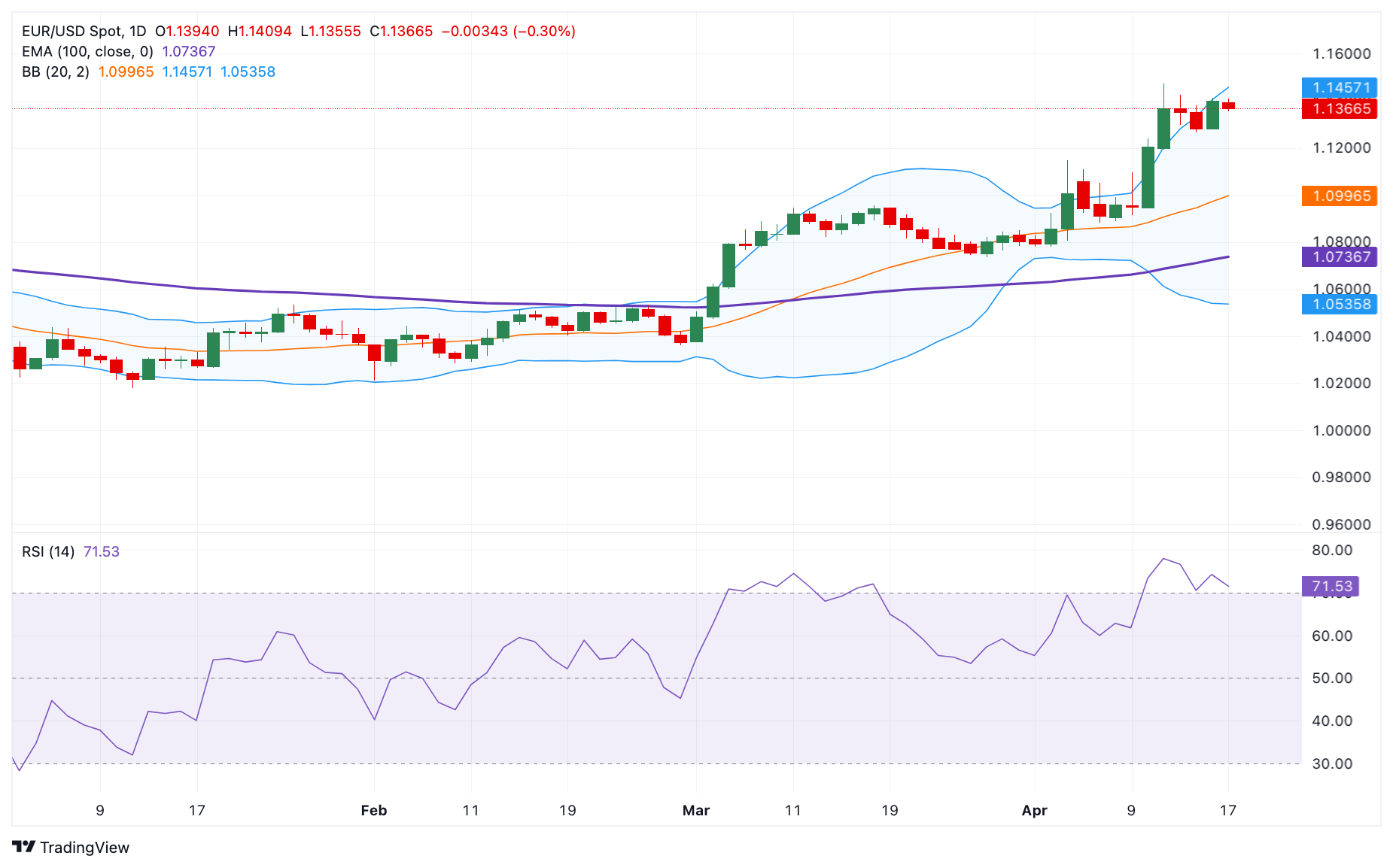
- The positive bias of the pair prevails above the 100-day EMA, but the overbought RSI condition might cap its upside.
- The immediate resistance level emerges at 1.1455; the first downside target to watch is 1.1264.

The EUR/USD pair attracts some sellers to around 1.1365 during the early European session on Thursday. Traders might prefer to wait on the sidelines ahead of the European Central Bank (ECB) interest rate decision later on Thursday. The ECB is widely anticipated to cut its key interest rate by 25 basis points (bps) at its April meeting, marking a sixth consecutive reduction amid global tariff tensions and economic uncertainty.
According to the daily chart, the constructive outlook of EUR/USD remains intact as the major pair holds above the key 100-day Exponential Moving Averages (EMA). However, the 14-day Relative Strength Index (RSI) stands above the midline near 71.50, indicating the overbought RSI condition. This suggests that further consolidation cannot be ruled out before positioning for any near-term EUR/USD appreciation.
The upper boundary of the Bollinger Band at 1.1455 acts as an immediate resistance level for the major pair. A decisive break above this level could see a rally to 1.1481, the high of January 13, 2022. Further north, the next hurdle to watch is 1.1608, the high of November 9, 2021.
In the bearish case, the initial support level is located at 1.1264, the low of April 15. Any follow-through selling below the mentioned level could expose the 1.1100 psychological mark. Extended losses could see a drop to 1.0780, the low of April 2.
ECB FAQs
The European Central Bank (ECB) in Frankfurt, Germany, is the reserve bank for the Eurozone. The ECB sets interest rates and manages monetary policy for the region. The ECB primary mandate is to maintain price stability, which means keeping inflation at around 2%. Its primary tool for achieving this is by raising or lowering interest rates. Relatively high interest rates will usually result in a stronger Euro and vice versa. The ECB Governing Council makes monetary policy decisions at meetings held eight times a year. Decisions are made by heads of the Eurozone national banks and six permanent members, including the President of the ECB, Christine Lagarde.
In extreme situations, the European Central Bank can enact a policy tool called Quantitative Easing. QE is the process by which the ECB prints Euros and uses them to buy assets – usually government or corporate bonds – from banks and other financial institutions. QE usually results in a weaker Euro. QE is a last resort when simply lowering interest rates is unlikely to achieve the objective of price stability. The ECB used it during the Great Financial Crisis in 2009-11, in 2015 when inflation remained stubbornly low, as well as during the covid pandemic.
Quantitative tightening (QT) is the reverse of QE. It is undertaken after QE when an economic recovery is underway and inflation starts rising. Whilst in QE the European Central Bank (ECB) purchases government and corporate bonds from financial institutions to provide them with liquidity, in QT the ECB stops buying more bonds, and stops reinvesting the principal maturing on the bonds it already holds. It is usually positive (or bullish) for the Euro.
EUR/USD daily chart
BRANDED CONTENT
If you're looking for the best brokers to trade the EUR/USD pair, explore our selected options. Knowing each broker’s strengths will help you find the ideal fit for your trading strategy.
Author

Lallalit Srijandorn
FXStreet
Lallalit Srijandorn is a Parisian at heart. She has lived in France since 2019 and now becomes a digital entrepreneur based in Paris and Bangkok.