EUR/USD Price Forecast: Bears retain control within descending channel
- EUR/USD holds steady as traders digest hawkish-leaning FOMC minutes.
- Fed policymakers remain concerned about inflation while describing labor market conditions as balanced.
- Technically, EUR/USD retains a bearish bias while trading within a descending channel and below key moving averages.

EUR/USD holds firm on Wednesday after reversing earlier losses triggered by renewed tensions between the United States (US) and Iran, while traders digest the June Federal Open Market Committee (FOMC) meeting minutes. At the time of writing, the pair is trading around 1.1427 after hitting an intraday low of 1.1391.
The US Dollar (USD) saw little immediate reaction to the minutes, suggesting much of the Federal Reserve's (Fed) message was already reflected in market pricing. The US Dollar Index (DXY), which tracks the Greenback's value against a basket of six major currencies, is trading around 100.97, easing from an intraday high of 101.27.
Officials remained cautious about inflation, which remains well above the central bank's 2% target, while describing labor market conditions as balanced.
Policymakers also signaled that the future path of interest rates will depend on incoming economic data, with some indicating that additional policy tightening could be warranted if inflation proves more persistent than expected.
Nevertheless, renewed geopolitical tensions and expectations that the Fed could deliver at least one interest rate hike this year should continue to underpin the Greenback, keeping downside pressure on EUR/USD.
Technical analysis:
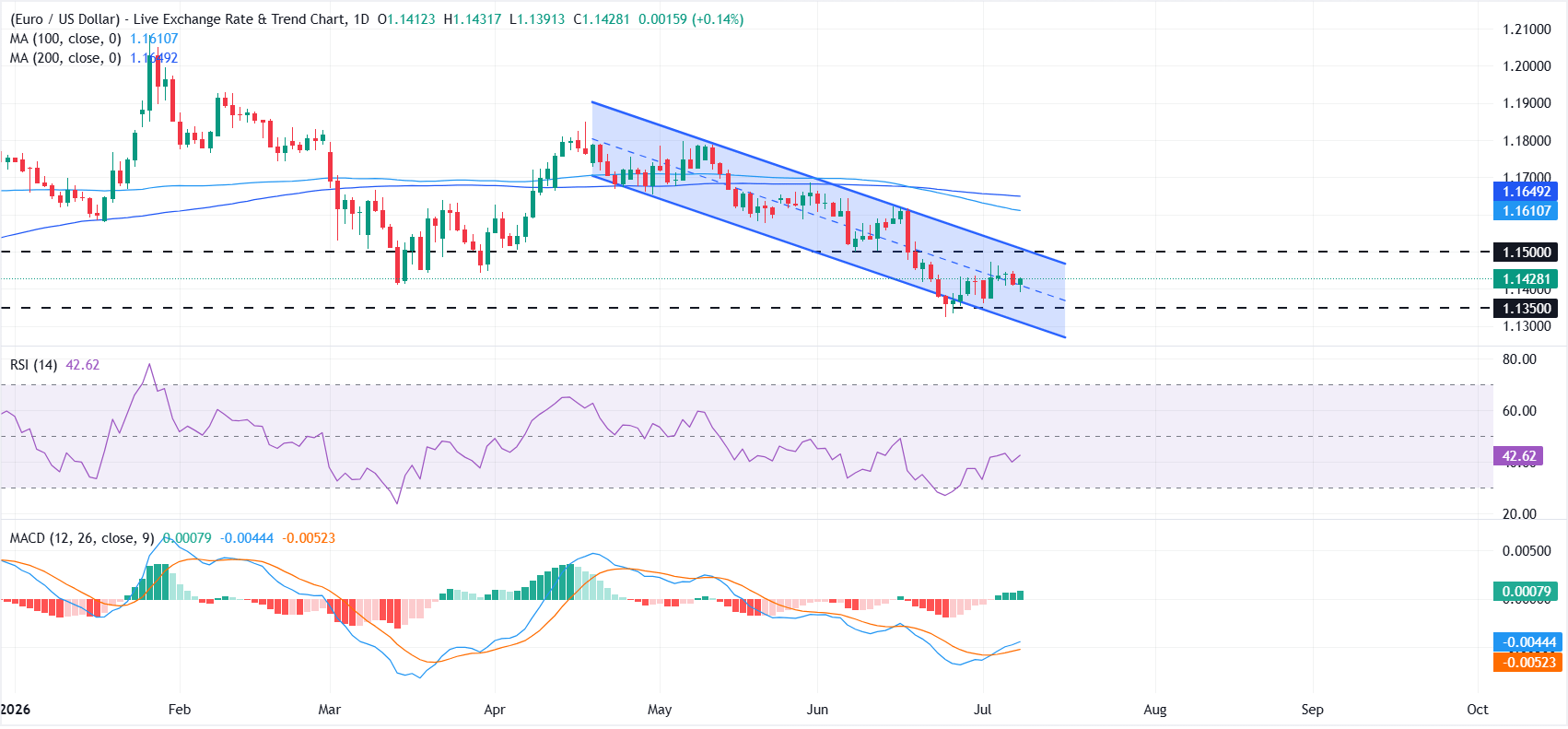
On the daily chart, EUR/USD is trading within a downward parallel channel and beneath its key moving averages, which keeps the near-term bias bearish.
However, momentum is showing signs of improvement, with the Relative Strength Index (RSI) recovering to 41 from near-oversold territory, while the Moving Average Convergence Divergence (MACD) has turned marginally positive, reinforcing the idea of a consolidative phase within a broader downside structure rather than a clear bullish reversal.
On the topside, initial resistance is seen at the horizontal level around 1.1500, closely aligned with the upper boundary of the descending channel, forming a tight cap on any corrective bounce.
Above these, the 100-day Simple Moving Average (SMA) at 1.1611, followed by the 200-day SMA at 1.1649, represent more substantial barriers that would need to be reclaimed to ease the prevailing bearish tone.
On the downside, immediate support emerges at the horizontal level near 1.1350, ahead of the channel floor around 1.1305, where a break would likely open the way for a continuation of the broader downtrend.
(The technical analysis of this story was written with the help of an AI tool. Know more.)
Author

Vishal Chaturvedi
FXStreet
I am a macro-focused research analyst with over four years of experience covering forex and commodities market. I enjoy breaking down complex economic trends and turning them into clear, actionable insights that help traders stay ahead of the curve.