|

EUR/USD Price Analysis: Pair hovers near 1.0500, lacking momentum ahead of Fed decision

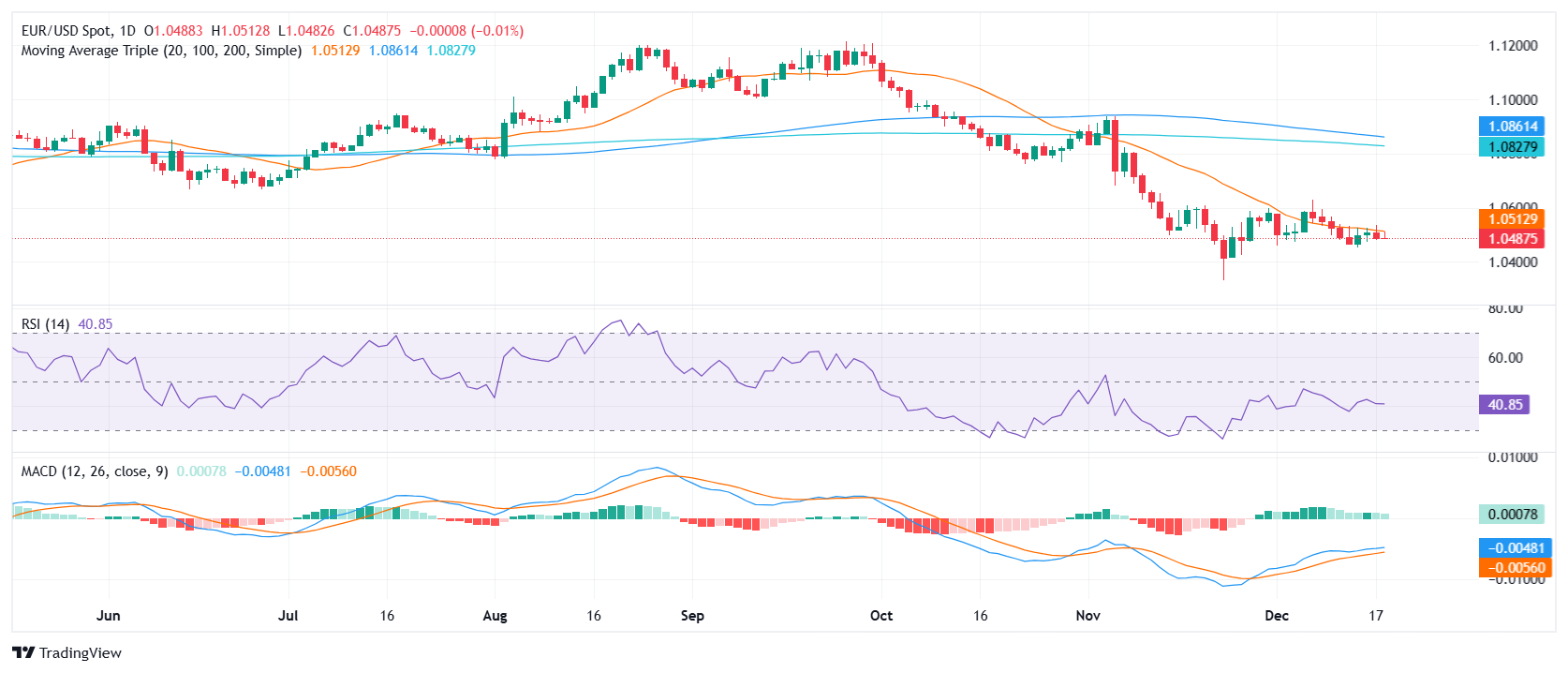
  • EUR/USD edges slightly higher on Wednesday, settling around 1.0500 but still capped by the 20-day SMA.
  • RSI holds at 42 in negative territory, signaling persistent caution and subdued buying interest.

The EUR/USD pair remains in a holding pattern on Wednesday, hovering near the 1.0500 mark. Despite recent attempts to gain traction, the 20-day Simple Moving Average (SMA) near 1.0550 continues to act as a formidable barrier, preventing the pair from establishing a more constructive bias. Market participants are now looking to the upcoming Federal Reserve (Fed) decision for fresh directional cues.

Technical indicators reflect a calm environment. The Relative Strength Index (RSI) is flat at 42, firmly in negative territory and suggesting limited buying interest. Meanwhile, the Moving Average Convergence Divergence (MACD) histogram shows flat green bars, underscoring the pair’s lack of decisive momentum.

In the near term, a clear break above the 20-day SMA would be required to shift the short-term outlook in favor of the bulls. Until then, the bias remains tilted to the downside, with the 1.0500 handle and the 1.0480 support area in focus. The upcoming Fed decision could provide the necessary catalyst for a breakout or further consolidation, shaping the pair’s short-term trajectory.

EUR/USD daily chart
Author

Patricio Martín

Patricio is an economist from Argentina passionate about global finance and understanding the daily movements of the markets.


More from Patricio Martín
Share:

Editor's Picks

GBP/USD bulls seem hesitant as Hormuz ship attack supports safe-haven USD

The GBP/USD pair sticks to a positive bias for the second straight day, albeit it remains below the previous day's swing high and trades just below the 1.3200 mark during the Asian session on Friday. Furthermore, the fundamental backdrop warrants caution before positioning for any meaningful recovery from November 2025 lows, around the 1.3140 region, touched on Wednesday.

EUR/USD softens toward 13‑month low near 1.1350 as rising US PCE inflation lifts US Dollar

The EUR/USD pair loses ground to around 1.1365 during the early Asian trading hours on Friday. The major remains near a 13-month low as market expectations for US interest rate hikes have risen. Traders brace for the release of the Michigan Consumer Sentiment Index report, which will be released later on Friday.

Gold drifts lower as Hormuz risks revive USD demand

Gold struggles to build on the overnight bounce from its lowest level since November 2025 as geopolitical risks stemming from an attack on a cargo vessel in the Strait of Hormuz support the US Dollar. Meanwhile, mostly in-line US inflation data eased bets for Fed rate hikes this year, capping the USD and helping the non-yielding bullion to hold above $4,000 during the Asian session. Nevertheless, the commodity remains on track to record losses for the fourth consecutive week.

Uniswap adds $150M in Spark stablecoin liquidity, launches no-code token auction tool
Uniswap received $150 million in stablecoin liquidity from Spark, with the assets set to transition to DualPool, a new custom liquidity hook, according to an announcement on Thursday. Under the new setup, liquidity providers will be able to earn swap fees while their underlying assets continue generating yield, eliminating the need to choose between the two.
Micron prints perfect, and now the chart has to answer
Memory’s biggest name just delivered the cleanest quarter of its life, and the most interesting thing about it is that the stock isn’t sure what to do with it. Micron closed out fiscal Q3 with revenue of $41.5 billion, up 346% on the year, a fifth straight record. Gross margin came in at 84.9%, up from 39% the same quarter a year ago. Earnings landed at $25.11 against a Street sitting near $20.49.
Regime change: Inside Kevin Warsh's first move to make the Fed unreadable on purpose

The rate did not move. That was the least interesting thing about Kevin Warsh's first meeting in charge of the Fed. The FOMC held its benchmark at 3.50%-3.75% for the fourth straight meeting, exactly as priced, and then the new chair used his first press conference to dismantle the machinery the market has leaned on for a decade.