|

EUR/USD Price Analysis: Pair edges above 1.0500 but still struggles below 20-day SMA

  • EUR/USD sees a slight uptick on Monday, hovering near 1.0500.
  • RSI rises modestly to 43 but remains in negative territory, signaling a fragile recovery.
  • MACD histogram shows rising green bars, yet the pair lacks the momentum to break above the 20-day SMA.

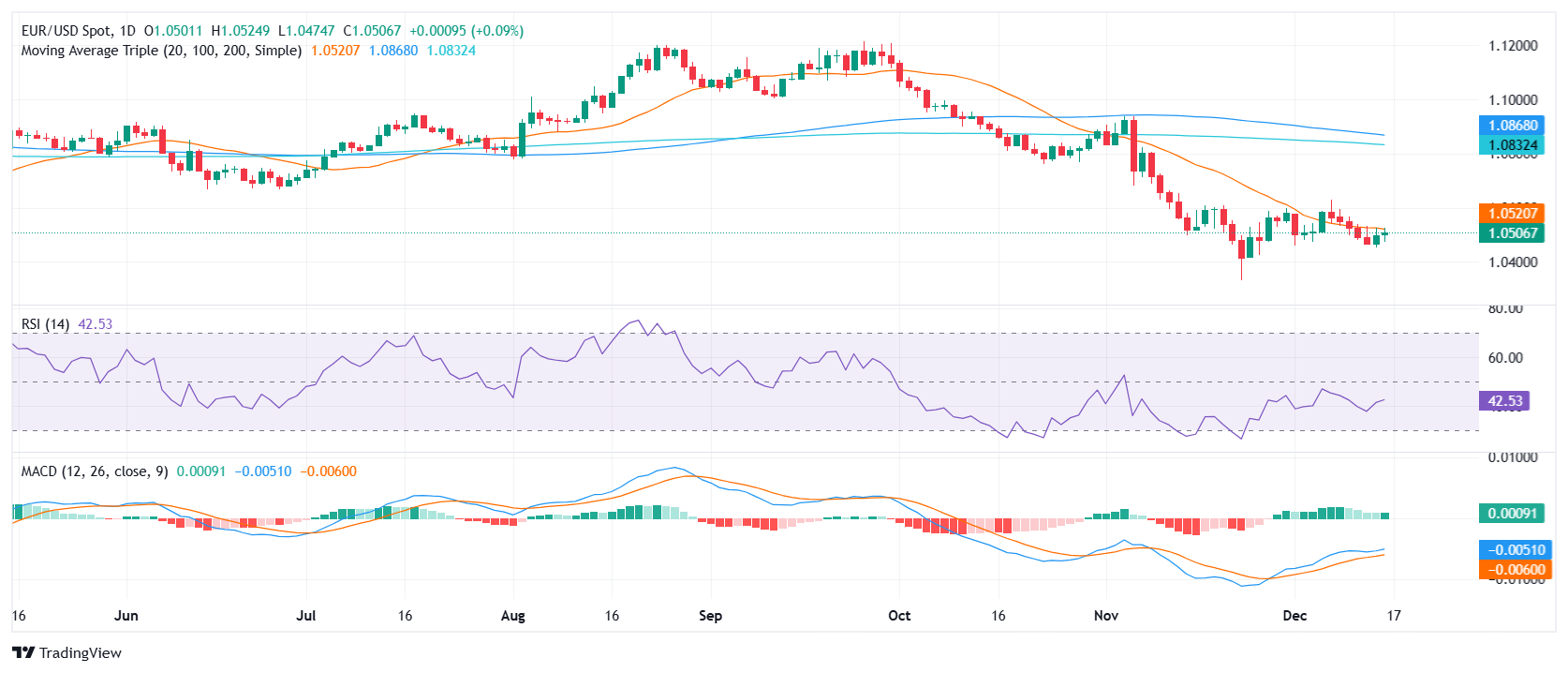
The EUR/USD pair managed another mild recovery on Monday, drifting slightly above the 1.0500 mark after bouncing from recent lows. Although the pair approached the 20-day Simple Moving Average (SMA) near 1.0520, it once again failed to breach this key resistance level, maintaining a cautious outlook.

Technical indicators reflect a tentative improvement but remain skewed to the downside. The Relative Strength Index (RSI) has ticked higher to 43, indicating a mild gain in buying interest, but it still resides in negative territory. Meanwhile, the Moving Average Convergence Divergence (MACD) histogram is now printing rising green bars, suggesting early signs of stabilizing momentum. However, the pair’s inability to overcome the 20-day SMA undermines the sustainability of any bullish attempt.

For a meaningful shift in sentiment, EUR/USD would need a decisive break above the 20-day SMA at around 1.0520. Until that occurs, the bias remains tilted to the downside, with initial support seen at the psychological 1.0500 level, followed by the 1.0480 area. A failure to hold above these levels could open the door to further losses, reinforcing the overall bearish perspective.

EUR/USD daily chart
Author

Patricio Martín

Patricio is an economist from Argentina passionate about global finance and understanding the daily movements of the markets.


More from Patricio Martín
Share:

Editor's Picks

AUD/USD turns lower toward 0.7000 after mixed Australian jobs data

AUD/USD is losing ground toward 0.7000 in the Asian session on Thursday, following the release of the Australian August jobs report, which showed that the Unemployment Rate rose to 4.6% versus 4.5% expected, while Employment Change beat estimates, arriving at 39.5K. Traders also remain unnerved ahead of the critical Trump-Xi meeting.

USD/JPY keeps the red near 158.00 as Japanese Yen firms up

USD/JPY retreats from three-week highs and holds losses near 158.00 in the Asian session on Thursday. Surging Japanese bond yields lift the Yen amid looming intervention risks, while the US Dollar preserves overnight gains to a two-month high amid hawkish Fed bets and elevated US bond yields.

Gold bears tighten their grip as Fed rate hike bets rise

Gold sticks to a negative bias for the second straight day, trading below the $4,300 mark or a one-week low during the first half of the European session as traders await a crucial meeting between US President Donald Trump and his Chinese counterpart Xi Jinping. Expectations for a major announcement are low, though market players will look for any progress on rare earths, technology restrictions, and an extension of the current US-China truce.

Bitcoin slips to $84,000 on rate hike bets – Worldcoin, Pepe lead losses
Bitcoin (BTC) price trades below $84,000 on Thursday, extending losses after a 2% decline the previous day. The pullback aligns with renewed inflation and rate-hike concerns, as US composite and services PMIs rose to 58.4 and 58.7 in September. Worldcoin (WLD) and Pepe (PEPE) recorded double-digit losses over the last 24 hours, emerging as the worst performers.
SNB leaves interest rates unchanged at 0%

Swiss National Bank leaves its key policy rates unchanged at 0%, as expected by market particiapnts. The key highlights of SNB’s monetary policy assessment are as followed: Banks' sight deposits held at the SNB will be remunerated at the SNB policy rate up to a certain threshold. SNB sees 2026 inflation at 0.7% (previous forecast was for 0.6%). The main risk to the economic outlook for Switzerland stems from developments in the global economy.

BoJ Recap: Not as hawkish as expected

The Bank of Japan (BoJ) raised its short-term interest-rate target to 1.25% from 1.00% in a 7-2 vote, marking another step in the normalisation of monetary policy and widely matching what everyone has been expecting for weeks.