EUR/USD price analysis: Euro steadies near 1.1200 as mixed signals persist
- EUR/USD trades around the 1.1200 zone with minor gains in Wednesday’s session.
- Mixed technical signals, with shorter-term averages suggesting selling pressure, while longer-term trends remain supportive.
- Key support levels hold below, while resistance clusters just above current levels.

The EUR/USD pair traded near the 1.1200 zone on Wednesday after the European session, reflecting a cautiously bullish tone as the market approaches the Asian session. Price action remains within the middle of its daily range, indicating balanced sentiment despite a mixed technical backdrop. While shorter-term momentum indicators signal caution, the broader trend remains supported by longer-term averages, providing a foundation for further upside if recent gains hold.
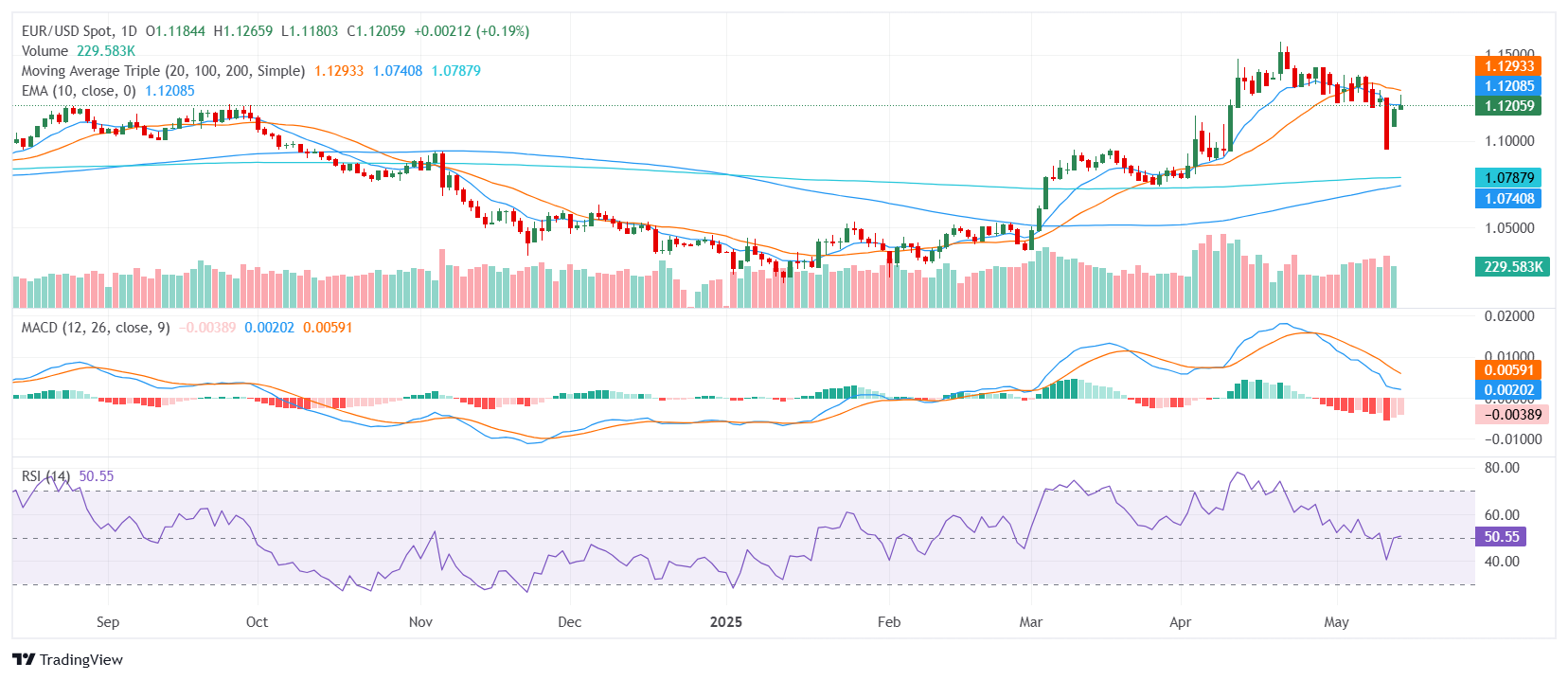
From a technical standpoint, the pair presents a complex picture. The Relative Strength Index hovers around 40, reflecting neutral conditions without clear directional momentum. The Moving Average Convergence Divergence, however, signals sell momentum, aligning with the cautious tone of the shorter-term moving averages. The Williams Percent Range also remains in neutral territory, suggesting the pair lacks immediate directional conviction. Meanwhile, the Average Directional Index trades in the 30s, pointing to a modest bullish bias, while the Bull Bear Power indicator further supports the buy sentiment, hinting at underlying strength.
The moving averages paint a divided picture. The 20-day Simple Moving Average continues to slope downward, reinforcing near-term resistance. In contrast, the 100-day and 200-day Simple Moving Averages, along with the 30-day and 50-day Exponential Moving Averages, provide stronger underlying support, indicating that the broader trend remains intact despite short-term fluctuations.
Support levels are found at 1.1199, 1.1128, and 1.1092. Resistance lies at 1.1238, 1.1242, and 1.1242. A sustained move above the immediate resistance zone could confirm a broader breakout, while a break below support might trigger a short-term correction, potentially testing the lower end of the recent range.
Daily Chart
Author

Patricio Martín
FXStreet
Patricio is an economist from Argentina passionate about global finance and understanding the daily movements of the markets.