EUR/USD plunges below 1.1700 as Fed turmoil sparks risk-off move
- US Dollar gets bid as traders flee risk assets amid Fed pressure, soaring bond yields and tariff disputes.
- Trump’s firing of Fed Governor Lisa Cook fuels legal uncertainty with Court of Appeals ruling tariffs illegal.
- French no-confidence vote and EU inflation surprise deepen volatility, while ECB hawks hint easing cycle may end.

The Euro tumbles late in the North American session, down by over 0.60% due to a risk-off mood triggered by threats to the independence of the Federal Reserve (Fed) and controversial US policy. Concerns over fiscal deterioration in many countries sent the EUR/USD sliding, trading at 1.1642 after falling beneath the 1.1700 figure.
Euro drops as global bond sell-off, French politics weigh
The last word about the firing of Fed Governor Lisa Cook by US President Donald Trump is awaiting a court ruling as the White House continued to exert pressure on the Fed to reduce interest rates. At the same time, fixed income traders demanding a higher premium over government debt sent global bond yields soaring.
Over the weekend, the US Court of Appeals declared Trump tariffs illegal, though kept them in place until October 14 as the case is headed for the Supreme Court.
All those factors are taking a toll on the shared currency as traders seeking safety bought Gold and the US Dollar.
In Europe, the no-confidence vote in France to be held on September 8, added to the downbeat sentiment surrounding most G8 FX currencies, except for the Greenback.
On the data front, US Manufacturing Purchasing Managers Indices (PMIs) from the Institute for Supply Management (ISM) and S&P Global showing mixed readings.
Across the pond, inflation figures at the European Union (EU) rose above estimates, giving a green light to European Central Bank (ECB) hawks to express that the end of the easing cycle is around the corner.
Euro Price This week
The table below shows the percentage change of Euro (EUR) against listed major currencies this week. Euro was the strongest against the Japanese Yen.
| USD | EUR | GBP | JPY | CAD | AUD | NZD | CHF | |
|---|---|---|---|---|---|---|---|---|
| USD | 0.47% | 0.77% | 0.92% | 0.35% | 0.40% | 0.43% | 0.63% | |
| EUR | -0.47% | 0.29% | 0.38% | -0.12% | -0.08% | -0.05% | 0.16% | |
| GBP | -0.77% | -0.29% | -0.02% | -0.42% | -0.37% | -0.34% | -0.08% | |
| JPY | -0.92% | -0.38% | 0.02% | -0.51% | -0.51% | -0.45% | -0.25% | |
| CAD | -0.35% | 0.12% | 0.42% | 0.51% | 0.06% | 0.08% | 0.34% | |
| AUD | -0.40% | 0.08% | 0.37% | 0.51% | -0.06% | 0.03% | 0.29% | |
| NZD | -0.43% | 0.05% | 0.34% | 0.45% | -0.08% | -0.03% | 0.26% | |
| CHF | -0.63% | -0.16% | 0.08% | 0.25% | -0.34% | -0.29% | -0.26% |
The heat map shows percentage changes of major currencies against each other. The base currency is picked from the left column, while the quote currency is picked from the top row. For example, if you pick the Euro from the left column and move along the horizontal line to the US Dollar, the percentage change displayed in the box will represent EUR (base)/USD (quote).
Daily digest market movers: EUR/USD trips down despite high EU inflation
- The ISM Manufacturing PMI remained in contraction for a sixth consecutive month in August, rising modestly from 48.0 to 48.7 but below the 49.0 forecast. Sub-components showed prices paid easing slightly to 63.7 from 64.8, underscoring that tariffs continue to filter into inflation. Factory employment remained weak, while production also declined.
- Separately, S&P Global reported that manufacturing activity softened, with its PMI slipping from 53.3 to 53.0, signaling a slowdown in overall sector momentum.
- ECB member Isabel Schnabel does not see a reason to cut rates, adding that rate hikes may come earlier than people think. ECB Kocher recommended caution at the next meeting, while Muller favors holding rates unchanged to watch the economy evolve.
- The latest EU data, particularly inflation metrics, were hotter than foreseen in August. The EU’s Harmonized Index of Consumer Prices (HICP) rose 2.1% YoY, up from estimates and July’s 2% print. Core HICP dipped from 2.4% to 2.3% YoY aligned with projections by most economists.
- Expectations that the Fed will reduce rates at the September meeting continued to trend higher. The Prime Market Terminal interest rate probability tool had priced in an 89% chance of the Fed easing policy by 25 basis points (bps) to 4.00%-4.25%. The ECB is likely to keep rates unchanged, a 92% probability, and only an 8% chance of a 25 bps cut.
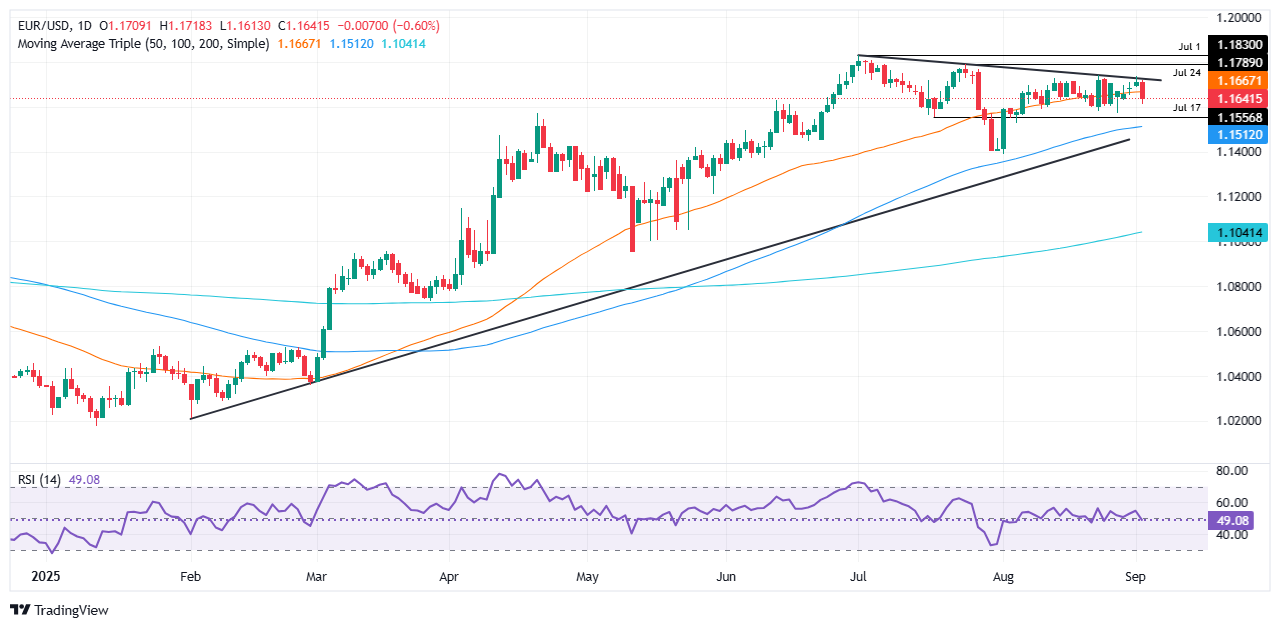
Technical outlook: EUR/USD makes a U-turn, aims toward 1.1600
The EUR/USD uptrend paused as the pair dips below the 50-day and 20-day Simple Moving Averages (SMAs), each at 1.1664 and 1.1660, an indication that buyers are losing steam in the near term as traders await the release of the latest Nonfarm Payroll (NFP) figures on Friday.
After bouncing back above its neutral line, the Relative Strength Index (RSI) turned bearish. Hence, sellers are in charge in the short term.
If EUR/USD extends its losses below 1.1600, traders will eye the 100-day SMA at 1.1517, ahead of 1.1500. On the flip side, if buyers drive prices above 1.1665, it will clear the path to test 1.1700 and the August 22 high of 1.1742. On further strength, expect a move toward the yearly high of 1.1829.
Euro FAQs
The Euro is the currency for the 19 European Union countries that belong to the Eurozone. It is the second most heavily traded currency in the world behind the US Dollar. In 2022, it accounted for 31% of all foreign exchange transactions, with an average daily turnover of over $2.2 trillion a day. EUR/USD is the most heavily traded currency pair in the world, accounting for an estimated 30% off all transactions, followed by EUR/JPY (4%), EUR/GBP (3%) and EUR/AUD (2%).
The European Central Bank (ECB) in Frankfurt, Germany, is the reserve bank for the Eurozone. The ECB sets interest rates and manages monetary policy. The ECB’s primary mandate is to maintain price stability, which means either controlling inflation or stimulating growth. Its primary tool is the raising or lowering of interest rates. Relatively high interest rates – or the expectation of higher rates – will usually benefit the Euro and vice versa. The ECB Governing Council makes monetary policy decisions at meetings held eight times a year. Decisions are made by heads of the Eurozone national banks and six permanent members, including the President of the ECB, Christine Lagarde.
Eurozone inflation data, measured by the Harmonized Index of Consumer Prices (HICP), is an important econometric for the Euro. If inflation rises more than expected, especially if above the ECB’s 2% target, it obliges the ECB to raise interest rates to bring it back under control. Relatively high interest rates compared to its counterparts will usually benefit the Euro, as it makes the region more attractive as a place for global investors to park their money.
Data releases gauge the health of the economy and can impact on the Euro. Indicators such as GDP, Manufacturing and Services PMIs, employment, and consumer sentiment surveys can all influence the direction of the single currency. A strong economy is good for the Euro. Not only does it attract more foreign investment but it may encourage the ECB to put up interest rates, which will directly strengthen the Euro. Otherwise, if economic data is weak, the Euro is likely to fall. Economic data for the four largest economies in the euro area (Germany, France, Italy and Spain) are especially significant, as they account for 75% of the Eurozone’s economy.
Another significant data release for the Euro is the Trade Balance. This indicator measures the difference between what a country earns from its exports and what it spends on imports over a given period. If a country produces highly sought after exports then its currency will gain in value purely from the extra demand created from foreign buyers seeking to purchase these goods. Therefore, a positive net Trade Balance strengthens a currency and vice versa for a negative balance.
Author

Christian Borjon Valencia
FXStreet
Markets analyst, news editor, and trading instructor with over 14 years of experience across FX, commodities, US equity indices, and global macro markets.

















