EUR/USD crashes through 1.15 as Trump turns up heat on Iran
- EUR/USD sinks to 1.1484 as safe-haven flows favor the US Dollar.
- Trump demands Iran’s “unconditional surrender,” DXY jumps to four-day high near 98.80.
- Strong German ZEW data is overshadowed by Fed risks and Middle East escalation.


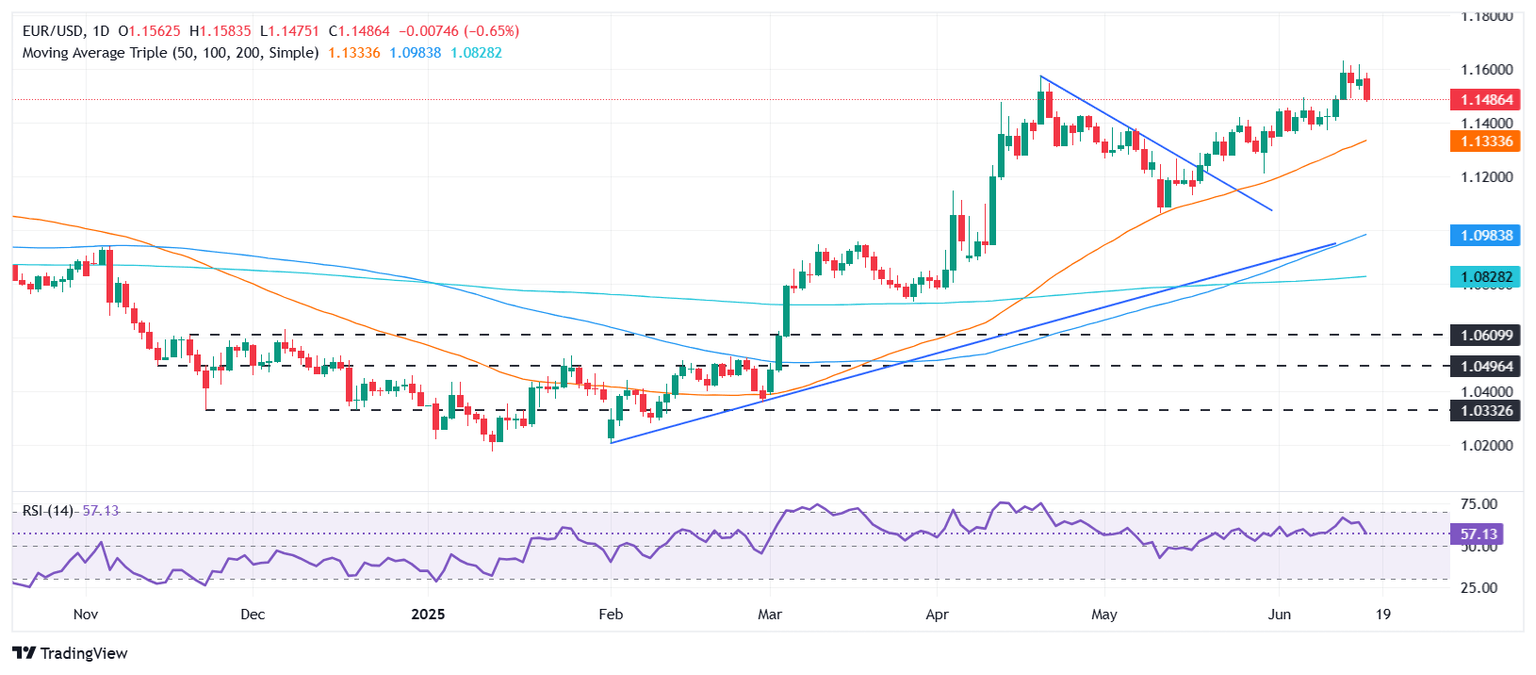
The EUR/USD pair is collapsing by over 0.60% as the US Dollar (USD) remains bid due to its safe-haven status amid the escalation of the Middle East conflict between Israel and Iran, which appears to be broadening as the White House considers its involvement. At the time of writing, the pair is trading at 1.1484, having dropped from daily highs of 1.1579.
Sentiment shifted sour as US President Trump posted on his social network a demand for Iran’s “unconditional surrender,” boosting the Greenback, which is hitting a four-day peak, as revealed by the US Dollar Index (DXY). The DXY, which tracks the US Dollar’s performance against other six currencies, posts a gain of over 0.67% at 98.79.
CNN reported that Trump’s decision to pursue a diplomatic exit from the Middle East conflict is waning, citing officials familiar with the matter. They added that Trump is evaluating using US military assets to strike Iran’s nuclear facilities.
Aside from geopolitics, US economic data revealed that US Retail Sales fell for the second consecutive month. At the same time, Industrial Production, announced by the Federal Reserve (Fed), also contracted. Across the pond in the Eurozone, German ZEW data exceeded forecasts, while two European Central Bank (ECB) officials had turned slightly neutral, adopting a wait-and-see mode.
Given the current backdrop, EUR/USD is likely to resume its ongoing uptrend. However, the Fed’s monetary policy meeting on Wednesday, the release of its latest Summary of Economic Projections (SEP) and the Chairman Jerome Powell press conference can dictate the pair’s direction.
Euro PRICE This week
The table below shows the percentage change of Euro (EUR) against listed major currencies this week. Euro was the strongest against the British Pound.
| USD | EUR | GBP | JPY | CAD | AUD | NZD | CHF | |
|---|---|---|---|---|---|---|---|---|
| USD | 0.51% | 0.96% | 0.51% | 0.69% | 0.10% | -0.00% | 0.59% | |
| EUR | -0.51% | 0.33% | -0.05% | 0.18% | -0.29% | -0.51% | 0.09% | |
| GBP | -0.96% | -0.33% | -0.33% | -0.15% | -0.61% | -0.83% | -0.24% | |
| JPY | -0.51% | 0.05% | 0.33% | 0.20% | -0.69% | -0.82% | -0.30% | |
| CAD | -0.69% | -0.18% | 0.15% | -0.20% | -0.52% | -0.69% | -0.10% | |
| AUD | -0.10% | 0.29% | 0.61% | 0.69% | 0.52% | -0.26% | 0.38% | |
| NZD | 0.00% | 0.51% | 0.83% | 0.82% | 0.69% | 0.26% | 0.60% | |
| CHF | -0.59% | -0.09% | 0.24% | 0.30% | 0.10% | -0.38% | -0.60% |
The heat map shows percentage changes of major currencies against each other. The base currency is picked from the left column, while the quote currency is picked from the top row. For example, if you pick the Euro from the left column and move along the horizontal line to the US Dollar, the percentage change displayed in the box will represent EUR (base)/USD (quote).
Daily digest market movers: EUR/USD plunges as sentiment worsens
- EUR/USD extended its losses, shrugging off the contraction of US Retail Sales in May, primarily due to a downturn in auto purchases. Sales in May decreased by 0.9% MoM, below the forecasted 0.7% decline. On an annual basis, sales rose 3.3%, easing from a 5% increase recorded in April.
- US Industrial Production declined by 0.2% MoM, missing estimates for a 0.1% uptick. This marks the second contraction in the past three months, indicating weakness in the manufacturing sector.
- On Tuesday and Wednesday, the Fed hosts its latest monetary policy meeting. Traders have priced in the expectation that rates will remain unchanged, but they’re eyeing the update of the Summary of Economic Projections (SEP).
- Regarding reaching a deal with the Eurozone, US President Trump said the European Union (EU) is not yet offering a fair deal.
- German ZEW data exceeded forecasts, with both metrics improving. ZEW noted that recent growth in investment and consumer demand has contributed to the upside.
- ECB Francois Villeroy commented that monetary policy is in a good position, even though tensions in the Middle East have risen. He supports ECB President Lagarde’s idea of a global role for the Euro. ECB Stournaras stated that the ECB had reached a “first point of equilibrium” and that further rate cuts would be data-dependent, as revealed by Greek media.
- It should be noted that the latest rise in Oil prices, sparked by the Middle East conflict, could trigger an inflation spiral, pushing prices higher and prompting central banks to become slightly hawkish.
- Financial market players do not expect that the ECB will reduce its Deposit Facility Rate by 25 basis points (bps) at the July monetary policy meeting.
Euro technical outlook: Bulls take a breather as EUR/USD drops below 1.1500
The EUR/USD uptrend trajectory is set to continue despite the ongoing pullback dragging spot prices below 1.15. Buyers are taking a respite, as depicted by the Relative Strength Index (RSI), suggesting that bullish momentum is fading.
This could pave the way for an EUR/USD retracement towards 1.1450 or below, challenging the 20-day Simple Moving Average (SMA) at 1.1411. Once cleared, 1.1400 is up next.
Conversely, if EUR/USD bulls regain 1.1500, immediate resistance emerges at 1.1600, followed by June 16 at 1.1614 and the yearly peak of 1.1631.
ECB FAQs
The European Central Bank (ECB) in Frankfurt, Germany, is the reserve bank for the Eurozone. The ECB sets interest rates and manages monetary policy for the region. The ECB primary mandate is to maintain price stability, which means keeping inflation at around 2%. Its primary tool for achieving this is by raising or lowering interest rates. Relatively high interest rates will usually result in a stronger Euro and vice versa. The ECB Governing Council makes monetary policy decisions at meetings held eight times a year. Decisions are made by heads of the Eurozone national banks and six permanent members, including the President of the ECB, Christine Lagarde.
In extreme situations, the European Central Bank can enact a policy tool called Quantitative Easing. QE is the process by which the ECB prints Euros and uses them to buy assets – usually government or corporate bonds – from banks and other financial institutions. QE usually results in a weaker Euro. QE is a last resort when simply lowering interest rates is unlikely to achieve the objective of price stability. The ECB used it during the Great Financial Crisis in 2009-11, in 2015 when inflation remained stubbornly low, as well as during the covid pandemic.
Quantitative tightening (QT) is the reverse of QE. It is undertaken after QE when an economic recovery is underway and inflation starts rising. Whilst in QE the European Central Bank (ECB) purchases government and corporate bonds from financial institutions to provide them with liquidity, in QT the ECB stops buying more bonds, and stops reinvesting the principal maturing on the bonds it already holds. It is usually positive (or bullish) for the Euro.
Author
Christian Borjon Valencia
FXStreet
Christian Borjon began his career as a retail trader in 2010, mainly focused on technical analysis and strategies around it. He started as a swing trader, as he used to work in another industry unrelated to the financial markets.