EUR/USD hits fresh lows ahead of US PMI, consumer sentiment data
- The Euro returns to lows near 1.1500 after failing to extend beyond 1.1550.
- Eurozone preliminary PMIs have crushed the Euro's frail recovery attempt.
- US Nonfarm payrolls beat forecasts in September, but the jobless rate grew unexpectedly

EUR/USD has reversed previous gains and trades at 1.1515 ahead of the US session opening, after hitting fresh two-week lows, right below the 1.1500 level earlier on the day. A frail Euro recovery was crushed by weaker Eurozone and German HCOB Purchasing Managers' Index (PMI) data, ahead of US preliminary PMIs and consumer sentiment releases
The Eurozone Manufacturing PMI fell into contraction levels, to a 49.7 reading in November, from 50.0 in October, against market expectations of an improvement, to 50.2. The Services PMI eased to 52.4, undershooting expectations of a steady 52.5 reading.
Likewise, German Manufacturing activity has shown a deeper contraction in November, with a decline to 48.4 from October's 49.6, while services activity eased to 52.7 from 54.6, well below market expectations of a 53.9 reading.
The US Dollar (USD), on the other hand, has maintained a firm tone through the week, as investors came to terms wth the fact that the US Federal Reserve (Fed) might take some time before easing its monetary policy further. The minutes of October's FOMC meeting revealed a wide divergence among policymakers, and the long-awaited Nonfarm Payrolls (NFP) data for September have failed to shed further light on the outcome of the Fed's December meeting.
Later today, European Central Bank officials, Luis de Guindos, Joachim Nagel, and José Luis Escrivá will take the stage. In the US session, the S&P Global preliminary PMIs and November's Michigan Consumer Sentiment Index, together with a slew of Fed officials, will provide the fundamental guidance for the USD.
Euro Price Today
The table below shows the percentage change of Euro (EUR) against listed major currencies today. Euro was the strongest against the Australian Dollar.
| USD | EUR | GBP | JPY | CAD | AUD | NZD | CHF | |
|---|---|---|---|---|---|---|---|---|
| USD | 0.07% | -0.05% | -0.56% | -0.06% | 0.04% | -0.17% | 0.00% | |
| EUR | -0.07% | -0.13% | -0.63% | -0.14% | -0.04% | -0.25% | -0.07% | |
| GBP | 0.05% | 0.13% | -0.53% | -0.01% | 0.10% | -0.12% | 0.06% | |
| JPY | 0.56% | 0.63% | 0.53% | 0.52% | 0.61% | 0.39% | 0.57% | |
| CAD | 0.06% | 0.14% | 0.00% | -0.52% | 0.10% | -0.12% | 0.08% | |
| AUD | -0.04% | 0.04% | -0.10% | -0.61% | -0.10% | -0.22% | -0.03% | |
| NZD | 0.17% | 0.25% | 0.12% | -0.39% | 0.12% | 0.22% | 0.17% | |
| CHF | -0.00% | 0.07% | -0.06% | -0.57% | -0.08% | 0.03% | -0.17% |
The heat map shows percentage changes of major currencies against each other. The base currency is picked from the left column, while the quote currency is picked from the top row. For example, if you pick the Euro from the left column and move along the horizontal line to the US Dollar, the percentage change displayed in the box will represent EUR (base)/USD (quote).
Daily digest market movers: Euro recovery loses steam
- US Dollar downside attempts remain limited, with investors paring back expectations of a Fed rate cut in December, while the Euro's recovery attempt is suffering a significant setback, following German and Eurozone's disappointing business activity figures.
- Earlier in the day, ECB President Christine Lagarde affirmed that Euro strength might bring down inflation further than expected, and that the bank will remain vigilant, ready to adjust its monetary policy if needed.
- In the US, S&P Global preliminary Manufacturing PMI is expected to have slowed to 52.0 in November from 52.5 in October, while the Services PMI is expected to remain steady at a 54.8 rate.
- Later on the day, the Michigan Consumer Sentiment Index is expected to show a moderate improvement, to 50.5 in November from last month's 50.3 reading. Consumer Inflation Expectations for the next 12 months are seen at 4.7% and at 3.6% in the next five years, in both cases, unchanged from October.
- On Thursday, US Nonfarm Payrolls data beat expectations with a 119K net increase in employment in September, well above the 50K gain consensus. August's reading was revised down to 4K net loss from the previously estimated 22K increase. The Unemployment Rate, however, unexpectedly rose to 4.4% from 4.3% in the previous month, which curbed market enthusiasm about the data release.
- In the Eurozone, the European Commission's preliminary Consumer Confidence Index remained steady at -14.2 in November, against expectations of a moderate improvement to -14.0.
Technical Analysis: EUR/USD remains vulnerable below 1.1550
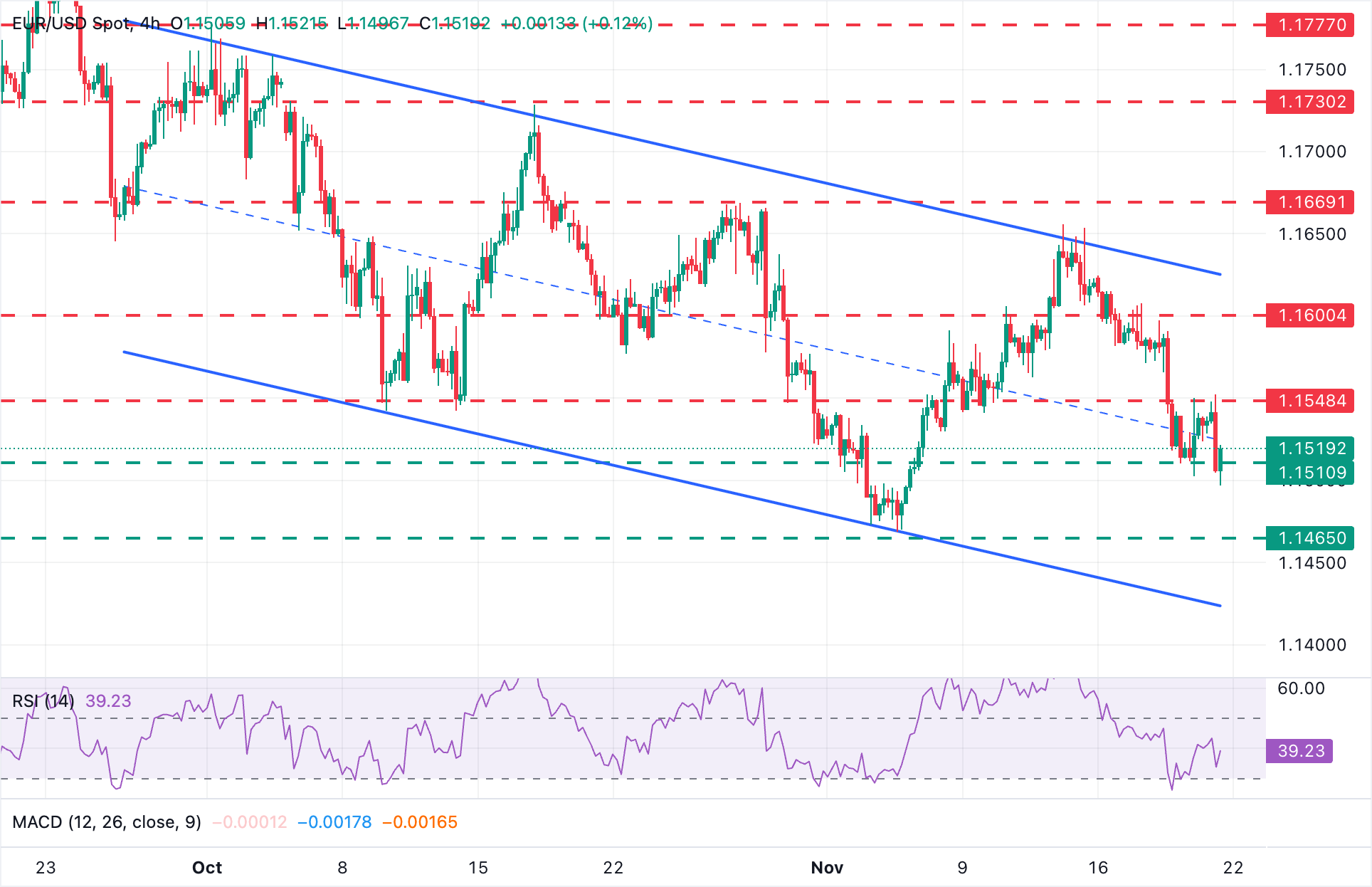
The EUR/USD has found support at the 1.1500 psychological level, but is failing to find acceptance above 1.1550, which leaves the pair vulnerable to further depreciation. Technical indicators are trending higher on the 4-hour chart, but the Relative Strength Index (RSI) remains below the key 50 level, which suggests that the recovery attempt remains frail.
The pair should breach Thursday's high at the mentioned 1.1550 level, to gather momentum, and shift the focus to the November 18 and 19 highs in the area of 1.1600 and to the top of a descending channel from the mid-October highs, which is now around 1.1625.
However, failure to break 1.1550 might increase bears' confidence to retest the 1.1500 psychological level, focusing on the November 5 lows, near 1.1470, and the mentioned channel support, around 1.1425
Economic Indicator
S&P Global Services PMI
The S&P Global Services Purchasing Managers Index (PMI), released on a monthly basis, is a leading indicator gauging business activity in the US services sector. As the services sector dominates a large part of the economy, the Services PMI is an important indicator gauging the state of overall economic conditions. The data is derived from surveys of senior executives at private-sector companies from the services sector. Survey responses reflect the change, if any, in the current month compared to the previous month and can anticipate changing trends in official data series such as Gross Domestic Product (GDP), industrial production, employment and inflation. A reading above 50 indicates that the services economy is generally expanding, a bullish sign for the US Dollar (USD). Meanwhile, a reading below 50 signals that activity among service providers is generally declining, which is seen as bearish for USD.
Read more.Next release: Fri Nov 21, 2025 14:45 (Prel)
Frequency: Monthly
Consensus: 54.8
Previous: 54.8
Source: S&P Global
Economic Indicator
S&P Global Manufacturing PMI
The S&P Global Manufacturing Purchasing Managers Index (PMI), released on a monthly basis, is a leading indicator gauging business activity in the US manufacturing sector. The data is derived from surveys of senior executives at private-sector companies from the manufacturing sector. Survey responses reflect the change, if any, in the current month compared to the previous month and can anticipate changing trends in official data series such as Gross Domestic Product (GDP), industrial production, employment and inflation. A reading above 50 indicates that the manufacturing economy is generally expanding, a bullish sign for the US Dollar (USD). Meanwhile, a reading below 50 signals that activity in the manufacturing sector is generally declining, which is seen as bearish for USD.
Read more.Next release: Fri Nov 21, 2025 14:45 (Prel)
Frequency: Monthly
Consensus: 52
Previous: 52.5
Source: S&P Global
Author

Guillermo Alcala
FXStreet
Graduated in Communication Sciences at the Universidad del Pais Vasco and Universiteit van Amsterdam, Guillermo has been working as financial news editor and copywriter in diverse Forex-related firms, like FXStreet and Kantox.

















