|

EUR/USD: Investors continue to add bets to position for drop in EUR

  • EUR/USD put (bearish) bias is the strongest in nearly three months. 
  • The pair risks extending the six-day losing streak on sliding German yields and growth concerns. 
  • Risk-on, however, could yield a minor corrective bounce. 

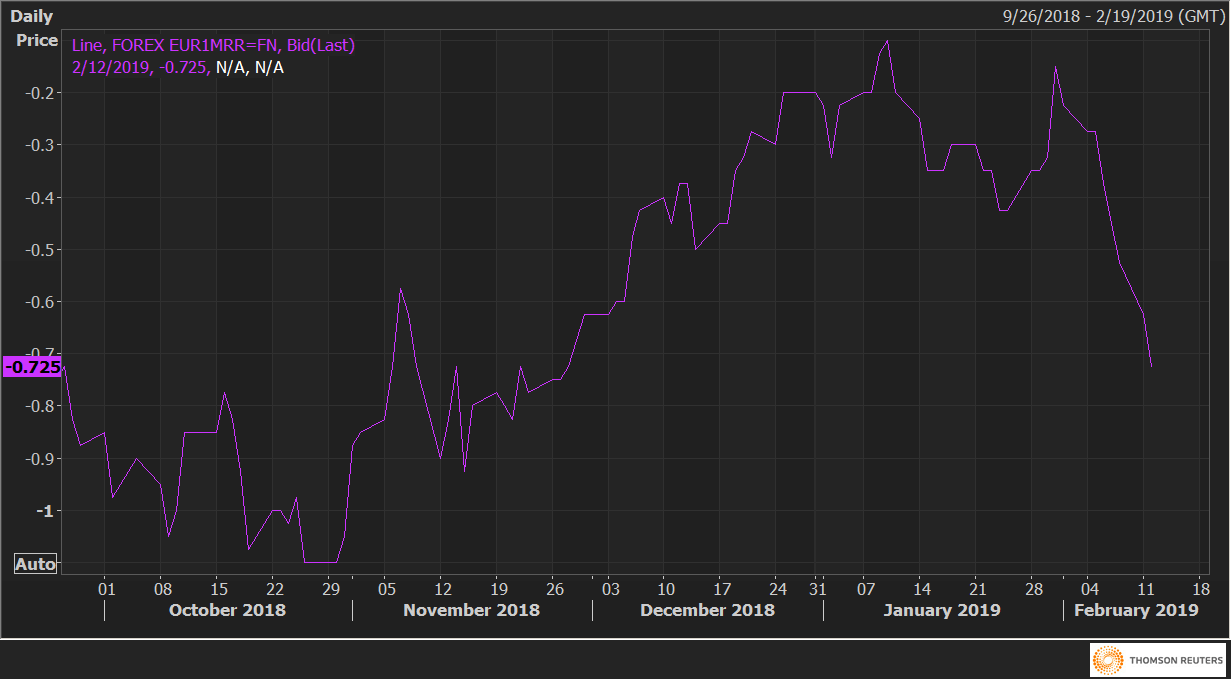
Risk reversals on the EUR, a gauge of calls to puts on the common currency, fell to its lowest level since the end of November, indicating investors are adding bets to position for further weakness in the EUR. 

As of writing, one-month 25 delta risk reversals are trading at -0.725 in favor of put options (bearish bets), the lowest level since Nov. 28. Notably, the gauge stood at -0.15 on Jan. 31. 

Put simply, investors are expecting EUR/USD to extend the six-day winning streak. After all, the European Central Bank (ECB) rate hike is increasingly looking like a distant dream, courtesy of a sharp slowdown in Germany and other core economies of the Eurozone

The technicals are also biased bearish: the 5- and 10-day moving averages (MAs) are trending south and the pair closed below the January low 1.1289 yesterday, having breached the crucial 200-week MA support on Friday. 

As a result, the November low of 1.1215 could come into play, possibly after a minor bounce, as the risk-on seen in the Asian equities and S&P 500 futures could hit the European shores, leading to broad-based USD weakness. 

A drop to 1.125 would also remain elusive if Bundesbank President and ECB member Weidmann downplays recession fears. 

EUR/USD pivot points

    1. R3 1.138
    2. R2 1.1356
    3. R1 1.1316
  1. PP 1.1292
    1. S1 1.1252
    2. S2 1.1228
    3. S3 1.1188

EUR1MRR

Author

Omkar Godbole

Omkar Godbole

FXStreet Contributor

Omkar Godbole, editor and analyst, joined FXStreet after four years as a research analyst at several Indian brokerage companies.


More from Omkar Godbole
Share:

Markets move fast. We move first.

Orange Juice Newsletter brings you expert driven insights - not headlines. Every day on your inbox.

By subscribing you agree to our Terms and conditions.

Editor's Picks

EUR/USD declines toward 1.1700 on solid USD recovery

EUR/USD turns south and declines toward 1.1700 on Wednesday. A solid comeback staged by the US Dollar weighs heavily on the pair, as traders look to USD short covering ahead of US CPI on Thursday. However, the downside could be capped by hawkish ECB expectations. 

GBP/USD slides toward 1.3300 after softer-than-expected UK inflation data

GBP/USD has come under intense selling pressure, eyeing 1.3300 in the European session on Wednesday. The UK annual headline and core CPI rose by 3.2% each, missing estimates of 3.5% and 3.4%, respectively, reaffirming dovish BoE expectations and smashing the Pound Sterling across the board. 

Gold clings to modest gains above $4,300

Following Tuesday's volatile action, Gold regains its traction on Wednesday and trades in positive territory above $4,300. While the buildup in the USD recovery momentum caps XAU/USD's upside, the cautious market stance helps ithe pair hold its ground.

Bitcoin, Ethereum and Ripple extend correction as bearish momentum builds

Bitcoin, Ethereum, and Ripple remain under pressure as the broader market continues its corrective phase into midweek. The weak price action of these top three cryptocurrencies by market capitalization suggests a deeper correction, as momentum indicators are beginning to tilt bearish.

Ukraine-Russia in the spotlight once again

Since the start of the week, gold’s price has moved lower, but has yet to erase the gains made last week. In today’s report we intend to focus on the newest round of peace talks between Russia and Ukraine, whilst noting the release of the US Employment data later on day and end our report with an update in regards to the tensions brewing in Venezuela.

AAVE slips below $186 as bearish signals outweigh the SEC investigation closure

Aave (AAVE) price continues its decline, trading below $186 at the time of writing on Wednesday after a rejection at the key resistance zone. Derivatives positioning and momentum indicators suggest that bearish forces still dominate in the near term.