EUR/USD holds steady around 1.0980 as upbeat US PMIs ease recession fears
- S&P Global PMI figures ease recessionary fears, boost US economy.
- Traders’ moods fluctuating to risk-on/off dominated the New York session.
- EU’s PMI results are mixed; manufacturing activity shranks, while Services and Composite Indices exceed expectations.
- Markets remain cautious amid uncertain rate outlooks from the Fed and the ECB.

The EUR/USD prepares to finish the week on a higher note, though it remains below the 1.1000 figure, albeit economic data from the United States (US) bolstered the US Dollar (USD). However, late into the Wall Street close, the greenback lost strength, US equities rose, and the Euro (EUR) recovered some ground. Hence, the EUR/USD is trading at 1.0988 after reaching a low of 1.0937.
US business activity picked up, but not so in the EU
Sentiment across the New York (NY) session fluctuated between risk-on/off. Investors’ recessionary fears about the US were pushed away by April’s S&P Global PMI figures, which showed the economy’s resilience, despite the US Federal Reserve (Fed) 475 bps of tightening. Manufacturing and Services PMIs exceeded estimates, with the former at 50.4, above 49 expectations, while the latter jumped to 53.7 from 51.5 estimates. Therefore, the Composite Index aimed higher to 53.5.
The market initially reacted to buying the US Dollar, which gained some ground vs. the Euro, as it dived to 1.0942. Nevertheless, buyers moved in and lifted the EUR/USD pair, though they failed to crack the 1.1000 mark.
This happened after Thursday’s data, namely, US unemployment claims, housing data, and the Philadelphia Fed Manufacturing Index, flashed a gloomy scenario, triggering flows towards safety, except for the US Dollar.
Aside from this, on the Eurozone (EU) side, Thursday’s calendar featured a surplus in the Balance of Trader of €4.6B, better than January’s deficit of €-31.6B, which was upward revised, alongside the Consumer Confidence, which improved a tick, to -17.5 above -18.5 estimates.
On Friday, the EU’s PMI was mixed, with the Manufacturing Index at 45.5, standing at contractionary territory missing estimates, while the Services and Composite Indices exceeded the consensus, expanding.
Fed and ECB May decisions loom
Meanwhile, central bankers from both sides of the Atlantic continued their hawkish rhetoric. For one part, Federal Reserve (Fed) officials agreed that inflation is too high, though there’s a myriad of opinions regarding how much tightening is left. On the European Central Bank (ECB), the baseline was made by its ECB Chief Economist Philip Lane, with most policymakers yet undecided about lifting rates by 50 or 25 bps.
EUR/USD Technical Analysis
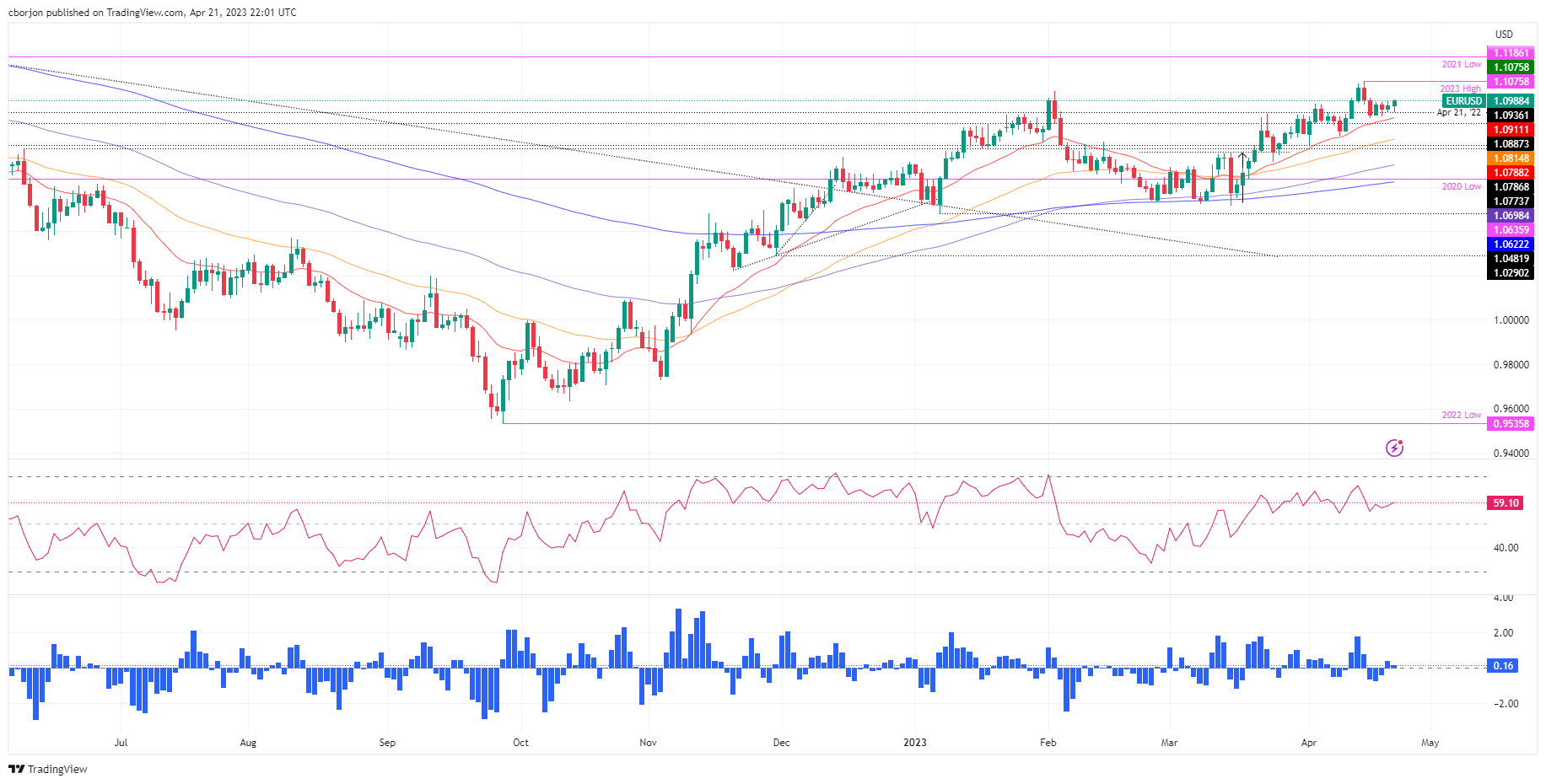
From a daily chart perspective, the EUR/USD remains supported by the 20-day EMA from March 20 until today. Yet EUR/USD tested the April 21, 2022 high-turned-support at 1.0936, bounced off, and clung to the 1.0980s area amidst the lack of an impactful catalyst that could break the EUR/USD’s trading range. Should the EUR/USD reclaim 1.1000, a test to the YTD high is on the cards, followed by 1.1100. Conversely, a fall below 1.0900 will expose the 20-day EMA at 1.0911. If EUR/USD drops below the latter, a dive to 1.0800 is likely.
Author

Christian Borjon Valencia
FXStreet
Markets analyst, news editor, and trading instructor with over 14 years of experience across FX, commodities, US equity indices, and global macro markets.