EUR/USD hits monthly high above 1.0900, makes a U-Turn on rising US yields, ahead of Powell’s speech
- EUR/USD drops 0.43%, reaching a monthly low of 1.0832, with eyes on the 200-day Moving Average.
- US Dollar Index (DXY) climbs 0.26% to 103.591 as US Treasury bond yields bolster the greenback.
- Eurozone’s light economic agenda keeps EUR/USD steady; S&P Global PMIs release awaited for directional cues.

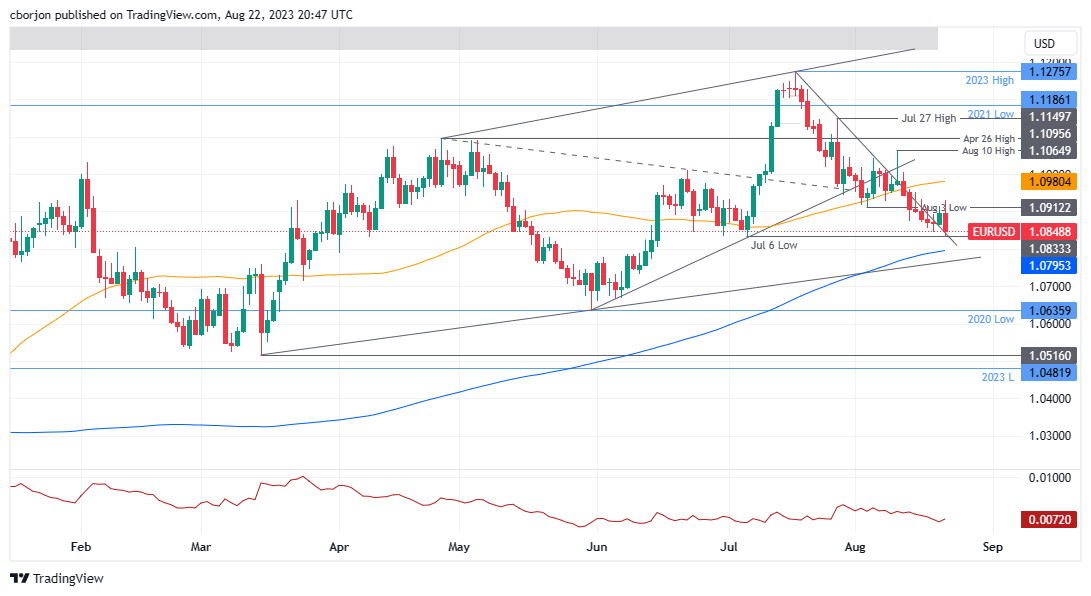
EUR/USD lost traction and registered losses of 0.43% on Tuesday, printing a new monthly low of 1.0832 and set to extend its fall toward the 200-day Moving Average (DMA) at 1.0795. However, late EUR/USD buyers stepped into the market and lifted the pair, which trades at 1.0848 after hitting a daily high of 1.0930.
US Stocks Uncertain; Richmond Fed’s Data and NAR’s Home Sales Report Influence Market Sentiment
US stocks waver amidst traders’ fragile sentiment as they brace for the US Federal Reserve Chair Jerome Powell’s speech at the Jackson Hole Symposium. US Treasury bond yields underpinned the greenback, with the 3-month, two, and 5-year Treasuries posting gains within the 0.28% - 0.78% range. Consequently, the buck climbs, as depicted by the US Dollar Index (DXY), which measures the buck’s value against a basket of six currencies, gains 0.26%, at 103.591.
Data-wise, the National Association of Realtors (NAR) released data indicating a -2.2% decrease in Existing Home Sales for July. However, it represents an improvement compared to the prior month’s -3.3%. NAR Chief Economist Lawrence Yun attributed this decline to factors such as limited “inventory availability” and elevated “mortgage rates,” according to the report.
The Richmond Fed revealed its Manufacturing Index for August, which plummeted -7 as expected in August, though its Services Index exceeded estimates of a -4 contraction, came at 4.
In recent statements by Richmond Fed President Thomas Barkin, he emphasized that the yield shift does not indicate “inappropriate” market tightening. Instead, he views it as a reaction to robust economic data. Barkin further stated that if inflation maintains its elevated levels and the economy continues showing signs of strength, it would bolster the argument for additional tightening measures.
Across the pond, a light Eurozone (EU) economic docket keeps the EUR/USD pair trading within familiar levels but set to test the next dynamic support at 200-DMA. On Wednesday, the release of S&P Global PMIs could dictate the direction of the EUR/YSD. On the US front, the economic docket would feature Fed speakers, S&P Global PMIs, Durable Good Orders, and New Home Sales.
EUR/USD Price Analysis: Technical outlook
The EUR/USD is still neutral to downward biased, as price action achieved successive series of lower highs and lower lows, with the August 3 daily low of 1.0912, seen as the first resistance level, crucial for buyers if they want to resume the uptrend. In that outcome, the next resistance would be the 50-DMA at 1.0980 before challenging 1.1000. Nonetheless, the EUR/USD’s path of least resistance is downwards. The first support would be the August 22 low of 1.0832, followed by the 1.0800 mark. A breach of the latter will expose the 200-DMA at 1.0795, and the mid-point between 1.07/1.08.
Author

Christian Borjon Valencia
FXStreet
Markets analyst, news editor, and trading instructor with over 14 years of experience across FX, commodities, US equity indices, and global macro markets.