EUR/USD hits five-year peak above 1.2080 as Trump dismisses Dollar
- EUR/USD surges over 1.3% after Trump signals comfort with Dollar weakness on Fox News.
- DXY tumbles to near four-year lows as tariffs on South Korea reignite the “sell America” trade.
- ECB officials strike a steady tone, reinforcing policy stability as Euro momentum accelerates.

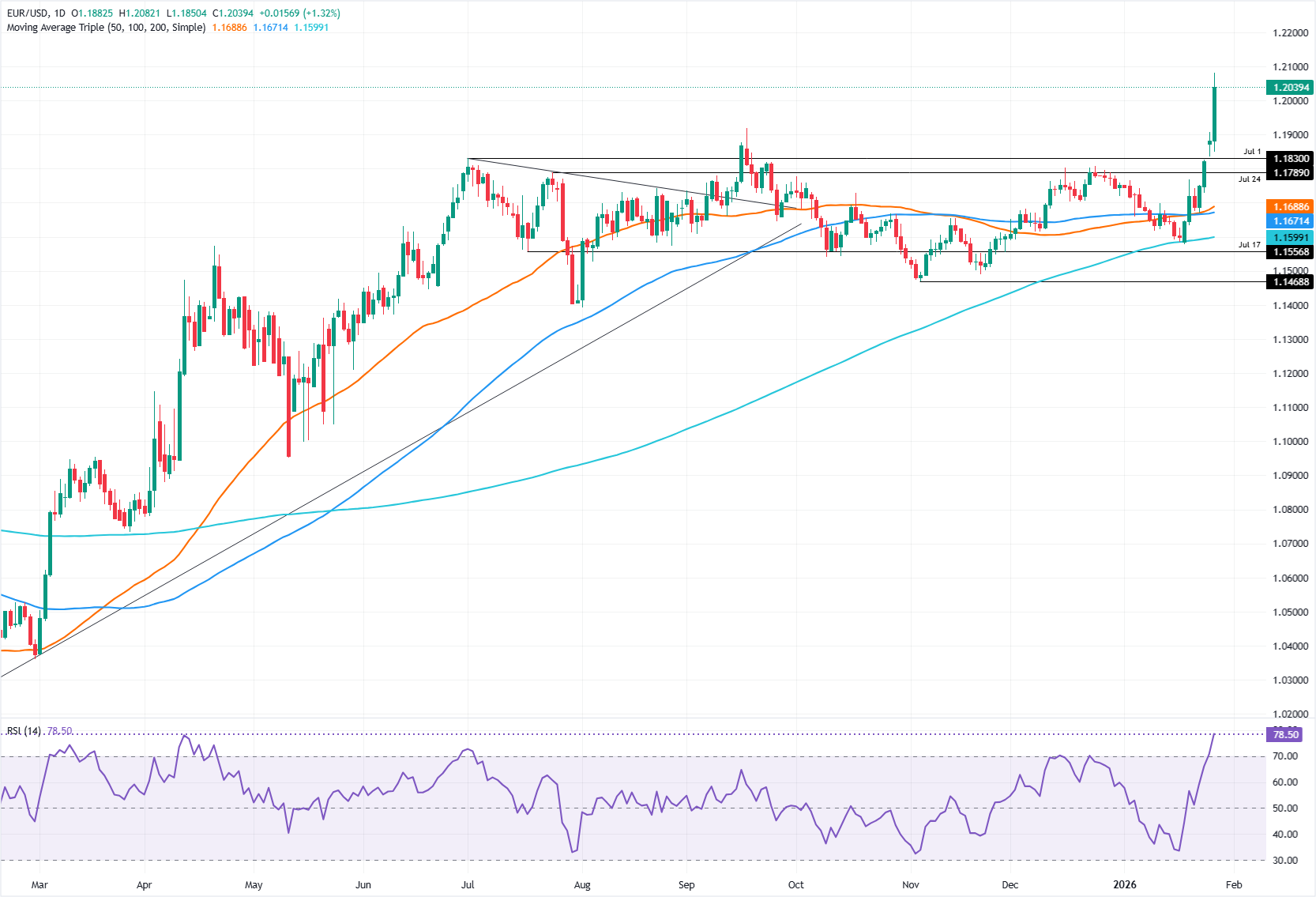
EUR/USD skyrockets to a new five-year high of 1.2082 on Tuesday after US President Donald Trump expressed that he does not think the Dollar has fallen too much, triggering a sell-off of the Greenback, which is down so far over 1.31% in the day. At the time of writing, the pair trades at 1.2037 up more than 1.30%.
Euro rockets as Trump’s comments greenlight aggressive Dollar selling amid trade-war escalation fears
On remarks at Fox News, Trump showed no concern about the US Dollar, adding that “The Dollar is seeking its own level, which is fair.” He added that the Dollar could be “up or down like a yo-yo.”
This was a green light for traders, following Trump tariff threats on South Korea due to the country’s failure to approve the trading deal. The White House announced 25% duties on Korean goods.
The US Dollar Index (DXY) which measures the buck’s performance against six peers is down 1.30% at 95.79, slightly higher than the four-year low reached on Trump’s remarks.
Economic data in the US revealed that Consumer Confidence deteriorated according to the Conference Board. Earlier, the ADP Employment Change 4-week average showed signs of weakness compared to the prior’s reading, dipping from 8,000 to 7,750.
Across the pond, European Central Bank (ECB) policymakers crossed the wires. Joachim Nagel of the Bundesbank said that there is no good argument for changing rates In either direction. ECB’s Martin Kocher.
ECB's Nagel said there is no reason to change rates anytime soon and agrees with Chief Economist Lane that there is no good argument for changing rates in either direction. ECB's Kocher remarked officials must be ready to act if needed.
Euro Price This week
The table below shows the percentage change of Euro (EUR) against listed major currencies this week. Euro was the strongest against the US Dollar.
| USD | EUR | GBP | JPY | CAD | AUD | NZD | CHF | |
|---|---|---|---|---|---|---|---|---|
| USD | -1.41% | -1.31% | -1.37% | -0.91% | -1.19% | -1.31% | -1.66% | |
| EUR | 1.41% | 0.11% | 0.04% | 0.50% | 0.24% | 0.11% | -0.23% | |
| GBP | 1.31% | -0.11% | -0.38% | 0.39% | 0.12% | -0.01% | -0.34% | |
| JPY | 1.37% | -0.04% | 0.38% | 0.47% | 0.19% | 0.09% | -0.30% | |
| CAD | 0.91% | -0.50% | -0.39% | -0.47% | -0.40% | -0.38% | -0.73% | |
| AUD | 1.19% | -0.24% | -0.12% | -0.19% | 0.40% | -0.13% | -0.50% | |
| NZD | 1.31% | -0.11% | 0.00% | -0.09% | 0.38% | 0.13% | -0.33% | |
| CHF | 1.66% | 0.23% | 0.34% | 0.30% | 0.73% | 0.50% | 0.33% |
The heat map shows percentage changes of major currencies against each other. The base currency is picked from the left column, while the quote currency is picked from the top row. For example, if you pick the Euro from the left column and move along the horizontal line to the US Dollar, the percentage change displayed in the box will represent EUR (base)/USD (quote).
Daily digest market movers: Euro is boosted by Trump comments
- US Consumer Confidence sank to its lowest level since 2014, with the Conference Board index sliding to 84.5 in January from an upwardly revised 94.2 in December.
- Dana M. Peterson, Chief Economist at the Conference Board, said that confidence “collapsed” in January, as worries about both current conditions and the outlook intensified. She noted that all five components of the index weakened, dragging confidence to its lowest reading since May 2014.
- On Wednesday, the Federal Reserve is widely expected to keep interest rates unchanged. However, markets will be closely focused on the press conference by Fed Chair Jerome Powell, particularly for any comments addressing questions around central bank independence.
- Speculation over a potential coordinated intervention by Japanese and US authorities to support the Yen pressured the US Dollar, looms. This following the Yen’s exchange rate check of the Federal Reserve Bank of New York with financial institutions.
- Prime Market Terminal data shows that traders are expecting 44 basis points of easing by the Federal Reserve towards the end of the year.
Technical outlook: EUR/USD rallies past 1.2000, eyes on 1.2100
The EUR/USD uptrend stays intact following Trump’s comments. This along with divergence between the Fed and the ECB might decrease the interest rate differential, increasing the prospects of the shared currency.
If EUR/USD climbs above 1.2100, the next resistance would be 1.2150 and the 1.2200 figure. Worth noting that bullish momentum is at its most extreme reading as depicted by the Relative Strength Index (RSI), which peaked at 76.90, shy of the most extreme high seen on July 30, 2020.
If the pair reverses below 1.2000, the first support would be 1.1950, followed by last year’s high of 1.1918 ahead of 1.1900. On further weakness, the next support would be the January 26 low of 1.1834.
Euro FAQs
The Euro is the currency for the 20 European Union countries that belong to the Eurozone. It is the second most heavily traded currency in the world behind the US Dollar. In 2022, it accounted for 31% of all foreign exchange transactions, with an average daily turnover of over $2.2 trillion a day. EUR/USD is the most heavily traded currency pair in the world, accounting for an estimated 30% off all transactions, followed by EUR/JPY (4%), EUR/GBP (3%) and EUR/AUD (2%).
The European Central Bank (ECB) in Frankfurt, Germany, is the reserve bank for the Eurozone. The ECB sets interest rates and manages monetary policy. The ECB’s primary mandate is to maintain price stability, which means either controlling inflation or stimulating growth. Its primary tool is the raising or lowering of interest rates. Relatively high interest rates – or the expectation of higher rates – will usually benefit the Euro and vice versa. The ECB Governing Council makes monetary policy decisions at meetings held eight times a year. Decisions are made by heads of the Eurozone national banks and six permanent members, including the President of the ECB, Christine Lagarde.
Eurozone inflation data, measured by the Harmonized Index of Consumer Prices (HICP), is an important econometric for the Euro. If inflation rises more than expected, especially if above the ECB’s 2% target, it obliges the ECB to raise interest rates to bring it back under control. Relatively high interest rates compared to its counterparts will usually benefit the Euro, as it makes the region more attractive as a place for global investors to park their money.
Data releases gauge the health of the economy and can impact on the Euro. Indicators such as GDP, Manufacturing and Services PMIs, employment, and consumer sentiment surveys can all influence the direction of the single currency. A strong economy is good for the Euro. Not only does it attract more foreign investment but it may encourage the ECB to put up interest rates, which will directly strengthen the Euro. Otherwise, if economic data is weak, the Euro is likely to fall. Economic data for the four largest economies in the euro area (Germany, France, Italy and Spain) are especially significant, as they account for 75% of the Eurozone’s economy.
Another significant data release for the Euro is the Trade Balance. This indicator measures the difference between what a country earns from its exports and what it spends on imports over a given period. If a country produces highly sought after exports then its currency will gain in value purely from the extra demand created from foreign buyers seeking to purchase these goods. Therefore, a positive net Trade Balance strengthens a currency and vice versa for a negative balance.
Author

Christian Borjon Valencia
FXStreet
Markets analyst, news editor, and trading instructor with over 14 years of experience across FX, commodities, US equity indices, and global macro markets.














