|

EUR/USD heads into Friday near 1.0550 ahead of EU CPI, US PCE inflation

  • The EUR/USD saw gains for Thursday as the DXY recedes.
  • Analysts expect further weakness from the Euro moving forward on the end of rate hike cycles.
  • Friday to close out the trading week with EU & US key inflation measures.

The EUR/USD tapped into an intraday high of 1.0580 on Thursday before settling to close out the US trading session down near 0.10550. The US Dollar (USD) has gained across the board with the US Dollar Index (DXY) catching a broad-market lift as risk appetite sours on weakening economic data, spiking Treasury yields, and recession concerns.

Investors are gearing up for a full data docket on Friday, with European Consumer Price Index (CPI) figures kicking things off.

European inflation is expected to decline moderately. with the annualized CPI reading for September forecast to tick down from 5.3% to 4.8%. 

Market forecasters are expecting a half-percent cut in the rate of price growth for Europe as the continental economy wobbles, with a dovish European Central Bank (ECB) looking entirely set to start looking for rate cuts if the economy continues to sour.

Friday will also see US Personal Consumption Expenditure (PCE) Price Index numbers. US PCE inflation is forecast to hold steady for the month of August at 0.2%, while the annualized figure for the same period is seen ticking lower from 4.2% to 3.9%.

Analysts broadly expect both EU and US inflation readings to step lower, but the weak-side bet goes to Europe as price growth is expected to slump noticeably in the coming months.

Read More:

The Pound and Euro should weaken substantially through early 2024 – Wells Fargo

EUR/USD Price Analysis: A drop to the YTD low appears on the table

Eurozone HICP Preview: Forecasts from five major banks, overall inflation-slowing trend

EUR/USD technical outlook

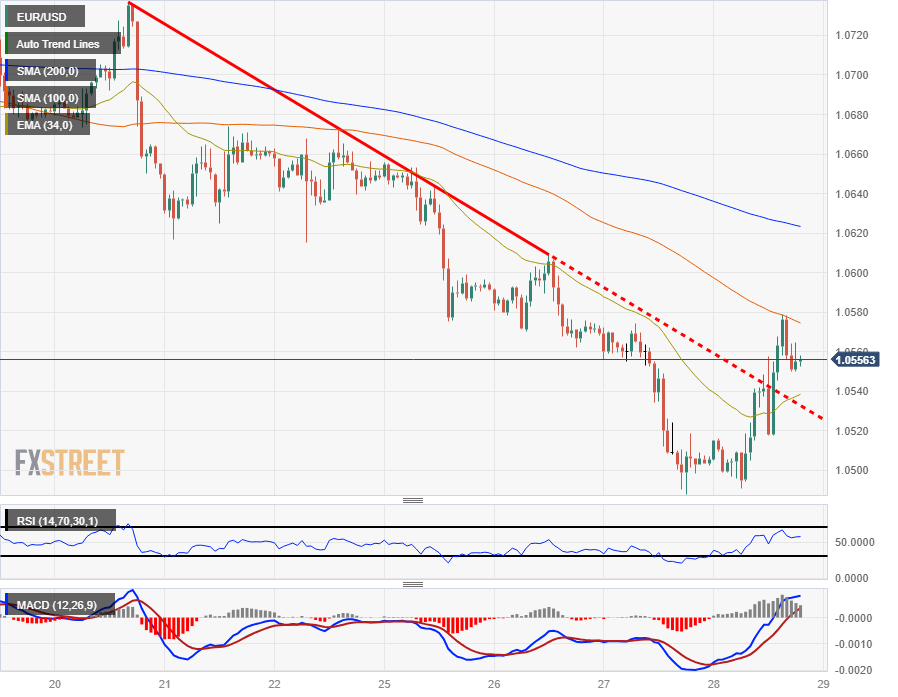
The EUR/USD is testing around 1.0555 after taking a downside rebound from the 100-hour Simple Moving Average (SMA) near 1.0580 in mid-Thursday trading. Hourly candles have broken to the upside of a descending intraday trendline from last week's swing high near 1.0730.

Technical resistance comes from the 200-hour SMA near 1.0620, while near-term price action will see support from the 34-hour Exponential Moving Average (EMA) near 1.0540.

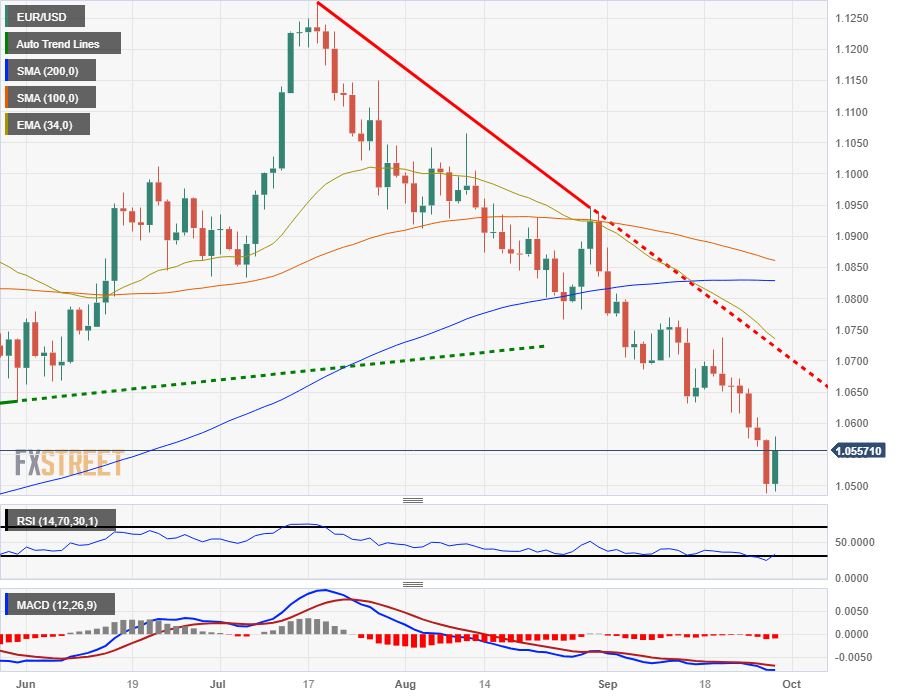
On the daily candlesticks, the EUR/USD is desperate for a green day after closing flat or in the red for the past seven straight trading sessions, and price action still remains firmly bearish with upside momentum capped by a descending trendline from July's peak near 1.1275.

The EUR/USD daily candles have accelerated away from the 200-day SMA, which is turning bearish from just north of the 1.0800 handle.

EUR/USD hourly chart
EUR/USD daily chart
EUR/USD technical levels

EUR/USD

Overview
Today last price1.0556
Today Daily Change0.0053
Today Daily Change %0.50
Today daily open1.0503
 
Trends
Daily SMA201.069
Daily SMA501.0845
Daily SMA1001.0865
Daily SMA2001.0829
 
Levels
Previous Daily High1.0575
Previous Daily Low1.0488
Previous Weekly High1.0737
Previous Weekly Low1.0615
Previous Monthly High1.1065
Previous Monthly Low1.0766
Daily Fibonacci 38.2%1.0521
Daily Fibonacci 61.8%1.0542
Daily Pivot Point S11.0469
Daily Pivot Point S21.0435
Daily Pivot Point S31.0383
Daily Pivot Point R11.0556
Daily Pivot Point R21.0608
Daily Pivot Point R31.0642

Author

Joshua Gibson

Joshua joins the FXStreet team as an Economics and Finance double major from Vancouver Island University with twelve years' experience as an independent trader focusing on technical analysis.


More from Joshua Gibson
Share:

Editor's Picks

AUD/USD consolidates above 0.7000/two-month low; bearish potential intact

The AUD/USD pair oscillates in a narrow range during the Asian session, and moves little following the release of mixed inflation figures from China. Spot prices currently trade around the 0.7025 region, nearly unchanged for the day, and remain within striking distance of a nearly two-month low set on Tuesday. Renewed hostilities between the US and Iran temper hopes for a deal to end the over three-month-old war.

Japanese Yen languishes despite wholesale inflation accelerates in May

USD/JPY flatlines after experiencing volatility, trading around 160.40 during the Asian hours on Wednesday. The pair continues to hold its ground, reflecting a struggling Japanese Yen that has failed to find support despite a massive acceleration in wholesale inflation. Driven by surging energy costs linked to the ongoing Middle East conflict, Japan’s Producer Price Index jumped 6.3% year-over-year in May. This hot printing comfortably outpaced April’s upwardly revised 5.3% figure and surpassed market consensus of 5.5%, marking the fastest pace of wholesale price growth in three years.

Gold plummets below $4,200 amid US‑Iran tensions ahead of US CPI

Gold extends the recent breakdown momentum below a technically significant 200-day Simple Moving Average (SMA) and drops to a fresh low since March 23, further below the $4,200 mark during the Asian session. Crude Oil prices rise amid renewed hostilities between the US and Iran, fueling inflation fears and bolstering bets for more hawkish central banks.

Bitcoin remains vulnerable, Ethereum weakens further, XRP signals more downside

Bitcoin, Ethereum, and Ripple remain under pressure mid-week, as the broader cryptocurrency market struggles to regain recovery momentum after last week’s massive correction. BTC struggles below $62,000, ETH continues to weaken below $1,650, while XRP’s momentum indicators remain biased toward further downside.

US CPI data set to show inflation at three-year high in May, backing Fed hawkish tilt

The US Bureau of Labor Statistics will publish the May Consumer Price Index (CPI) data on Wednesday. The report is expected to show another step up in consumer inflation, driven by the persistently high Oil prices due to the ongoing crisis in the Middle East.

The US economy defies the rules: 100 days into the Oil shock and the recession signal is still missing

More than three months after the start of the Iran war and the resulting disruption to global energy markets, the US economy continues to display remarkable resilience. The conflict has triggered a sharp rise in Oil prices, reignited inflationary pressures and fueled widespread concerns about a potential economic slowdown.














