EUR/USD flat near 1.1540 as NFP surprise bolsters dovish Fed bets
- EUR/USD trades at 1.1538 after solid US jobs growth offsets a softer unemployment reading.
- Markets lift the probability of a December rate cut to 39% amid mixed messages from Fed officials.
- Eurozone sentiment is stable at -14.2, while German producer prices meet expectations with limited impact.

EUR/USD holds firm on Thursday after an outstanding jobs report in the United States (US), hinting that the labor market remains solid, despite softening during the second half of 2025. At the time of writing, the pair trades at 1.1533.
Euro holds firm despite upbeat US jobs data, investors increased expectations for a December cut
The reopening of the US government keeps economic data flowing, despite being delayed, as the September Nonfarm Payrolls, which should’ve been released on the first Friday of October, crushed the forecasts. Despite this, not everything was good news as the Unemployment Rate ticked higher but remained within the Federal Reserve’s (Fed) latest projections.
After the data, investors increased bets that the Fed could reduce borrowing costs at the December meeting, from 29% to 39%, according to the CME FedWatch Tool.
Federal Reserve officials had crossed the wires. The hawkish leaning were Chicago Fed Austan Goolsbee, Cleveland Fed Beth Hammack, and Fed Governor Michael Barr. The latest surprised the markets, saying that he is worried that inflation is still at 3%.
In the Eurozone, Consumer Confidence printed -14.2 in November, the same as in October, which was the highest level since February. Germany revealed that producer prices were mostly aligned with forecasts, though they had a limited impact on the Euro.
Daily market movers: Strong NFP data, caps Euro's recovery
- US Nonfarm Payrolls in September rose by 119K, well above the 50K expected and a sharp rebound from August’s –4K print. The Unemployment Rate ticked up to 4.4% from 4.3%, though it remained below the Federal Reserve’s 2025 projection of 4.5% outlined in the Summary of Economic Projections (SEP).
- The Department of Labor reported that Initial Jobless Claims for the week ending November 15 fell to 220K — the lowest level since September — signaling that the labor market, while softening, continues to show underlying stability.
- Chicago Fed Austan Goolsbee said that inflation at 3% is too high and appears to have stalled. He added that he’s “uneasy frontloading too many rate cuts.” Cleveland Fed President Beth Hammack cautioned that easing monetary policy at this stage could encourage excessive financial risk-taking. She warned that “cutting rates risks prolonging high inflation,” and added that current financial conditions remain “quite accommodative.”
- Federal Reserve Governor Michael Barr adopted a hawkish tone, saying he remains concerned that inflation is still running around 3%, well above the Fed’s 2% target.
- The US Dollar Index (DXY), which measures the Greenback’s value against a basket of six currencies, is up 0.10% at 100.22, capping the Euro’s advance.
Technical Outlook: Euro's downtrend stalls, remains bearish
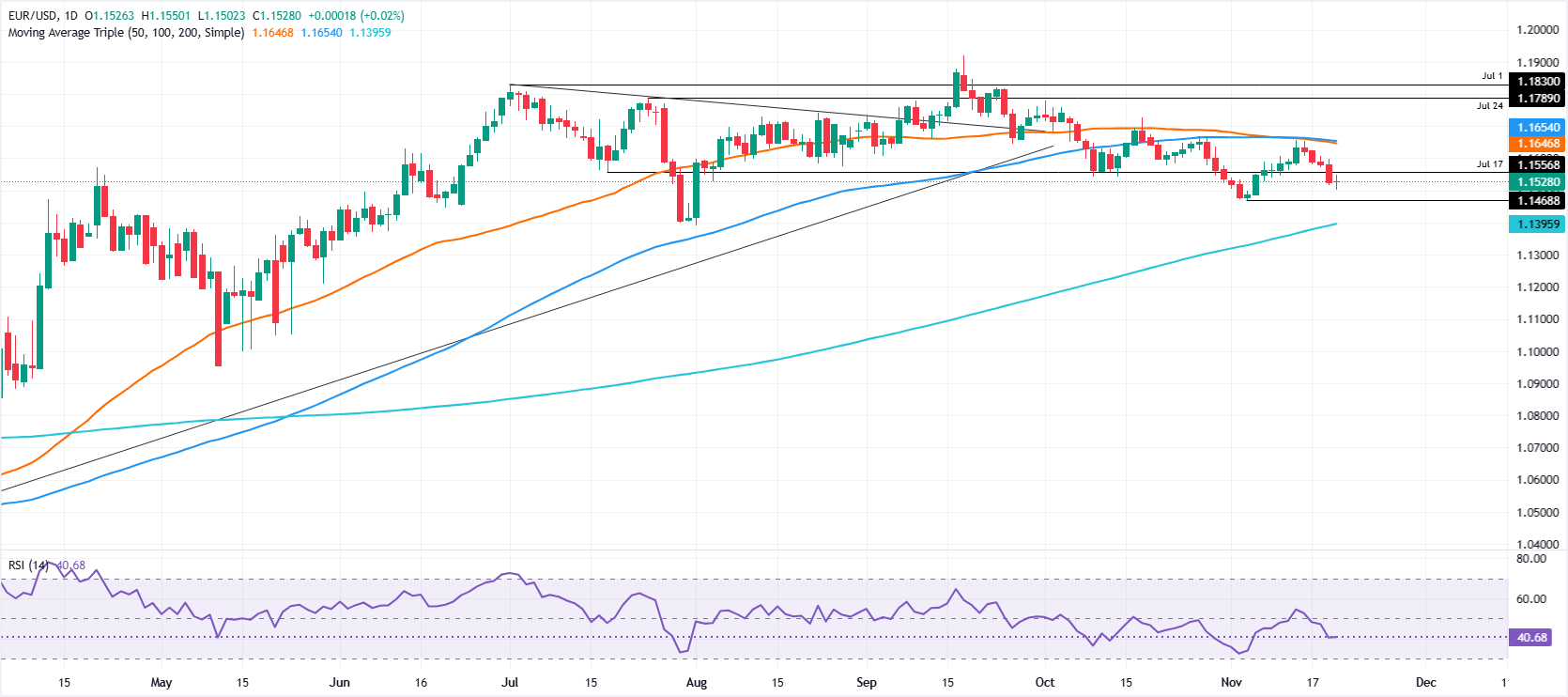
EUR/USD is snapping a four-day losing streak, yet it remains below the 1.1550 print, a crucial level ahead of stir resistance at the confluence of the 50- and 100-day Simple Moving Averages (SMAs) at 1.1646/54. A breach of those three levels clears the path to challenge 1.1700.
Despite this, momentum is bearish as depicted by the Relative Strength Index (RSI). That said, the EUR/USD path of least resistance is tilted to the downside.
Key support lies at the 1.1500 mark, followed by the November 5 swing low of 1.1468. A decisive break will expose the 200-day SMA at 1.1395.
Euro FAQs
The Euro is the currency for the 20 European Union countries that belong to the Eurozone. It is the second most heavily traded currency in the world behind the US Dollar. In 2022, it accounted for 31% of all foreign exchange transactions, with an average daily turnover of over $2.2 trillion a day. EUR/USD is the most heavily traded currency pair in the world, accounting for an estimated 30% off all transactions, followed by EUR/JPY (4%), EUR/GBP (3%) and EUR/AUD (2%).
The European Central Bank (ECB) in Frankfurt, Germany, is the reserve bank for the Eurozone. The ECB sets interest rates and manages monetary policy. The ECB’s primary mandate is to maintain price stability, which means either controlling inflation or stimulating growth. Its primary tool is the raising or lowering of interest rates. Relatively high interest rates – or the expectation of higher rates – will usually benefit the Euro and vice versa. The ECB Governing Council makes monetary policy decisions at meetings held eight times a year. Decisions are made by heads of the Eurozone national banks and six permanent members, including the President of the ECB, Christine Lagarde.
Eurozone inflation data, measured by the Harmonized Index of Consumer Prices (HICP), is an important econometric for the Euro. If inflation rises more than expected, especially if above the ECB’s 2% target, it obliges the ECB to raise interest rates to bring it back under control. Relatively high interest rates compared to its counterparts will usually benefit the Euro, as it makes the region more attractive as a place for global investors to park their money.
Data releases gauge the health of the economy and can impact on the Euro. Indicators such as GDP, Manufacturing and Services PMIs, employment, and consumer sentiment surveys can all influence the direction of the single currency. A strong economy is good for the Euro. Not only does it attract more foreign investment but it may encourage the ECB to put up interest rates, which will directly strengthen the Euro. Otherwise, if economic data is weak, the Euro is likely to fall. Economic data for the four largest economies in the euro area (Germany, France, Italy and Spain) are especially significant, as they account for 75% of the Eurozone’s economy.
Another significant data release for the Euro is the Trade Balance. This indicator measures the difference between what a country earns from its exports and what it spends on imports over a given period. If a country produces highly sought after exports then its currency will gain in value purely from the extra demand created from foreign buyers seeking to purchase these goods. Therefore, a positive net Trade Balance strengthens a currency and vice versa for a negative balance.
Author

Christian Borjon Valencia
FXStreet
Markets analyst, news editor, and trading instructor with over 14 years of experience across FX, commodities, US equity indices, and global macro markets.