EUR/USD flat around 1.1650 as hot US PPI, geopolitics freeze trade
- EUR/USD trades sideways amid Middle East tensions, lack of fresh Eurozone catalysts.
- Hot US PPI and strong Retail Sales weigh on January’s Fed easing expectations.
- Traders await Eurozone inflation, US Jobless Claims and regional Fed surveys.

EUR/USD consolidates on Wednesday, hoovers around the 1.1645, unchanged amid a risk-off mood sponsored by geopolitical risks, which kept traders on the sidelines. A scarce economic docket in the Eurozone, but a busy one in the US, revealed that factories input prices had risen and weighed on traders’ bets for a Fed rate cut in January.
Euro consolidates as firmer US data fails to boost the Greenback
Tensions in the Middle East kept most G10 currencies within familiar levels, except for the Japanese Yen, which was underpinned by verbal intervention of Japanese authorities. Wall Street shows signs of rotation, with the two largest US equity indices printing losses, while the Dow Jones was unchanged and the Russell 2000 rose 0.7%.
Data from the US revealed that the Producer Price Index (PPI) came hot in November, hitting the 3% threshold in headline and underlying figures on an annual basis. Retail Sales revealed that American consumers remain resilient driving the US economy higher, while the latest update of the Atlanta GDP Now model, shows that the estimate for Q4 2025 is 5.3%, up from 5.1%.
In the meantime, Federal Reserve officials were busy during the day. Regional Bank Presidents Bostic, Kashkari —twice, Paulson, Goolsbee and Governor Miran crossed the wires, yet provided no novelty regarding their previous policy stance.
In Europe, the docket was empty, yet lawmakers in the European Union are deciding whether to postpone a vote to lift tariffs on US industrial goods to leverage themselves against Greenland takeover by the Trump administration. In addition to this, the French budget is pending for approval, yet it could pass without parliamentary approval, according to Politico citing sources.
What’s in the calendar for January 15?
The docket in the Eurozone will feature inflation for December in France and Spain, and Industrial Production figures for the bloc. In the US, traders focus will be on Initial Jobless Claims, the NY and Philadelphia Fed Manufacturing Indices for January, and speeches by Fed officials.
Daily digest market movers: Euro remains flat for two straight days
- The US Dollar Index (DXY), which tracks the American’s currency value against a basket of other six, is down 0.14% at 99.05.
- The US Bureau of Labor Statistics revealed that November’s PPI rose by 3% exceeding forecasts of 2.7% and October’s 2.8% reading. Excluding food and energy, the so-called core PPI increased by 3% as well, above forecasts of 2.7% and the previous reading —October, of 2.9%.
- US Retail Sales rebounded strongly in November, rising 0.6% month-on-month after October’s 0.1% contraction, and topping market expectations of 0.4%. Control Group Retail Sales—used by the Census Bureau in the calculation of GDP—increased 0.4%, in line with forecasts, though easing from a downwardly revised 0.6% gain in the prior month.
- Atlanta Fed President Raphael Bostic struck a hawkish tone, warning that inflation remains well above desired levels and arguing that monetary policy must stay restrictive for now. Minneapolis Fed President Neel Kashkari said the Fed must continue to balance both sides of its mandate, noting that the economy has not slowed as much as anticipated. He pointed to solid growth, a stabilizing labor market, and easing inflation.
- Fed Governor Stephen Miran reiterated his strongly dovish stance, calling for as many as 150 basis points of rate cuts this year. Echoing that view, Anna Paulson said inflation could reach the Fed’s 2% target by year-end, adding that current policy is only slightly restrictive.
- Chicago Fed President Austan Goolsbee emphasized that central bank independence remains essential to maintaining price stability.
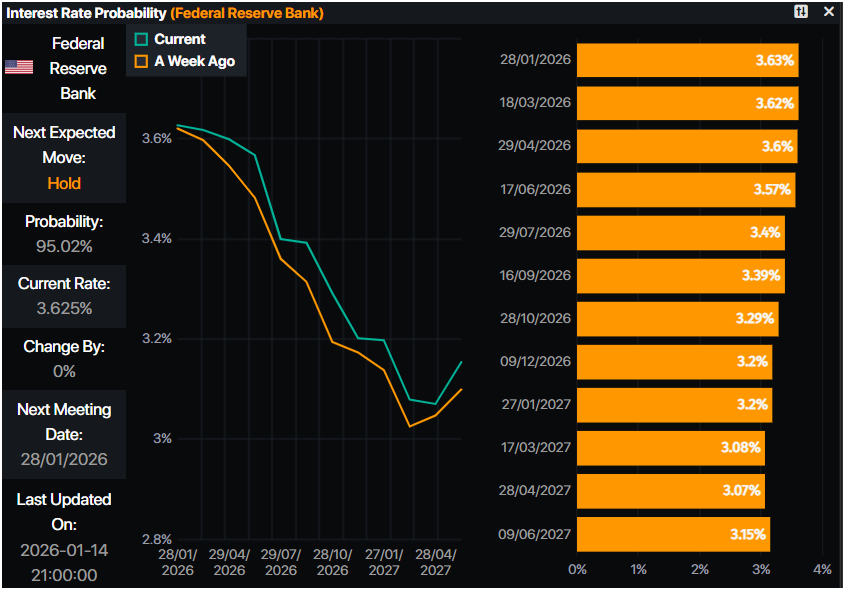
- Money market had trimmed the odds for a 25-basis point rate cut by the Fed, revealed the Interest Rate Probability tool by Prime Market Terminal. Traders see the Fed funds rate finishing at 3.20% so far, implying 55 basis points of cuts.
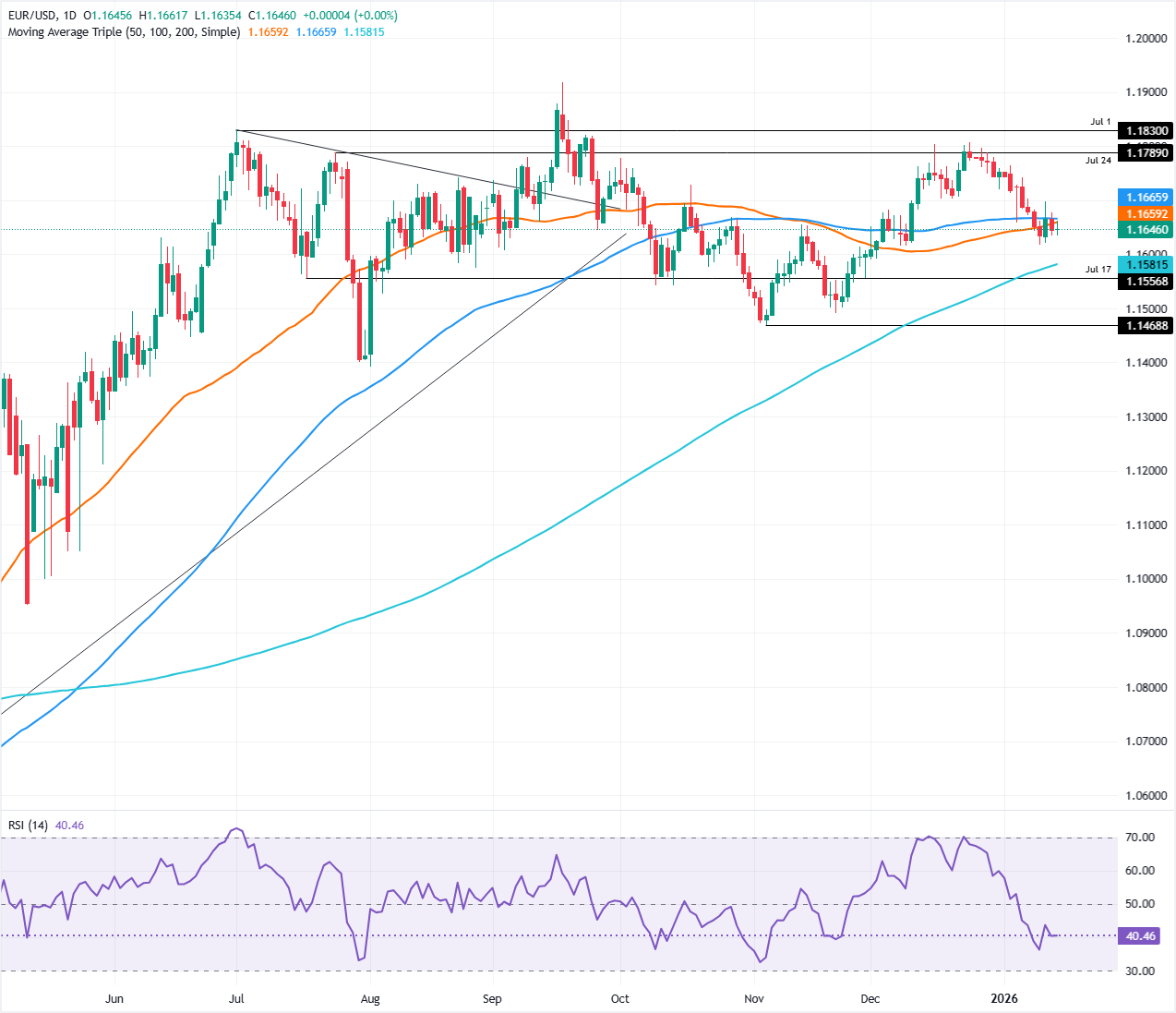
Technical outlook: EUR/USD hovers around 1.1650 amid the lack of catalysts
EUR/USD trades sideways, unable to crack the 1.1700 figure on the upside, and 1.1650 on the downside. Nevertheless, momentum remains bearish as depicted by the Relative Strength Index (RSI), with the index remaining below its neutral level.
If the Euro clears 1.1700 it opens the door to test the 20-day Simple Moving Average (SMA) at 1.1716, followed by 1.1750. Once surpassed, up next lies 1.1800. Conversely if the pair slumps below 1.1600, the first support would be the 200-day SMA at 1.1579. Once breached, the next key support is 1.1500 and the August 1 low of 1.1391.
Euro Price This week
The table below shows the percentage change of Euro (EUR) against listed major currencies this week. Euro was the strongest against the Japanese Yen.
| USD | EUR | GBP | JPY | CAD | AUD | NZD | CHF | |
|---|---|---|---|---|---|---|---|---|
| USD | -0.12% | -0.30% | 0.08% | -0.23% | 0.06% | -0.16% | -0.16% | |
| EUR | 0.12% | -0.19% | 0.26% | -0.12% | 0.18% | -0.05% | -0.05% | |
| GBP | 0.30% | 0.19% | 0.45% | 0.08% | 0.37% | 0.14% | 0.15% | |
| JPY | -0.08% | -0.26% | -0.45% | -0.37% | -0.06% | -0.29% | -0.28% | |
| CAD | 0.23% | 0.12% | -0.08% | 0.37% | 0.29% | 0.08% | 0.07% | |
| AUD | -0.06% | -0.18% | -0.37% | 0.06% | -0.29% | -0.23% | -0.22% | |
| NZD | 0.16% | 0.05% | -0.14% | 0.29% | -0.08% | 0.23% | -0.01% | |
| CHF | 0.16% | 0.05% | -0.15% | 0.28% | -0.07% | 0.22% | 0.00% |
The heat map shows percentage changes of major currencies against each other. The base currency is picked from the left column, while the quote currency is picked from the top row. For example, if you pick the Euro from the left column and move along the horizontal line to the US Dollar, the percentage change displayed in the box will represent EUR (base)/USD (quote).
Euro FAQs
The Euro is the currency for the 20 European Union countries that belong to the Eurozone. It is the second most heavily traded currency in the world behind the US Dollar. In 2022, it accounted for 31% of all foreign exchange transactions, with an average daily turnover of over $2.2 trillion a day. EUR/USD is the most heavily traded currency pair in the world, accounting for an estimated 30% off all transactions, followed by EUR/JPY (4%), EUR/GBP (3%) and EUR/AUD (2%).
The European Central Bank (ECB) in Frankfurt, Germany, is the reserve bank for the Eurozone. The ECB sets interest rates and manages monetary policy. The ECB’s primary mandate is to maintain price stability, which means either controlling inflation or stimulating growth. Its primary tool is the raising or lowering of interest rates. Relatively high interest rates – or the expectation of higher rates – will usually benefit the Euro and vice versa. The ECB Governing Council makes monetary policy decisions at meetings held eight times a year. Decisions are made by heads of the Eurozone national banks and six permanent members, including the President of the ECB, Christine Lagarde.
Eurozone inflation data, measured by the Harmonized Index of Consumer Prices (HICP), is an important econometric for the Euro. If inflation rises more than expected, especially if above the ECB’s 2% target, it obliges the ECB to raise interest rates to bring it back under control. Relatively high interest rates compared to its counterparts will usually benefit the Euro, as it makes the region more attractive as a place for global investors to park their money.
Data releases gauge the health of the economy and can impact on the Euro. Indicators such as GDP, Manufacturing and Services PMIs, employment, and consumer sentiment surveys can all influence the direction of the single currency. A strong economy is good for the Euro. Not only does it attract more foreign investment but it may encourage the ECB to put up interest rates, which will directly strengthen the Euro. Otherwise, if economic data is weak, the Euro is likely to fall. Economic data for the four largest economies in the euro area (Germany, France, Italy and Spain) are especially significant, as they account for 75% of the Eurozone’s economy.
Another significant data release for the Euro is the Trade Balance. This indicator measures the difference between what a country earns from its exports and what it spends on imports over a given period. If a country produces highly sought after exports then its currency will gain in value purely from the extra demand created from foreign buyers seeking to purchase these goods. Therefore, a positive net Trade Balance strengthens a currency and vice versa for a negative balance.
Author

Christian Borjon Valencia
FXStreet
Markets analyst, news editor, and trading instructor with over 14 years of experience across FX, commodities, US equity indices, and global macro markets.

















