EUR/USD prods the low end near 1.0800 as Euro broadly underperforms
- EUR/USD backslides as ECB headlines stoke ECB rate cut bets.
- Europe sees GDP figures on Wednesday ahead of US Fed rate call.
- Markets bet on ECB rate cut in April.

EUR/USD fell to its lowest bids since mid-December, testing the 1.0800 handle after European Central Bank (ECB) officials left the doors wide open for rate cuts much earlier than investors had previously anticipated.
Europe delivers a round of Gross Domestic Product (GDP) figures on Tuesday, headlined by pan-European GDP growth for the fourth quarter at 10:00 GMT. The US Federal Reserve’s (Fed) latest rate call is slated for Wednesday, to be followed by a Federal Open Market Committee (FOMC) press conference half an hour after the Fed’s monetary policy statement.
Daily digest market movers: EUR/USD sheds weight after ECB officials spark early rate cut hopes
- EUR/USD slipped further back on Monday after ECB board member and Banco de Portugal Governor Mário Centeno sparked rate cut hopes.
- ECB’s Centeno suggested the ECB should cut rates sooner rather than later to head off the possibility of European inflation declining too far below the ECB’s 2% target.
- ECB Centeno shrugged off the idea of the ECB waiting for first-quarter wage growth figures before punching the rate cut button, claiming there are no second-round inflation effects of wage increases.
- ECB board member Centeno is not in the ECB Governing Council vote rotation until March.
- Money markets have fully priced in a first rate trim from the ECB of 25 basis points in April.
- Rate swaps expect 149 basis points in ECB rate cuts through the end of the year.
- ECB policymaker and Slovakian central bank chief Peter Kazimir quickly followed Centeno, stating that a June rate cut is far more likely than April.
- ECB’s Kazimir pulled in the reins, claiming that rate cut talk remains ‘premature’, but agreed the top of the rate hike cycle has peaked and the ECB’s next move will be a cut, but only when appropriate.
- ECB Vice-President Luis de Guindos followed up by agreeing that inflationary risks are on the downside but reiterated that the ECB’s policies will reflect available data.
- Fed Chairman Jerome Powell is expected to deliver language on Wednesday that corroborates money market bets of a benchmark rate cut in May.
- Rate swaps are pricing in nearly a 90% chance of at least 25 basis points off the top from the Fed before June.
Euro price today
The table below shows the percentage change of Euro (EUR) against listed major currencies today. Euro was the weakest against the Japanese Yen.
| USD | EUR | GBP | CAD | AUD | JPY | NZD | CHF | |
| USD | 0.26% | 0.08% | -0.07% | -0.22% | -0.36% | -0.24% | -0.12% | |
| EUR | -0.24% | -0.16% | -0.31% | -0.46% | -0.58% | -0.48% | -0.36% | |
| GBP | -0.09% | 0.18% | -0.16% | -0.32% | -0.42% | -0.34% | -0.19% | |
| CAD | 0.08% | 0.32% | 0.15% | -0.16% | -0.27% | -0.18% | -0.04% | |
| AUD | 0.23% | 0.49% | 0.31% | 0.16% | -0.11% | 0.00% | 0.11% | |
| JPY | 0.34% | 0.60% | 0.56% | 0.26% | 0.08% | 0.07% | 0.23% | |
| NZD | 0.27% | 0.51% | 0.35% | 0.18% | 0.02% | -0.10% | 0.17% | |
| CHF | 0.11% | 0.37% | 0.19% | 0.04% | -0.11% | -0.23% | -0.12% |
The heat map shows percentage changes of major currencies against each other. The base currency is picked from the left column, while the quote currency is picked from the top row. For example, if you pick the Euro from the left column and move along the horizontal line to the Japanese Yen, the percentage change displayed in the box will represent EUR (base)/JPY (quote).
Technical Analysis: EUR/USD tests low-side barriers, resistance zones piling up above 1.0850
Monday saw EUR/USD decline over eight-tenths of a percent peak-to-trough from Friday’s near-term peak at 1.0886, and the pair continues to waffle below the 200-hour Simple Moving Average (SMA) descending into 1.0870.
Technical resistance has piled up in a familiar zone just below the 1.0900 handle, capping off intraday momentum to the top side and chaining EUR/USD into a defensive position as bids test old chart territory.
Daily candlesticks show the way open for a bearish test into December’s swing lows near 1.0750 as price action churns into the low side of the 200-day SMA near 1.0850. The pair’s ongoing pattern of higher lows is set for a challenge if buyers aren’t able to prop the pair back up over the 50-day SMA near 1.0925.
EUR/USD Hourly Chart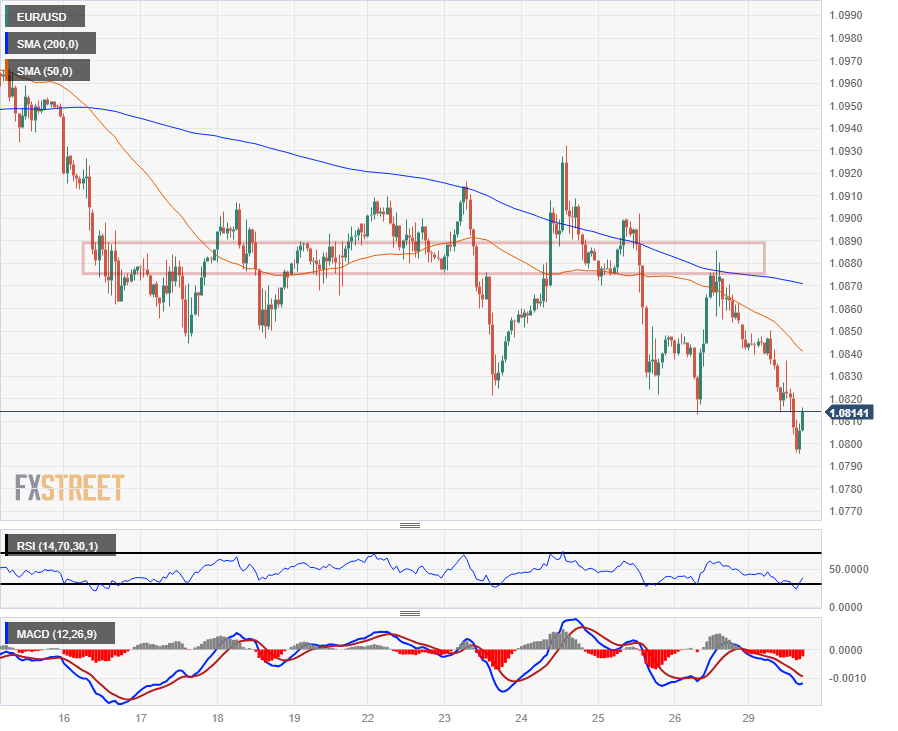
EUR/USD Daily Chart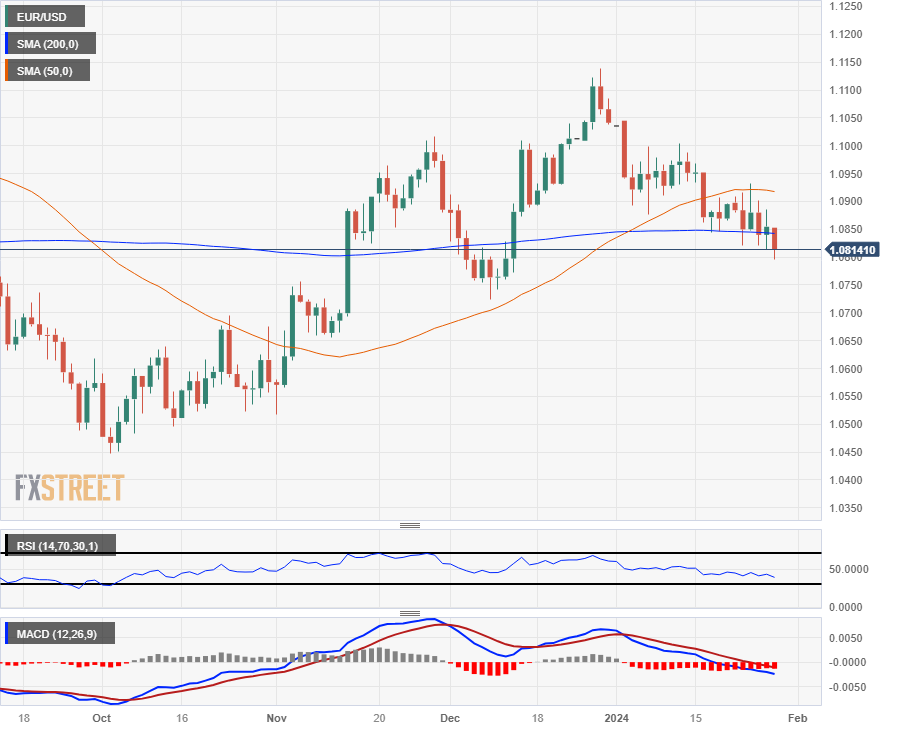
Euro FAQs
What is the Euro?
The Euro is the currency for the 20 European Union countries that belong to the Eurozone. It is the second most heavily traded currency in the world behind the US Dollar. In 2022, it accounted for 31% of all foreign exchange transactions, with an average daily turnover of over $2.2 trillion a day.
EUR/USD is the most heavily traded currency pair in the world, accounting for an estimated 30% off all transactions, followed by EUR/JPY (4%), EUR/GBP (3%) and EUR/AUD (2%).
What is the ECB and how does it impact the Euro?
The European Central Bank (ECB) in Frankfurt, Germany, is the reserve bank for the Eurozone. The ECB sets interest rates and manages monetary policy.
The ECB’s primary mandate is to maintain price stability, which means either controlling inflation or stimulating growth. Its primary tool is the raising or lowering of interest rates. Relatively high interest rates – or the expectation of higher rates – will usually benefit the Euro and vice versa.
The ECB Governing Council makes monetary policy decisions at meetings held eight times a year. Decisions are made by heads of the Eurozone national banks and six permanent members, including the President of the ECB, Christine Lagarde.
How does inflation data impact the value of the Euro?
Eurozone inflation data, measured by the Harmonized Index of Consumer Prices (HICP), is an important econometric for the Euro. If inflation rises more than expected, especially if above the ECB’s 2% target, it obliges the ECB to raise interest rates to bring it back under control.
Relatively high interest rates compared to its counterparts will usually benefit the Euro, as it makes the region more attractive as a place for global investors to park their money.
How does economic data influence the value of the Euro?
Data releases gauge the health of the economy and can impact on the Euro. Indicators such as GDP, Manufacturing and Services PMIs, employment, and consumer sentiment surveys can all influence the direction of the single currency.
A strong economy is good for the Euro. Not only does it attract more foreign investment but it may encourage the ECB to put up interest rates, which will directly strengthen the Euro. Otherwise, if economic data is weak, the Euro is likely to fall.
Economic data for the four largest economies in the euro area (Germany, France, Italy and Spain) are especially significant, as they account for 75% of the Eurozone’s economy.
How does the Trade Balance impact the Euro?
Another significant data release for the Euro is the Trade Balance. This indicator measures the difference between what a country earns from its exports and what it spends on imports over a given period.
If a country produces highly sought after exports then its currency will gain in value purely from the extra demand created from foreign buyers seeking to purchase these goods. Therefore, a positive net Trade Balance strengthens a currency and vice versa for a negative balance.
Author

Joshua Gibson
FXStreet
Joshua joins the FXStreet team as an Economics and Finance double major from Vancouver Island University with twelve years' experience as an independent trader focusing on technical analysis.