EUR/USD falls to 1.1705 as US Dollar rebounds despite Fed cut bets
- The Euro retreats from 1.1779 high as the US Dollar recovery offsets weaker US labor data.
- BLS revises payrolls down by -911K through March 2025, reinforcing expectations for a 25 bps September cut.
- Focus shifts to PPI, CPI and Initial Jobless Claims, while the French political reshuffle adds to EZ uncertainty.

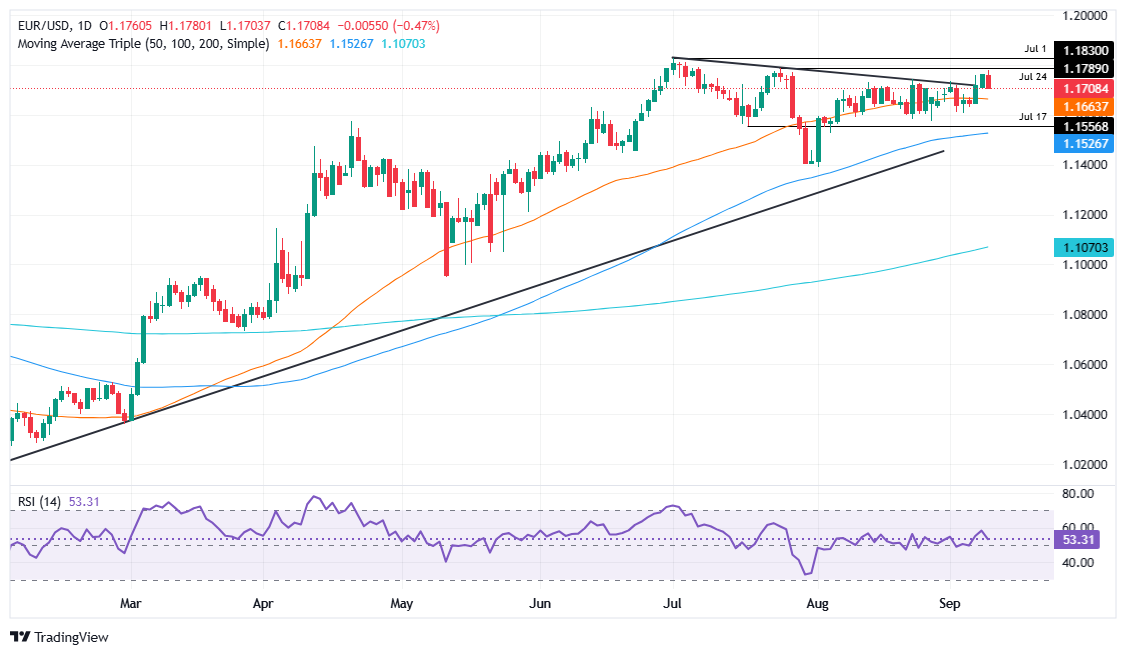
EUR/USD retreated over 0.48% on Tuesday, even though data from the United States (US) seems to confirm that the Federal Reserve (Fed) might reduce interest rates at next week’s meeting. Despite this, the Greenback has recovered, a headwind for the pair, which trades at 1.1705 after reaching a daily high of 1.1779.
Euro slips after US payrolls revision cements easing case, with traders eyeing key inflation data this week
Data from the US Bureau of Labor Statistics (BLS) showed that the labor market is showing some cracks as payrolls were revised downward through March 2025, by -911,000 or -0.6%. The report has cemented the case for at least a 25-basis-point rate cut by the Fed, if not for high inflation prints, which could be revealed ahead of the week.
The Producer Price Index (PPI) and the Consumer Price Index (CPI) figures for August will be released on Wednesday and Thursday, respectively. Also, further labor market data in the form of Initial Jobless Claims could dictate Fed officials’ decision on September 16-17.
In Europe, the economic docket remains empty with traders waiting for the monetary policy decision of the European Central Bank (ECB). Nevertheless, political turmoil in France continued, even though the French President Emmanuel Macron appointed Sebastien Lecornu as the new Prime Minister (PM).
Daily market movers: EUR/USD on the defensive as the Dollar recovers
- Traders will focus on US inflation data midweek, with the Producer Price Index (PPI) due Wednesday and the Consumer Price Index (CPI) on Thursday. Headline PPI in August is expected to remain unchanged at 3.3% YoY, while Core PPI is forecast to ease to 3.5% from 3.7%.
- CPI inflation for the same period is expected to rise to 2.9% YoY from 2.7%, whereas Core CPI, which excludes food and energy, is expected to hold steady at 3.1%.
- The Nonfarm Payrolls revision, alongside the August jobs print, had increased expectations for a rate cut by the Fed. The Prime Market Terminal interest rate probability tool priced in a 90% chance of the Fed easing policy by 25 basis points (bps) and a 10% chance for a 50-bps cut. The ECB is likely to keep rates unchanged, with a 93% probability, and only a 6% chance of a 25-bps cut.
- Meanwhile, Fitch expects two 25-basis- point rate cuts, each in September and December, with three more reductions penciled in 2026. Conversely, the ratings agency does not project any rate cuts by the European Central Bank (ECB) again.
Technical outlook: EUR/USD remains bullish, despite retreating to 1.1700
EUR/USD formed a bearish engulfing candle pattern, an indication that buyers are losing steam and sellers are stepping ahead of the ECB’s meeting. Momentum as depicted by the Relative Strength Index (RSI) remains bullish but set for consolidation.
If EUR/USD tumbles below 1.1700, a move towards the 20-day Simple Moving Average (SMA) at 1.1672 is on the cards. On further weakness lies the 50-day SMA at 1.1659, followed by the 100-day SMA at 1.1535.
On the other hand, if the pair rises past July 24 1.1788, this clears the path toward 1.1800 and 1.1829.
Euro FAQs
The Euro is the currency for the 19 European Union countries that belong to the Eurozone. It is the second most heavily traded currency in the world behind the US Dollar. In 2022, it accounted for 31% of all foreign exchange transactions, with an average daily turnover of over $2.2 trillion a day. EUR/USD is the most heavily traded currency pair in the world, accounting for an estimated 30% off all transactions, followed by EUR/JPY (4%), EUR/GBP (3%) and EUR/AUD (2%).
The European Central Bank (ECB) in Frankfurt, Germany, is the reserve bank for the Eurozone. The ECB sets interest rates and manages monetary policy. The ECB’s primary mandate is to maintain price stability, which means either controlling inflation or stimulating growth. Its primary tool is the raising or lowering of interest rates. Relatively high interest rates – or the expectation of higher rates – will usually benefit the Euro and vice versa. The ECB Governing Council makes monetary policy decisions at meetings held eight times a year. Decisions are made by heads of the Eurozone national banks and six permanent members, including the President of the ECB, Christine Lagarde.
Eurozone inflation data, measured by the Harmonized Index of Consumer Prices (HICP), is an important econometric for the Euro. If inflation rises more than expected, especially if above the ECB’s 2% target, it obliges the ECB to raise interest rates to bring it back under control. Relatively high interest rates compared to its counterparts will usually benefit the Euro, as it makes the region more attractive as a place for global investors to park their money.
Data releases gauge the health of the economy and can impact on the Euro. Indicators such as GDP, Manufacturing and Services PMIs, employment, and consumer sentiment surveys can all influence the direction of the single currency. A strong economy is good for the Euro. Not only does it attract more foreign investment but it may encourage the ECB to put up interest rates, which will directly strengthen the Euro. Otherwise, if economic data is weak, the Euro is likely to fall. Economic data for the four largest economies in the euro area (Germany, France, Italy and Spain) are especially significant, as they account for 75% of the Eurozone’s economy.
Another significant data release for the Euro is the Trade Balance. This indicator measures the difference between what a country earns from its exports and what it spends on imports over a given period. If a country produces highly sought after exports then its currency will gain in value purely from the extra demand created from foreign buyers seeking to purchase these goods. Therefore, a positive net Trade Balance strengthens a currency and vice versa for a negative balance.
Author

Christian Borjon Valencia
FXStreet
Markets analyst, news editor, and trading instructor with over 14 years of experience across FX, commodities, US equity indices, and global macro markets.

















