EUR/USD extends slide below 1.1600 amid French political turmoil and stronger US Dollar
- EUR/USD extends its decline below 1.1600, hitting its lowest level since late August.
- The Euro weakens as French political turmoil following PM Lecornu’s resignation weighs on sentiment.
- Price action remains bearish below the 21, 50 and 100-day SMAs, reinforcing downside momentum.

The Euro (EUR) remains under broad selling pressure against the US Dollar (USD) on Thursday, extending losses below the 1.1600 mark as the abrupt resignation of French Prime Minister Sébastien Lecornu sparks caution among investors and dampens appetite for the common currency.
Political uncertainty in France has deepened concerns over fiscal stability within the Eurozone, prompting traders to rotate out of the Euro and into the Greenback amid a broader risk-off mood.
At the time of writing, EUR/USD is hovering near 1.1585 in the American session, marking its lowest level since August 27 and down about 1.30% so far this week.
Meanwhile, the US Dollar Index (DXY), which tracks the value of the Greenback against a basket of six major currencies, has climbed to a two-month high near 99.20, extending its winning streak for the fourth consecutive day as investors favor the USD over its major counterparts.
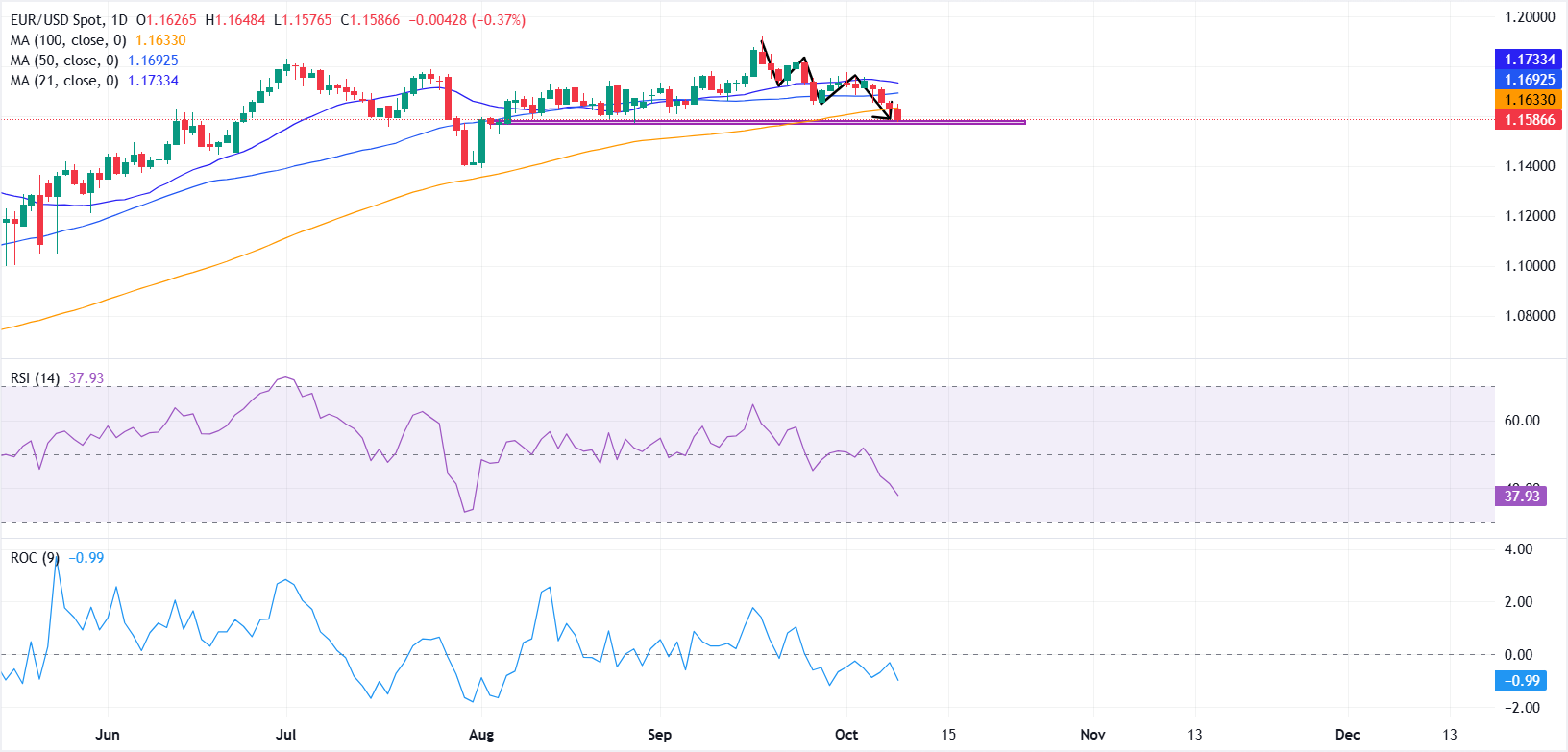
Technically, EUR/USD has turned decisively bearish since topping at 1.1918 on September 17, forming a clear sequence of lower highs and lower lows. The pair is trading below its 21-day, 50-day and 100-day Simple Moving Averages (SMAs) at 1.1735, 1.1692 and 1.1633, respectively, reinforcing the downside bias.
The alignment of these moving averages tilts the broader setup firmly in favor of sellers, as momentum indicators continue to point lower. The daily Relative Strength Index (RSI) hovers near 38, indicating persistent selling pressure but still shy of oversold territory, while the Rate of Change (ROC) remains negative, reflecting sustained downward momentum.
On the downside, the 1.1580-1.1560 region remains pivotal support from early August. A daily close below this area would likely trigger a deeper slide toward the August 5 low at 1.1527 and the August swing low near 1.1391.
On the upside, immediate resistance is seen around 1.1648, the daily high, which closely aligns with the 100-day SMA. A sustained break above this zone could prompt a recovery toward the 50-day SMA, while bulls need to reclaim the 1.1700 handle to regain near-term control and confirm a meaningful recovery.
Euro Price Today
The table below shows the percentage change of Euro (EUR) against listed major currencies today. Euro was the strongest against the New Zealand Dollar.
| USD | EUR | GBP | JPY | CAD | AUD | NZD | CHF | |
|---|---|---|---|---|---|---|---|---|
| USD | 0.43% | 0.58% | 0.21% | 0.35% | 0.28% | 0.67% | 0.47% | |
| EUR | -0.43% | 0.15% | -0.18% | -0.10% | 0.00% | 0.27% | -0.08% | |
| GBP | -0.58% | -0.15% | -0.37% | -0.22% | -0.16% | 0.16% | -0.19% | |
| JPY | -0.21% | 0.18% | 0.37% | 0.03% | 0.14% | 0.40% | 0.17% | |
| CAD | -0.35% | 0.10% | 0.22% | -0.03% | 0.02% | 0.36% | -0.01% | |
| AUD | -0.28% | -0.00% | 0.16% | -0.14% | -0.02% | 0.35% | -0.09% | |
| NZD | -0.67% | -0.27% | -0.16% | -0.40% | -0.36% | -0.35% | -0.34% | |
| CHF | -0.47% | 0.08% | 0.19% | -0.17% | 0.00% | 0.09% | 0.34% |
The heat map shows percentage changes of major currencies against each other. The base currency is picked from the left column, while the quote currency is picked from the top row. For example, if you pick the Euro from the left column and move along the horizontal line to the US Dollar, the percentage change displayed in the box will represent EUR (base)/USD (quote).
Author

Vishal Chaturvedi
FXStreet
I am a macro-focused research analyst with over four years of experience covering forex and commodities market. I enjoy breaking down complex economic trends and turning them into clear, actionable insights that help traders stay ahead of the curve.