EUR/USD edges lower on Good Friday, United States Nonfarm Payrolls eyed
- EUR/USD pares weekly gains during three-week uptrend on Good Friday holiday.
- United States statistics weigh on Federal Reserve bets and favor the Euro buyers.
- Recession fears, geopolitical headlines prod EUR/USD buyers ahead of the key US Nonfarm Payrolls.

Euro bulls take a breather as the EUR/USD pair sits around 1.0920, awaiting the key United States employment numbers during early Friday. In doing so, the Euro pair also bears the burden of the Good Friday holidays in the major Western markets, including Europe.
It’s worth noting, however, that the comparatively more hawkish bias for the European Central Bank (ECB) than the Federal Reserve (Fed) keeps the EUR/USD on the way to posting the third consecutive weekly gain, despite recent recession woes.
Euro cheers upbeat data
EUR/USD remains firmer overall as the latest data from Germany and the Eurozone appear to keep the European Central Bank (ECB) hawks on the table, unlike their US counterparts.
That said, Germany’s Industrial Production (IP) rose 0.6% YoY in February versus -2.7% market forecasts and -1.6% previous readings. The monthly figures also came in firmer than 0.1% expected, to 2.0% versus 3.7% prior. On Wednesday, Germany Factory Orders improved to -5.7% YoY for February from -12.0 revised down prior and -10.5% market forecasts while the MoM growth came in at 4.8% compared to 0.3% expected and 0.5% previous readings.
On a broader front, Eurozone S&P Global Composite PMI eased to 53.7 in March versus 54.1 first readings whereas Services PMI also declined to 55.0 during the stated month from 55.6 preliminary forecasts.
Elsewhere, the US Initial Jobless Claims improved to 228K for the week ended on March 31 versus 200K expected and upwardly revised 246K prior. It’s worth noting that the Challenger Job Cuts for the said month rose to 89.703K from 77.77K prior. Previously, US JOLTS Job Openings dropped to the 19-month low in February while the ADP Employment Change for March also disappointed markets with 145K figures. Further, the US ISM Services PMI for March also amplified pessimism as it dropped to 51.2 versus 54.5 expected and 55.1 prior.
European Central Bank policymakers appear more hawkish than Federal Reserve talks
Considering the upbeat data, European Central Bank (ECB) Chief Economist Philip Lane signaled in a university lecture in Cyprus that the May decision depends on three factors, namely inflation outlook, underlying dynamic and how quickly these interest rate increases are restricting the economy and bringing down inflation.” The policymaker also said that due to these reasons they haven’t indicated or pre-announced what the expectation is for the next meeting or the upcoming meetings.
On the other hand, St. Louis Federal Reserve President James Bullard said on Thursday he thinks inflation is going to be sticky going forward.
With the comparatively more hawkish ECB policymaker's tone, the EUR/USD remains firmer ahead of the key data.
Recession woes challenge Euro buyers
It should be noted that the Federal Reserve’s (Fed) preferred gauge of economic health cited the recession woes and put a floor under the EUR/USD prices. “Research from the Fed has argued that the ‘near-term forward spread’ comparing the forward rate on Treasury bills 18 months from now with the current yield on a three-month Treasury bill was the most reliable bond market signal of an imminent economic contraction,” per Reuters.
On the same line are comments from International Monetary Fund (IMF) Managing Director Kristalina Georgieva who said in her prepared remarks on Thursday that she expects the global economy to grow by less than 3% in 2023, down from 3.4% in 2022, per Reuters.
All eyes on United States employment numbers
Given the recently downbeat US employment clues, as well as the hopes of no rate hikes from the Federal Reserve (Fed), today’s US jobs report for March becomes crucial even as the Good Friday holiday is expected to limit the EUR/USD pair’s reaction to data.
Market forecasts suggest a softer print of the headline Nonfarm Payrolls (NFP), to 240K from 311K prior, as well as no change in the Unemployment Rate of 3.6%. However, the mixed expectations for the Average Hourly Earnings make the outcome even more interesting.
Also read: Nonfarm Payrolls Preview: Markets fear depressing data, three scenarios for the US Dollar
EUR/USD technical analysis
EUR/USD stays within a three-day-old descending triangle chart pattern, suggesting further upside on the bullish breakout.
Adding strength to the hopes of witnessing further Euro gains is the steady Relative Strength Index (RSI) line, placed at 14, not to forget the quote’s successful trading above the 200-Hour Moving Average (HMA).
That said, the EUR/USD bulls need validation from 1.0930 to retake control.
Following that, the latest peak of 1.0973 and the yearly high of around 1.1035 can test the Euro buyers ahead of directing them to the March 2022 high of near 1.1185.
Meanwhile, a downside break of the 1.0885 level comprising the triangle’s lower line will defy the bullish chart pattern and can lure the EUR/USD bears. Even so, the 200-HMA level of 1.0880 can act as an extra filter towards the south before delivering the quote to the bear’s door.
EUR/USD: Hourly chart
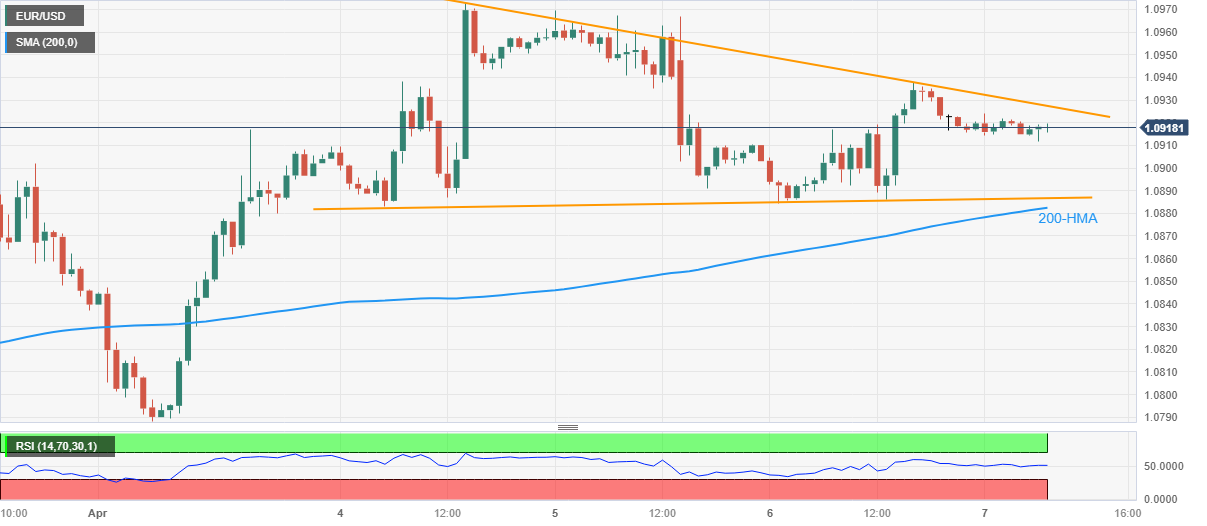
Trend: Further upside expected
Author

Anil Panchal
FXStreet
Anil Panchal has nearly 15 years of experience in tracking financial markets. With a keen interest in macroeconomics, Anil aptly tracks global news/updates and stays well-informed about the global financial moves and their implications.