EUR/USD reverses losses as optimism abut US China talks fades
- Confidence in the USD fades with US-China talks underway.
- Strong Eurozone investors' Confidence and hawkish comments from ECB officials are supporting the Euro.
- The pair remains within recent ranges, with investors awaiting developments from the trade negotiations
EUR/USD has retraced previous losses during Tuesday's European session, returning above 1.1420 at the time of writing. The pair, however, remains fluctuating within the last few days’ trading range, with investors reluctant to place large directional bets as US and Chinese representatives continue to discuss trade issues.
Positive remarks from some officials, namely US President Donald Trump’s comments affirming that he is getting “good reports” from the meeting, are contributing to keeping market sentiment buoyed and have provided some support to the US Dollar (USD).
Traders, however, are likely to remain looking from the sidelines, awaiting news about concrete progress. The world’s two largest economies have gone into the meeting with a constructive attitude, aiming to revive the spirit of last month’s meeting in Switzerland, which led to a significant reduction in their reciprocal tariffs.
This time, however, thorny issues such as rare earths’ trade, restrictions on chips’ exports, or visas for students will force both parties to make sacrifices if they want to reach a deal. And this might take some time.
In the Eurozone, the Sentix Investors' Confidence Index has shown a significant improvement in June, with the indicator jumping to positive levels for the first time in one year. Beyond that, ECB's Olli Rehn and Francoise de Villeroy have reinforced the bank's recent hawkish stance, and Italian Industrial Output advanced against expectations. All in all, favourable figures for the Euro.
Euro PRICE Today
The table below shows the percentage change of Euro (EUR) against listed major currencies today. Euro was the strongest against the British Pound.
| USD | EUR | GBP | JPY | CAD | AUD | NZD | CHF | |
|---|---|---|---|---|---|---|---|---|
| USD | -0.06% | 0.37% | -0.03% | -0.08% | -0.05% | -0.09% | -0.09% | |
| EUR | 0.06% | 0.44% | 0.02% | 0.02% | 0.04% | -0.02% | -0.01% | |
| GBP | -0.37% | -0.44% | -0.49% | -0.43% | -0.40% | -0.47% | -0.44% | |
| JPY | 0.03% | -0.02% | 0.49% | -0.01% | -0.05% | -0.13% | -0.14% | |
| CAD | 0.08% | -0.02% | 0.43% | 0.00% | 0.01% | -0.04% | -0.02% | |
| AUD | 0.05% | -0.04% | 0.40% | 0.05% | -0.01% | -0.05% | -0.04% | |
| NZD | 0.09% | 0.02% | 0.47% | 0.13% | 0.04% | 0.05% | 0.02% | |
| CHF | 0.09% | 0.00% | 0.44% | 0.14% | 0.02% | 0.04% | -0.02% |
The heat map shows percentage changes of major currencies against each other. The base currency is picked from the left column, while the quote currency is picked from the top row. For example, if you pick the Euro from the left column and move along the horizontal line to the US Dollar, the percentage change displayed in the box will represent EUR (base)/USD (quote).
,
Daily digest market movers: Lack of news leads to muted market movement
- The US Dollar is nudging higher against most peers, yet still constrained within the recent ranges. The US Dollar Index (DXY) has bounced up, but it is struggling to take a significant distance from the nearly two-month lows hit last week.
- Trump affirmed on Monday that he is “only getting good reports,” but that dealing with China is not easy. These comments feed hopes of a positive outcome, but risk appetite remains subdued.
- The Eurozone Sentix Confidence Index has improved to a 0.2% reading in June, up from a -8.1 in May and a -19.5 in April, beating expectations of a -6.0 reading. German economic expectations improved for the fourth consecutive month, although they remained in negative territory, while the sentiment about the Eurozone has improved by more than 30 points in the last two months.
- ECB's Rehn stated that the bank should focus on keeping inflation steady at 2% and warned about complacency over the inflation outlook, dampening hopes about any potential interest rate cut in the coming months.
- In Italy, Industrial Production increased 1% in April, its best reading since February 2022, following a flat reading in March, and beating expectations of a 0.1% monthly increase.
- The highlight of the week will be Wednesday’s US Consumer Price Index (CPI), which is expected to have grown steadily at 0.2% in May with the yearly inflation increasing to 2.5% from 2.3% in April. Core inflation is also expected to have accelerated, endorsing the Fed’s hawkish stance.
- The Federal Reserve is on its blackout period ahead of next week’s monetary policy meeting. Futures markets are not pricing any rate cut at least until September, with nearly two rate cuts foreseen for this year, as data from the CME Group’s Fed Watch Tool shows.
Technical analysis: EUR/USD looks for direction above 1.1370
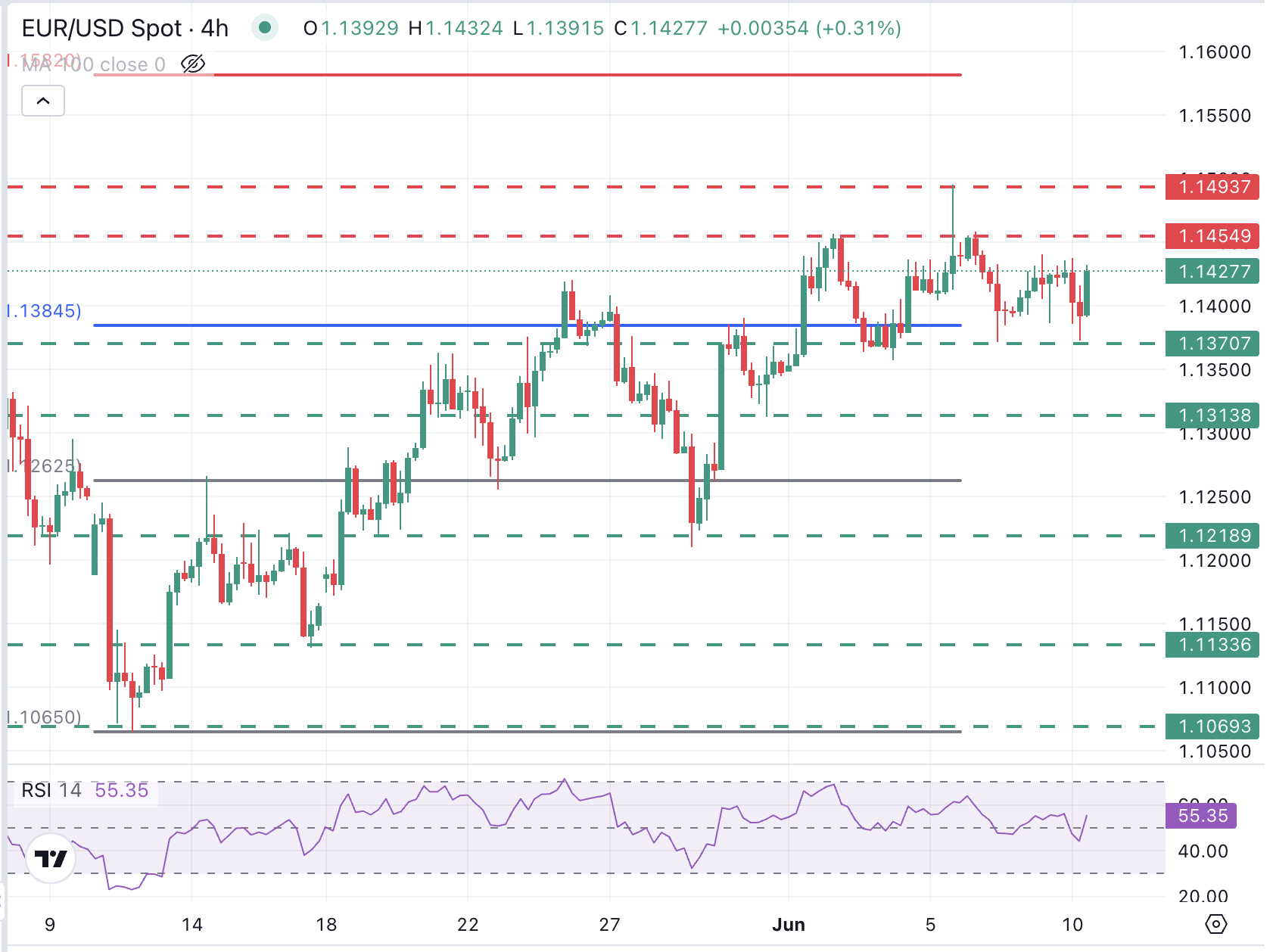
EUR/USD keeps moving within an upward trend, but the rejection at around 1.1500 seen last week and a bearish divergence on the 4-hour chart suggest that bulls might be losing steam.
Price action shows a mild negative tone on Tuesday, but sellers should break the 1.1370 support level to confirm a deeper correction heading to 1.1315 (May 30 low) and the 1.1215-1.1220 (May 20 and 28 lows).
On the upside, the June 3 high at 1.1455 is likely to challenge bulls ahead of the June 5 high at 1.1495.
Euro FAQs
The Euro is the currency for the 19 European Union countries that belong to the Eurozone. It is the second most heavily traded currency in the world behind the US Dollar. In 2022, it accounted for 31% of all foreign exchange transactions, with an average daily turnover of over $2.2 trillion a day. EUR/USD is the most heavily traded currency pair in the world, accounting for an estimated 30% off all transactions, followed by EUR/JPY (4%), EUR/GBP (3%) and EUR/AUD (2%).
The European Central Bank (ECB) in Frankfurt, Germany, is the reserve bank for the Eurozone. The ECB sets interest rates and manages monetary policy. The ECB’s primary mandate is to maintain price stability, which means either controlling inflation or stimulating growth. Its primary tool is the raising or lowering of interest rates. Relatively high interest rates – or the expectation of higher rates – will usually benefit the Euro and vice versa. The ECB Governing Council makes monetary policy decisions at meetings held eight times a year. Decisions are made by heads of the Eurozone national banks and six permanent members, including the President of the ECB, Christine Lagarde.
Eurozone inflation data, measured by the Harmonized Index of Consumer Prices (HICP), is an important econometric for the Euro. If inflation rises more than expected, especially if above the ECB’s 2% target, it obliges the ECB to raise interest rates to bring it back under control. Relatively high interest rates compared to its counterparts will usually benefit the Euro, as it makes the region more attractive as a place for global investors to park their money.
Data releases gauge the health of the economy and can impact on the Euro. Indicators such as GDP, Manufacturing and Services PMIs, employment, and consumer sentiment surveys can all influence the direction of the single currency. A strong economy is good for the Euro. Not only does it attract more foreign investment but it may encourage the ECB to put up interest rates, which will directly strengthen the Euro. Otherwise, if economic data is weak, the Euro is likely to fall. Economic data for the four largest economies in the euro area (Germany, France, Italy and Spain) are especially significant, as they account for 75% of the Eurozone’s economy.
Another significant data release for the Euro is the Trade Balance. This indicator measures the difference between what a country earns from its exports and what it spends on imports over a given period. If a country produces highly sought after exports then its currency will gain in value purely from the extra demand created from foreign buyers seeking to purchase these goods. Therefore, a positive net Trade Balance strengthens a currency and vice versa for a negative balance.
Author

Guillermo Alcala
FXStreet
Graduated in Communication Sciences at the Universidad del Pais Vasco and Universiteit van Amsterdam, Guillermo has been working as financial news editor and copywriter in diverse Forex-related firms, like FXStreet and Kantox.