EUR/USD eases as Trump turns tariff threats to Europe
- EUR/USD fell back 0.3% on Thursday as Europe gets added to Trump’s tariff list.
- Trump plans more tariffs on targeted EU goods after Europe retaliated against steel tariffs.
- US consumer sentiment and inflation expectations dominate Friday’s data docket.

EUR/USD trimmed a bit more of its recent gains on Thursday, falling back around one-third of one percent as Europe gears up for a protracted back-and-forth on trade tariffs with US President Donald Trump. The Trump administration kicked off a global 25% import tax on all steel and aluminum that crosses the border into the US, sparking a wave of retaliatory tariffs from most of the US’s (formerly) closest trading partners. The EU has announced a set of tariffs on key, targeted US products, specifically Harley Davidson motorcycles and US distilled whisky, prompting an irate outburst from President Trump on Thursday.
US President Trump wants to tariff EU wine, reiterates interest in Greenland
Donald Trump threatened to impose a steep 200% tariff on all European wines and champagne via his social media account during Thursday’s early US session, sparking widespread market concerns that the Trump administration is barreling towards a disastrous outcome to its ham-handed trade policies that don’t entirely seem to serve a function or purpose. Now, the US markets pivot to Friday’s consumer confidence and inflation expectations readings, which come at a time when the average US consumer is growing increasingly concerned about the rhetoric leaking out of both the White House and Donald Trump’s social media accounts.
German Harmonized Index of Consumer Prices (HICP) inflation figures from February are due early Friday, however the final, non-preliminary figure is entirely unlikely to turn many heads. Coming up on Friday, the US data docket will close out a relatively packed week with the University of Michigan (UoM) Consumer Sentiment Index as well as UoM’s Consumer Inflation Expectations. Both figures are likely to see some negative influence from President Trump’s tariff tirades, and median market forecasts see the sentiment index declining to 63.1 for March, down from February’s 64.7. At the last print, the average consumer respondent expected 5-year inflation to clock in around 3.5%, implying inflation expectations remain entrenched well above the Federal Reserve’s (Fed) 2% target.
EUR/USD price forecast
EUR/USD looks like its recent bull run is now over, confirming a technical retreat back below 1.0900 just as quickly as it jumped the major handle in the first place. However, Fiber has climbed nearly 7.6% bottom-to-top from the last major swing low near 1.0175, with bulls easily snapping the 200-day Exponential Moving Average (EMA) in the process.
EUR/USD is now running aground of technical resistance from the 1.0900 handle, a technical region that flummoxed Euro bulls the last time around back in October and November of last year.
EUR/USD daily chart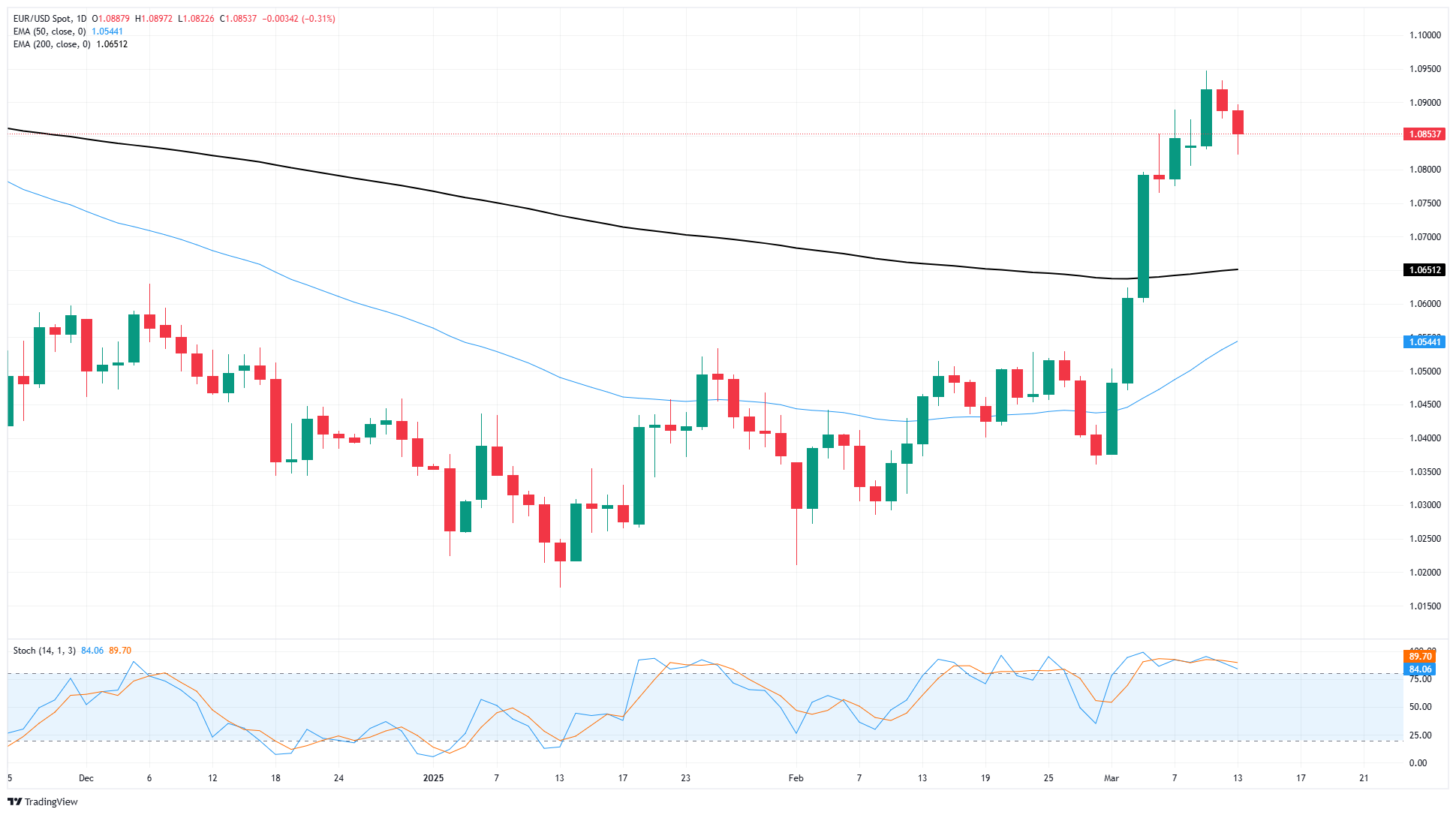
Euro FAQs
The Euro is the currency for the 19 European Union countries that belong to the Eurozone. It is the second most heavily traded currency in the world behind the US Dollar. In 2022, it accounted for 31% of all foreign exchange transactions, with an average daily turnover of over $2.2 trillion a day. EUR/USD is the most heavily traded currency pair in the world, accounting for an estimated 30% off all transactions, followed by EUR/JPY (4%), EUR/GBP (3%) and EUR/AUD (2%).
The European Central Bank (ECB) in Frankfurt, Germany, is the reserve bank for the Eurozone. The ECB sets interest rates and manages monetary policy. The ECB’s primary mandate is to maintain price stability, which means either controlling inflation or stimulating growth. Its primary tool is the raising or lowering of interest rates. Relatively high interest rates – or the expectation of higher rates – will usually benefit the Euro and vice versa. The ECB Governing Council makes monetary policy decisions at meetings held eight times a year. Decisions are made by heads of the Eurozone national banks and six permanent members, including the President of the ECB, Christine Lagarde.
Eurozone inflation data, measured by the Harmonized Index of Consumer Prices (HICP), is an important econometric for the Euro. If inflation rises more than expected, especially if above the ECB’s 2% target, it obliges the ECB to raise interest rates to bring it back under control. Relatively high interest rates compared to its counterparts will usually benefit the Euro, as it makes the region more attractive as a place for global investors to park their money.
Data releases gauge the health of the economy and can impact on the Euro. Indicators such as GDP, Manufacturing and Services PMIs, employment, and consumer sentiment surveys can all influence the direction of the single currency. A strong economy is good for the Euro. Not only does it attract more foreign investment but it may encourage the ECB to put up interest rates, which will directly strengthen the Euro. Otherwise, if economic data is weak, the Euro is likely to fall. Economic data for the four largest economies in the euro area (Germany, France, Italy and Spain) are especially significant, as they account for 75% of the Eurozone’s economy.
Another significant data release for the Euro is the Trade Balance. This indicator measures the difference between what a country earns from its exports and what it spends on imports over a given period. If a country produces highly sought after exports then its currency will gain in value purely from the extra demand created from foreign buyers seeking to purchase these goods. Therefore, a positive net Trade Balance strengthens a currency and vice versa for a negative balance.
Author

Joshua Gibson
FXStreet
Joshua joins the FXStreet team as an Economics and Finance double major from Vancouver Island University with twelve years' experience as an independent trader focusing on technical analysis.